🎧 Listen to this story
Narrated by Schedar · 6,626 characters
The Policy That Was Never a Policy
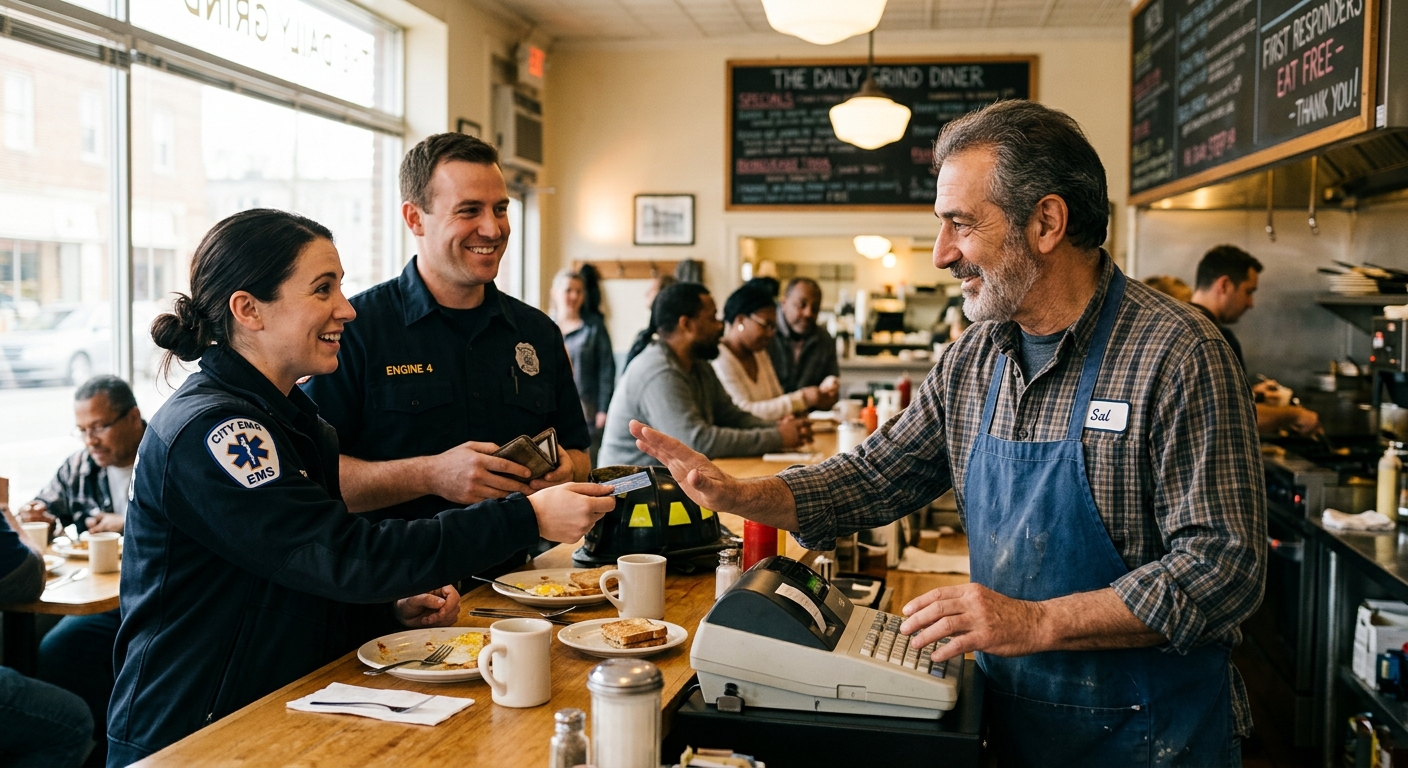
There was no grand announcement. No press release, no sign hung in the window, no social media campaign. It started quietly, the way most genuinely good things do. Gary Malone, owner of Malone’s Corner Diner in a mid-sized Ohio town, simply told his waitstaff one morning before the breakfast rush: if a first responder walks through that door in uniform, their meal is on the house. No questions, no limits, no expiration date.
That was eleven years ago. He has never changed the policy.
“I didn’t think it was a big deal,” Gary says, leaning against the counter between the coffee station and the pie display. “These people run into burning buildings. They pull strangers out of car wrecks at two in the morning. The least I can do is make sure they don’t have to worry about the cost of a plate of eggs.”
What It Actually Looks Like on a Tuesday Morning
Walk into Malone’s Corner Diner on any given weekday and you will likely find at least two or three tables occupied by people in uniform. A pair of EMTs wrapping up a night shift, still carrying the particular exhaustion that comes from twelve hours of high-stakes decisions. A firefighter stopping in alone before heading home to his kids. A police officer who has made this her third Tuesday stop in a row because, she admits, it’s the only place in town where she feels completely welcome.
The staff knows most of them by name. They know how Officer Rivera takes her coffee (black, splash of cold water so she can drink it fast). They know that the crew from Station 7 always orders the same thing, biscuits and gravy with extra gravy on the side. This is not a transactional place. It is, in every meaningful sense, a community table.
“It stops being about the food pretty quickly,” says Denise, a waitress who has worked at the diner for six years. “These folks come in here and they decompress. Sometimes they laugh. Sometimes they’re really quiet. We just make sure they feel taken care of. That’s the whole job.”
The Math That Doesn’t Add Up (Until It Does)
The obvious question is a financial one. How does a small, independent diner absorb the cost of feeding first responders for free, shift after shift, year after year?
Gary is candid about it. There are months where it stings a little. There are weeks where the numbers require some creative menu planning or careful supplier negotiations. But he frames the cost not as a loss, but as an investment in something harder to quantify.
“This town shows up for me,” he says simply. “Word got out about what we do here, and regular customers started coming in specifically because of it. People told me they wanted to spend their money somewhere that stood for something. I’ve had customers leave extra-large tips and tell the server it’s to help cover the first responders. The community carries this thing with me.”
There is also, Gary notes, the matter of what the diner has become in the neighborhood. It is the place people suggest when someone has had a hard week. It is where families go after a scary hospital visit because it feels warm and safe. The goodwill is not abstract. It fills tables.
What First Responders Say About It
Sit down with a few of the regulars and the responses share a common thread, one that goes beyond gratitude for a free meal.
Marcus, a paramedic with eight years on the job, puts it this way: “In this line of work, you spend a lot of time in spaces where people are at their worst moments. You absorb a lot. Coming in here, where Gary and his staff genuinely seem happy to see you, where you’re treated like a person and not just a uniform, it recalibrates something. It sounds small but it isn’t.”
Lieutenant Carla Booth of the fire department echoes that. “There’s a real conversation in first responder communities about mental health and burnout. Places like this, people like Gary, they’re part of the support system even if they don’t realize it. Feeling seen matters. Feeling like your community appreciates what you do, not just in a bumper sticker way but in a real, tangible way, that matters enormously.”
The Ripple Effects Nobody Predicted
Over eleven years, the free meal policy has generated outcomes Gary never anticipated. Here are a few worth noting:
- A mentor relationship: A teenage boy who bussed tables for two summers watched how Gary treated first responders and went on to pursue a career in emergency medicine. He still stops in when he’s home.
- A community response fund: Several regular customers quietly organized a yearly fundraiser to offset the cost of the program, presenting Gary with a check each spring that he consistently tries to refuse and they consistently insist he take.
- A national moment: A customer’s photo of Gary personally delivering food to a table of exhausted EMTs after a multi-vehicle accident response went modestly viral two years ago, bringing in visitors from neighboring counties who wanted to see the place for themselves.
- Copycat kindness: At least three other local business owners have cited Gary’s example as the inspiration for starting their own first responder appreciation programs.
The Philosophy Behind the Griddle
Gary is not a philosopher. He will tell you that himself, a little gruffly, before refilling your coffee without being asked. But spend enough time in his diner and a clear set of values emerges from the walls and the daily rhythms of the place.
He believes in the idea that a business exists inside a community, not separate from it. That the exchange of money for goods is the floor of what commerce can be, not the ceiling. That small gestures, repeated consistently over time, accumulate into something that changes the texture of a neighborhood.
“I’m just a guy who makes breakfast,” he says. “But I can make breakfast in a way that says something. I’d rather it say something good.”
A Lesson Wrapped in a Short Stack
There is something instructive about Gary’s approach that extends well beyond the restaurant industry. He did not wait for a large budget, a viral moment, or a nonprofit structure to begin doing something meaningful. He identified what he had, a warm space, reliable food, a daily stream of people, and he decided to direct that resource toward the people who needed a moment of grace.
The lesson is not “feed people for free.” The lesson is: look at what you already have, and ask who it could serve.
Every one of us has a version of a diner. A skill, a space, a habit, a small daily act that could be redirected toward someone who carries more than most. Gary just happened to have an actual griddle.
And eleven years of free eggs.