
🎧 Listen to this story
Narrated by Sadachbia · 6,500 characters
The Night Everything Changed
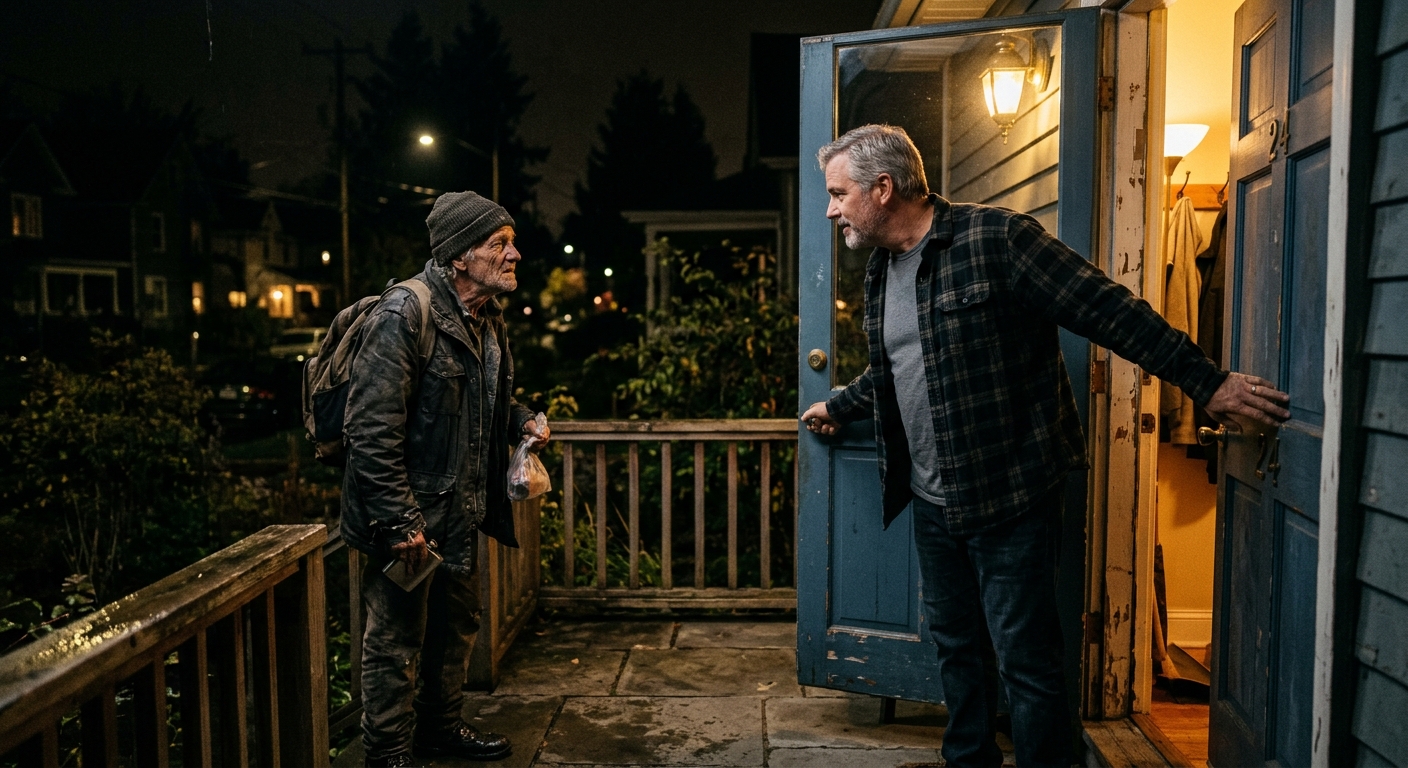
It was 12:47 a.m. on a Tuesday in November when Marcus Reilly heard the knock. His restaurant, a modest Italian-American spot called Reilly’s Table in Binghamton, New York, had been closed for nearly two hours. The chairs were up on the tables. The grill was cold. Marcus was doing what he did every night after close, mopping the kitchen floor in silence, listening to the low hum of the refrigerator units and thinking about whether he could afford to keep the heat on through December.
He almost didn’t answer. But something made him set down the mop.
At the back door stood a woman he had never seen before. She was holding a child on her hip, a boy of maybe four years old, and behind her, half-hidden in the shadows, were two more kids. She didn’t ask for money. She didn’t make a scene. She just looked at him and said, quietly, “My kids haven’t eaten today.”
Marcus Reilly stood there for exactly three seconds. Then he opened the door wider and said, “Come in. I’ll fire up the stove.”
A Simple Meal, A Profound Moment
What happened that night in Reilly’s Table was not complicated. Marcus made pasta. He heated sauce. He sliced bread and poured milk for the kids. The woman, whose name was Diane, sat at the counter and watched her children eat with the kind of exhausted relief that is hard to describe and nearly impossible to forget.
“She didn’t say much,” Marcus recalled in a conversation earlier this year. “She didn’t have to. I’ve worked in kitchens my whole life, and I know hungry. I know what it looks like when someone is trying to hold it together in front of their kids.”
He didn’t charge her. He packed up leftovers for the next day. He walked them to her car, which turned out to be the place they had been sleeping for six days.
He went home that night and couldn’t sleep. Not because he was troubled, but because something had shifted. “I kept thinking about how easy it was,” he said. “I had food. She needed food. That’s it. That’s the whole math of it.”
From One Night to a Movement
Marcus didn’t make a big announcement. He didn’t post on social media. He simply started leaving his back door unlocked on nights when he knew he had leftover food. He told one person at the local shelter. Word spread the way it does in small cities, quietly, person to person, through people who needed to know.
Within three weeks, he was opening the kitchen two nights a week after close. Within two months, it was four nights. Local volunteers started showing up to help. A retired line cook named Gerald came in every Thursday. Two college students, both studying social work, started coordinating with local shelters to bring people by.
“I never meant to start a program,” Marcus said, laughing softly. “I just meant to feed those three kids.”
What the Community Learned, and Gave Back
The story of Reilly’s Table spread beyond Binghamton when a local journalist named Petra Okafor wrote a short piece about it for a regional magazine. The response was overwhelming, and not just in donations, though those came too. What surprised Marcus most was the number of other restaurant owners who reached out.
Within six months, a loose network of seven restaurants in the area had adopted similar informal late-night policies. They called it, almost jokingly at first, the “Back Door Coalition.” No formal nonprofit status. No logo. Just a shared agreement that leftover food and a working stove were enough to make a difference.
What the Back Door Coalition Actually Does
- Keeps kitchens open for two to four hours after official closing time, two to five nights per week
- Coordinates with local shelters, transitional housing programs, and social workers to connect people in need
- Provides hot meals, not just food parcels, because dignity matters as much as nutrition
- Trains volunteer staff on how to welcome guests without making them feel like charity cases
- Redistributes excess food that would otherwise go to waste, reducing both hunger and food waste simultaneously
The Harder Conversation
Marcus is quick to point out that what he does is not a solution. He says it plainly and without apology. “A plate of pasta at midnight is not housing policy. It’s not a living wage. It’s not mental health support. I’m not confused about what I am.”
But he pushes back equally hard against the idea that small gestures don’t matter. “People get so caught up in the scale of a problem that they talk themselves out of doing the thing right in front of them. Diane’s kids were hungry that night. I fed them. The next morning they woke up having eaten. That’s real. That happened.”
It’s a tension that anyone working in grassroots community care knows intimately: the gap between systemic change and immediate need, and the emotional labor of living in that gap every day. Marcus navigates it with a kind of grounded practicality that is itself a lesson.
What He Wants People to Take Away
When asked what he hopes people understand about what he’s built, Marcus’s answer is characteristically simple.
“You probably have something someone else needs,” he said. “Not someday. Right now. Tonight. The question is just whether you’re willing to open the door.”
Diane, Two Years Later
Diane and her children are no longer living in their car. She asked Marcus if she could share her story publicly, and he said that was entirely her choice. She now works part-time at a grocery distribution center and rents a two-bedroom apartment with her kids. She volunteers at a local food pantry on Saturdays.
She and Marcus stay in touch. She brought him a homemade pie last Thanksgiving.
“He didn’t save my life,” she said, when Petra Okafor followed up with her for a second article. “He just gave me a night where I could breathe. And sometimes that’s all you need to keep going.”
The Knock You Almost Didn’t Answer
There is a version of this story where Marcus doesn’t open the door. Where he figures it’s too late, too complicated, too much. Where he finishes mopping, turns off the lights, and goes home. It would have been understandable. Most of us have let those moments pass without ever knowing what they were.
But Marcus opened the door. He fired up the stove. He did the one small thing that was available to him at 12:47 a.m. on a Tuesday in November, and it became something that has fed hundreds of people and inspired dozens more to do the same.
The next time you hear a knock, metaphorical or otherwise, it might be worth pausing before you decide you’re closed.