🎧 Listen to this story
Narrated by Sulafat · 8,412 characters
When the Ground Disappears
There is a particular kind of grief that does not announce itself politely. It does not knock. It simply arrives, takes up every corner of the room, and refuses to leave. For Sandra Okafor, a 52-year-old teacher from Columbus, Ohio, that grief came in waves so relentless that she began to wonder if the woman she had been before 2021 had simply ceased to exist.
In January of that year, her mother, Ruth, passed away from complications following a stroke. She was 79 years old, sharp-witted until nearly the very end, and the kind of woman who could make a stranger feel like family within five minutes. Sandra had barely begun to process that loss when, in April, her father, James, died of a heart attack. The two had been married for 54 years. Many who knew him said he simply could not imagine going on without Ruth. Perhaps he chose not to.
And then, in October, her husband of 26 years, Michael, was diagnosed with an aggressive form of pancreatic cancer. He died eleven weeks later, two days before Christmas.
Twelve months. Three funerals. A life that looked, from the outside, like a building that had been quietly demolished from within.
The Silence That Followed
Sandra described the months after Michael’s death in a way that many grief counselors would recognize immediately. “I stopped cooking,” she said. “Not because I wasn’t hungry, but because cooking had always been something we did together. Even just making coffee in the morning felt like a betrayal of something I couldn’t name.”
She took a leave of absence from her teaching job. She stopped returning phone calls. Her adult daughter, Nadia, would drive two hours every weekend just to sit with her, sometimes without either of them saying much at all. Friends brought food. Neighbors shoveled her driveway without being asked. The community around Sandra quietly, persistently refused to let her disappear entirely.
But the internal landscape was another matter. Sandra would later describe a feeling that therapists call cumulative grief, a compounding of losses that does not follow the traditional stages in any predictable way. “I wasn’t just mourning three people,” she explained. “I was mourning the version of myself that existed in relationship to all three of them. The daughter. The wife. The girl who still had both her parents. All of those identities were just gone.”
What the Research Tells Us About Compounded Loss
Sandra’s experience, while extraordinary in its concentration, is not as uncommon as we might hope. Grief researchers have documented what they call bereavement overload, a state in which the mind and body are so overwhelmed by successive losses that the normal grieving process becomes disrupted or frozen entirely.
Dr. M. Katherine Shear, founder of the Center for Complicated Grief at Columbia University, has written extensively about how unprocessed grief can manifest not just as sadness, but as physical illness, cognitive fog, identity disorientation, and a profound loss of motivation. The body, quite literally, keeps score.
For Sandra, the physical toll was real. She lost 18 pounds in three months. She developed insomnia so severe that she would sometimes sit awake until 4 a.m., not crying, not thinking clearly, simply staring. “It was like my nervous system forgot how to rest,” she said.
The Turning Point Nobody Saw Coming
The moment that began to shift things did not come from a therapist’s office, though therapy would later become crucial. It came from a second-grade classroom.
Eight months after Michael’s death, Sandra’s principal called to check in. Not to pressure her, but to mention, gently, that her students had been asking about her. One child, a seven-year-old named Marcus, had apparently told his mother, “I think Mrs. Okafor is very sad and I want to make her a card.” His mother had relayed this to the school. The principal passed it along to Sandra.
“Something cracked open in me when I heard that,” Sandra said. “Not in a sad way. In a way that felt like a window being opened in a room that had been sealed shut.”
She returned to her classroom two weeks later, part-time at first. She cried in her car before going in. She cried in the bathroom between periods. But she also laughed, genuinely, on her third day back, when Marcus solemnly presented her with a drawing of a rainbow and informed her it was “scientifically proven to make people feel better.”
“He was right,” she said. “I don’t know how, but he was right.”
Seven Things Sandra Learned About Grief That Nobody Warns You About
- Grief is not linear, and pretending it is will exhaust you. Sandra had heard about the five stages her entire adult life. What nobody told her was that she might feel acceptance and rage on the same Tuesday afternoon.
- You are allowed to laugh. Laughter is not a sign that you have moved on or that you loved someone less. It is a sign that you are still alive, and that is something worth honoring.
- The body needs tending, even when you cannot bring yourself to care about it. Sandra’s therapist eventually helped her understand that sleep, food, and movement were not luxuries. They were the infrastructure grief needed to be processed at all.
- Community matters more than we are taught to admit. The neighbors who shoveled her driveway. The daughter who drove two hours to sit in silence. The student with the scientifically proven rainbow. None of it fixed anything. All of it mattered enormously.
- Identity grief is real. Losing the roles we play in others’ lives, daughter, wife, partner, is its own separate mourning that often goes unnamed and therefore unaddressed.
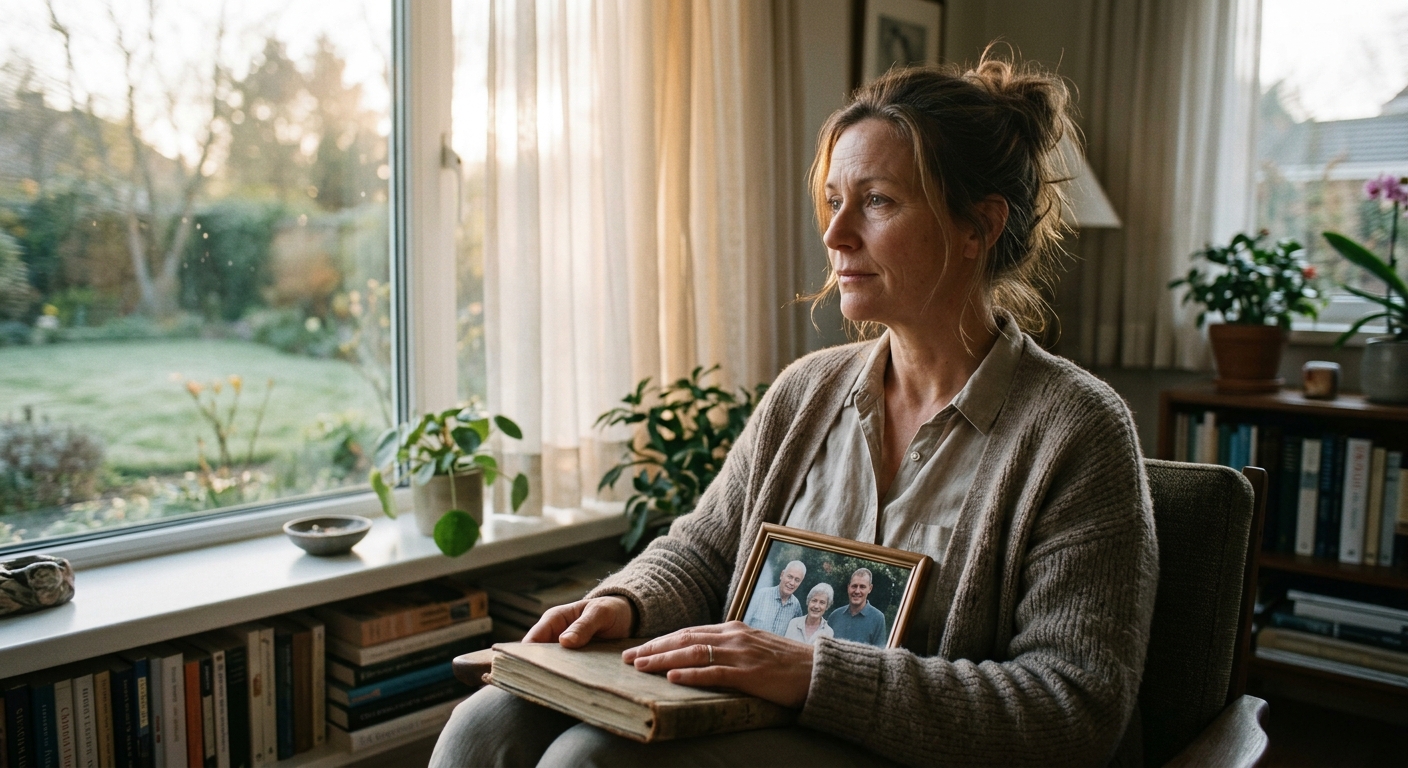
- Returning to purpose is not the same as getting over it. Sandra still grieves. She keeps photographs of Michael, Ruth, and James on her desk at school. She talks about them to her students without apology. Purpose and pain are not opposites.
- Asking for help is an act of courage, not weakness. Sandra eventually began attending a grief support group, something she resisted for months. “I thought it would be depressing,” she admitted. “It was the opposite. It was the first place I felt completely understood.”
Learning to Live, Not Just Survive
Two years after the worst year of her life, Sandra describes her existence with a word that surprises people: grateful. Not grateful that she suffered. Not grateful that she lost the three people who had formed the foundation of her world. Grateful, she says, for the precision with which grief taught her what mattered.
“I used to rush through things,” she said. “I used to be too tired to call my mom back and think, I’ll do it tomorrow. I used to let weeks go by without really sitting with Michael, just being present with him. Grief taught me that tomorrow is not guaranteed to anyone. It’s not a punishment. It’s just the truth, and once you really understand that, you start living differently.”
She has since become a volunteer facilitator at the grief support group that once helped her. She runs what she calls a “quiet hour” in her classroom every Friday, where students are encouraged to draw, write, or simply sit without pressure. Several parents have written to thank her, saying their children have come home and talked about feelings they had never found words for before.
A Note to Anyone in the Middle of It
If you are reading this from inside your own dark year, Sandra wanted to say something directly to you. It is not a platitude. It is something she wishes someone had said to her in those early, airless months.
“You don’t have to be okay yet. You don’t have to have a plan for healing or a timeline for feeling better. You just have to stay. Stay in the room. Let people sit with you. Let the casseroles pile up on your counter. Let the neighbor shovel the driveway. Let the seven-year-old give you the rainbow. The path back is not something you find all at once. It’s something you find one small moment at a time, and eventually, you look up and realize you have been walking it all along.”
There are no clean endings to stories like this one. Michael is still gone. Ruth and James are still gone. Sandra still has mornings that knock the wind out of her without warning. But she is also standing in a classroom, surrounded by children who are learning what it looks like when a person chooses, over and over again, to keep going. And that, she says, is enough. More than enough. It is everything.