
🎧 Listen to this story
Narrated by Gacrux · 7,532 characters
The Drive That Changed Everything
Every weekday morning at 5:45 a.m., before most people had reached for their alarm clocks, Coach Darnell Whitfield was already behind the wheel. His coffee sat steaming in the cupholder. The highway stretched dark and empty in front of him. And somewhere ahead, a fourteen-year-old kid named Marcus was lacing up his sneakers in a cramped apartment hallway, waiting.
The drive was exactly 54 miles each way. Darnell made it twice a day, five days a week, for nearly two full years. No payment. No fanfare. No social media posts about what he was doing. Just a man who believed in a kid, and a car that kept showing up.
This is not a story about athletic triumph, though there is some of that too. This is a story about what happens when one adult decides that a child’s circumstances will not define his ceiling.
How It Started: A Try-Out and a Hard Truth
Marcus Rivera had been playing basketball since he was eight years old, shooting at a bent hoop bolted to the side of a community center in their mid-sized Midwestern city. By the time he was thirteen, it was clear to anyone watching that he had something. Instinct. Court vision. A work ethic that embarrassed kids twice his size.
When Marcus tried out for a competitive travel team coached by Darnell Whitfield, he made the roster on the first day of evaluations. Darnell told him flat out: “You’re one of the best young players I’ve seen in a long time.”
There was just one problem. The team trained four days a week at a private sports facility on the other side of the city. Membership and training fees came out to roughly $280 a month. For Marcus and his mother, a home health aide working two jobs to keep their two-bedroom apartment, that number might as well have been $2,800.
“I remember watching him walk out of that first practice,” Darnell recalled in an interview with a local sports outlet. “He had this look on his face. Not sad exactly. More like resigned. Like he already knew what the answer was going to be before he even asked his mom.”
The Decision No One Asked Him to Make
Darnell went home that night and talked it over with his wife. They had two kids of their own. He worked full-time as a physical education teacher. The math was not simple and the sacrifice was not small.
But by the next morning, he had already mapped out the route.
He reached out to Marcus’s mother, a woman named Celia, and made a quiet offer: he would cover the facility fees out of pocket, and he would personally drive Marcus to and from every practice session. No strings attached. No expectation of repayment. Just a handshake and a schedule.
“I didn’t know what to say,” Celia told a reporter later. “I asked him why. He just said, ‘Because somebody did it for me once, and it’s my turn.'”
What Those Car Rides Actually Looked Like
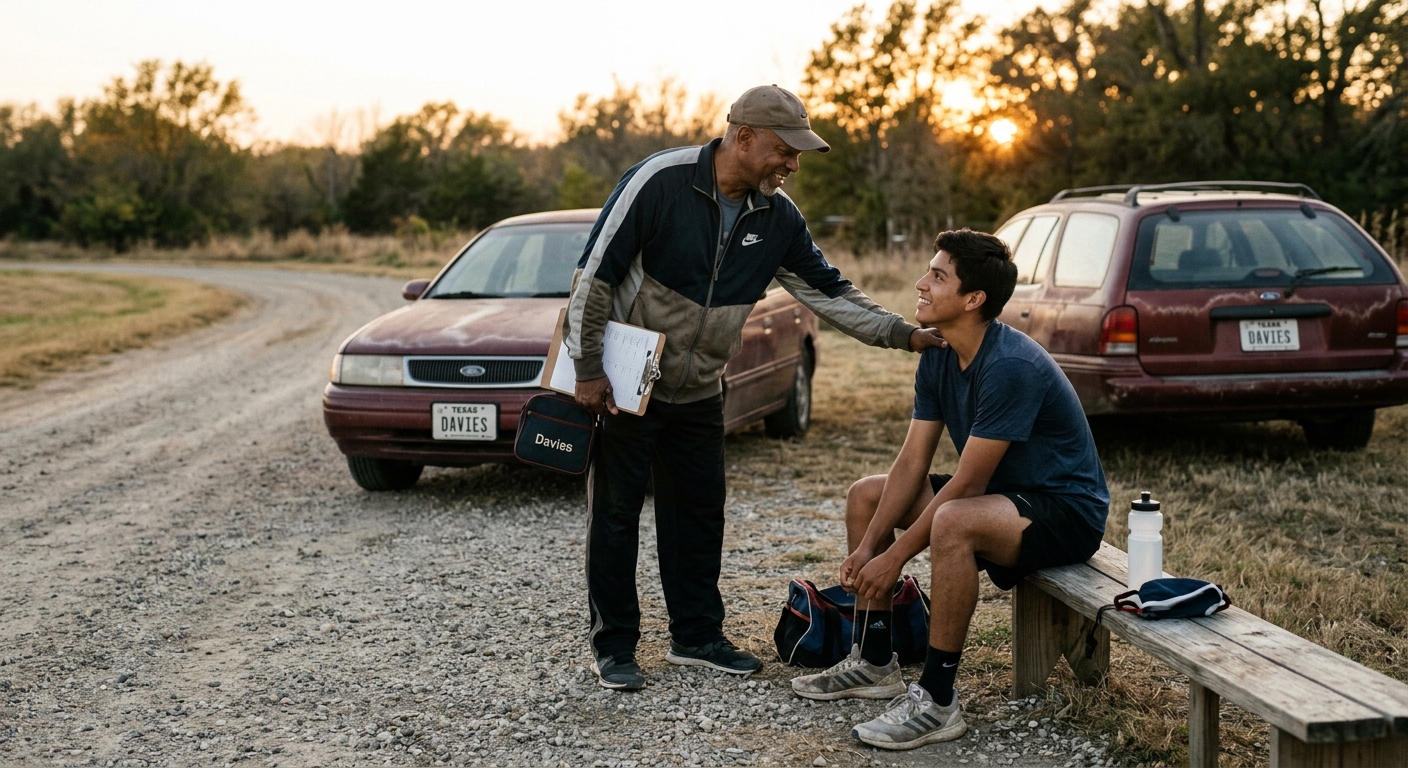
What happened inside that car over the next two years turned out to be just as important as what happened on the court. Darnell used those drives intentionally. He asked Marcus questions. He listened. He talked about failure and resilience and what it meant to be a man who shows up even when no one is watching.
Some mornings they talked about basketball. Some mornings they talked about school, about Marcus’s struggles in algebra, about a girl he liked, about a conflict with a friend. Some mornings they just listened to music and didn’t talk at all.
“Coach never made me feel like he was doing me a favor,” Marcus, now seventeen, said recently. “He treated me like I was worth his time. That’s different. That changes how you see yourself.”
Small Moments That Left Big Marks
- The morning Darnell stopped at a diner and bought Marcus his first real sit-down breakfast, then told him to order whatever he wanted.
- The afternoon Marcus had a breakdown after a bad practice and Darnell pulled over, turned off the engine, and just sat with him until he was ready to talk.
- The day Darnell handed Marcus a copy of a book about a first-generation college athlete and said, “This is going to be your story someday.”
- The quiet drive after Marcus’s team lost in the regional semifinals, when Darnell said simply, “Losing like this is where champions are built.”
The Ripple Effect on the Team
Something else happened that nobody quite expected. When the other kids on the team found out what Coach Darnell was doing, the culture of the team shifted. Players started showing up earlier. Complaints about practice conditions dropped off. Older players began mentoring younger ones without being asked.
“Coach showed us what commitment actually looks like,” said one of Marcus’s teammates. “Not the word. The thing itself.”
The team went on to win back-to-back regional championships. Several players earned academic and athletic scholarships. But the coaches and parents who were part of that program will tell you the championships are not the part they are most proud of.
What This Story Teaches Us About Mentorship
It would be easy to read this story and focus on the grand gesture, the hours, the miles, the money. But Darnell himself pushes back on that framing whenever it comes up.
“I didn’t do anything heroic,” he said. “I just didn’t look away. That’s all mentorship really is. You see a kid who needs someone in their corner, and you don’t look away.”
Lessons Worth Carrying With Us
- Presence is the most powerful resource you can give a young person. It costs nothing and means everything.
- Mentorship is not a program, it is a decision. Darnell did not wait for a formal structure to tell him what to do. He just did it.
- The car ride matters as much as the court. So much of what shapes a young person happens in the in-between moments, not the headline events.
- One adult can redirect an entire trajectory. Research on youth development consistently shows that a single trusted adult outside the family is one of the strongest predictors of long-term resilience in young people.
- Generosity does not require abundance. Darnell was not wealthy. He stretched his own budget and his own schedule. The size of the sacrifice does not diminish the size of the impact.
Where Marcus Is Now
At seventeen, Marcus Rivera has received interest from three Division II college programs. His GPA has climbed from a 2.1 to a 3.4. He volunteers at a youth basketball camp on weekends, where he has started doing something that has made his mother cry every time she hears about it.
He gives younger kids rides home after practice.
“Coach taught me that you pass it on,” Marcus said with a grin. “You don’t wait until you’re rich or successful or have it all figured out. You just pass it on right now, with whatever you’ve got.”
The Road Still Traveled
Darnell Whitfield still coaches. He still teaches PE at the same school. He is not famous. He does not have a book deal or a documentary in the works. He is just a man who made a quiet decision five years ago and followed through on it every single morning before the sun came up.
When asked if he would do it all again, he barely pauses before answering.
“I’d leave earlier,” he said. “And I’d bring better coffee.”
There are Darnell Whitfields everywhere. In every city, every small town, every school and rec center and neighborhood. They are the people who notice the kid others overlook, who make the call no one else made, who show up without being asked and keep showing up without being thanked.
They are proof that you do not need a platform, a nonprofit, or a viral moment to change a life. Sometimes all you need is a full tank of gas and the will to drive.