
🎧 Listen to this story
Narrated by Sadachbia · 8,871 characters
The Woman Who Turned a Metal Tube in the Sky Into a Community
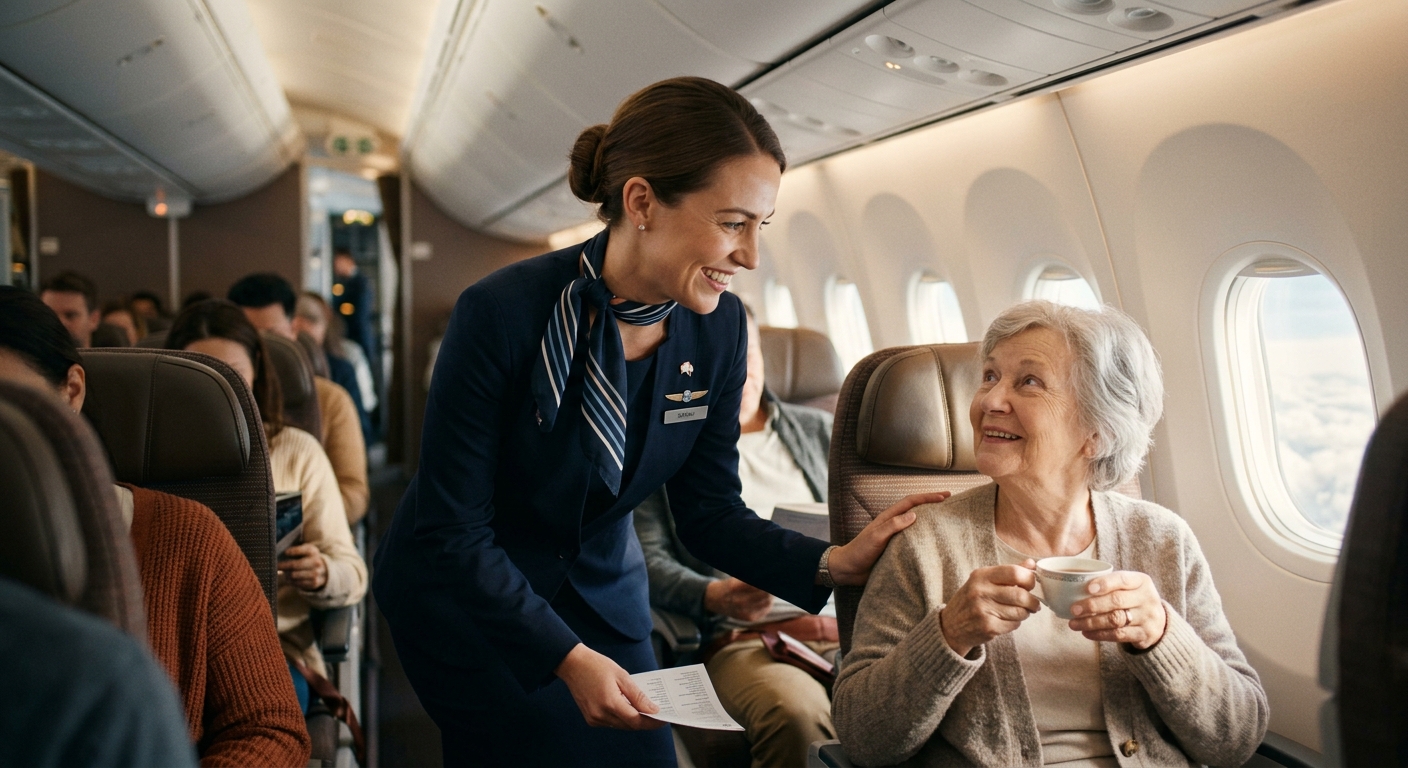
In an era of noise-canceling headphones, in-flight entertainment screens, and the general human desire to simply be left alone at altitude, one flight attendant quietly became a legend. Her name is Marisol Vega, and for over two decades she worked transatlantic and domestic routes for a major U.S. carrier. She retired in 2022, but the passengers who flew with her regularly still talk about her the way people talk about a beloved teacher or a neighborhood institution.
The reason? Marisol memorized them. Not just their names, but their stories.
Frequent flyers on her regular routes describe a phenomenon that borders on the surreal. You’d board a Tuesday morning flight from Chicago to New York, settle into your seat, and Marisol would appear at your elbow. “How did the job interview go?” she’d ask, referencing a conversation from six weeks prior. Or: “Did your daughter end up choosing that college in Vermont?” Or simply: “Your usual coffee, right? Two sugars, no cream.”
For thousands of road warriors who had come to see airports as purgatory and planes as flying waiting rooms, Marisol Vega made the sky feel a little more like home.
How It Started: A Nervous Passenger and a Small Act of Attention
Marisol herself described the origin of her practice in an interview she gave to an aviation industry newsletter shortly before her retirement. It was not a grand plan, she explained. It started with one passenger.
“I was maybe three years into the job,” she recalled. “A man boarded who was clearly terrified of flying. White-knuckled, sweating. I sat with him for a few minutes before takeoff because we had time. His name was Gerald. He was flying to his mother’s funeral and had never been on a plane before.”
She talked Gerald through the flight, explained every sound, every tremor of turbulence, held his attention with conversation. By the time they landed, he was calm. A few months later, Gerald appeared on one of her flights again. “He walked on and he looked around like he was hoping I’d be there,” Marisol said. “When he saw me, his whole body relaxed. That was it. That was the moment I understood what I could actually do in this job.”
From that point forward, she started keeping a small notebook.
The Notebook System
Marisol was careful to clarify that she never used airline databases or personal records to gather her information. Everything she knew about her passengers came from conversations, willingly shared, in the normal course of a flight.
After each shift, she would write down names, details, and context. A few sentences per person. Nothing invasive, nothing pulled from a screen. Just what people had told her freely over a plastic cup of ginger ale somewhere over Ohio.
- Names and faces: She trained herself to associate names with physical features and mannerisms, using memory techniques she had researched on her own time.
- Life context: Major events like weddings, job changes, health scares, and moves were noted briefly so she could follow up.
- Preferences: Beverage orders, aisle versus window tendencies, whether someone wanted to be left alone or loved to chat.
- Emotional state patterns: Some passengers were always anxious. Some were grieving a long-term loss. Some were celebrating something quietly.
Over twenty-three years, her notebooks filled up. She estimates she has meaningful notes on over four thousand individual passengers.
What Passengers Say: A Reported Look at Lives She Touched
Terrence Bloom, a consultant who flew the Chicago-New York corridor regularly for a decade, described Marisol’s effect in straightforward terms. “I was going through a divorce the first time I really talked to her,” he said. “I didn’t mean to say anything, but she asked how I was doing and I just… told her. She listened. She didn’t offer advice. She just listened and said, ‘That sounds really hard.’ A flight attendant said that to me and I almost cried at 30,000 feet.”
Terrence flew that route for years afterward. “Every time she was on the crew, she’d ask about my kids. She remembered their names. She remembered that my son was into robotics. Nobody at my office remembered that. She did.”
A woman named Priya Chandrasekaran shared a similar story. She had been flying regularly during her mother’s illness, making frequent trips between coasts to help with care. “Marisol once put her hand on my arm and just said, ‘How is she doing?’ I hadn’t told anyone at work what I was going through. On that plane, with that stranger, I felt seen. Completely seen.”
The Science Behind Why This Matters So Much
Psychologists and behavioral researchers have spent considerable time studying the impact of being recognized and remembered by others. The findings are consistent and striking.
Being remembered signals that you matter
When someone remembers your name and your story, the brain interprets it as evidence of social worth. It activates the same reward pathways as other forms of positive social feedback. In environments where we expect anonymity, the effect is amplified significantly.
Air travel is uniquely dehumanizing
Airports strip people of agency. You wait in lines, remove your shoes, sit where you are told, eat what is available. Research on stress and environment consistently shows that people in low-control situations are more vulnerable and more responsive to human warmth. A moment of genuine recognition in that context carries extraordinary weight.
The loneliness epidemic as backdrop
Studies from the past decade have repeatedly identified chronic loneliness as one of the most significant public health concerns in modern society. Frequent business travelers, despite their near-constant movement through crowds, often report profound isolation. Marisol, without a research degree or a clinical framework, had intuited something that health professionals were only beginning to document formally.
7 Things We Can Learn From Marisol Vega
- Attention is a form of love. You do not need resources or status to give someone your full, genuine attention. It costs nothing and means everything.
- Memory can be a skill, not just a gift. Marisol trained herself. She built systems. She practiced. Remembering people is something most of us can improve with intention.
- Your job title does not define your impact. Marisol was not a therapist, a counselor, or a community organizer. She was a flight attendant. The role does not limit the reach.
- Small follow-ups create big connections. Asking “how did that go?” weeks later tells someone that the first conversation was real, not filler. It transforms a transaction into a relationship.
- People will tell you what they need if you create the space. Marisol did not pry. She opened a door, quietly, and waited to see who wanted to walk through it.
- Consistency builds trust over time. One warm interaction is nice. The same warmth, repeated over years, becomes a foundation. It becomes something people rely on.
- You may never know the full impact of what you do. Marisol knows some of the stories, the ones people told her. But the quiet steadiness she provided to thousands of anxious, grieving, exhausted travelers? That ripples out in ways no notebook could ever capture.
What She Says About the Work
When asked if the practice ever felt like a burden, Marisol was quiet for a moment. “Sometimes I’d have a bad day, and I’d think, I just want to hand out peanuts and go home,” she admitted, laughing. “But then someone would get on, and I’d remember something about them, and I’d see their face change when I said it. And I’d think, no. This is the job. The real job.”
She does not consider herself extraordinary. This is perhaps the most extraordinary thing about her.
“I just paid attention,” she said. “I think a lot of us stop paying attention to each other. We’re tired, we’re busy, we’re on our phones. I just decided not to stop. That’s really all it was.”
A Final Thought at Cruising Altitude
Marisol Vega’s notebooks are sitting in a box in her home in Phoenix. She has thought about what to do with them, whether to donate them, whether to write something herself someday. For now, they sit quietly, holding four thousand small histories of people who passed through the sky and were, for a moment, genuinely known.
In a world that often feels faster and more anonymous by the year, that is not a small thing. It is, in fact, an enormous thing. And it started with a terrified man named Gerald, a delayed flight, and a young woman who decided to sit down and listen.
The next time you are tempted to dismiss a small act of attention as insignificant, think about Marisol. Think about how a single notebook, a single decision to remember, turned an ordinary job into a twenty-three-year ministry of human connection.
You do not need wings to do what she did. You just need to look up.