
🎧 Listen to this story
Narrated by Schedar · 7,707 characters
The Letters That Keep Coming
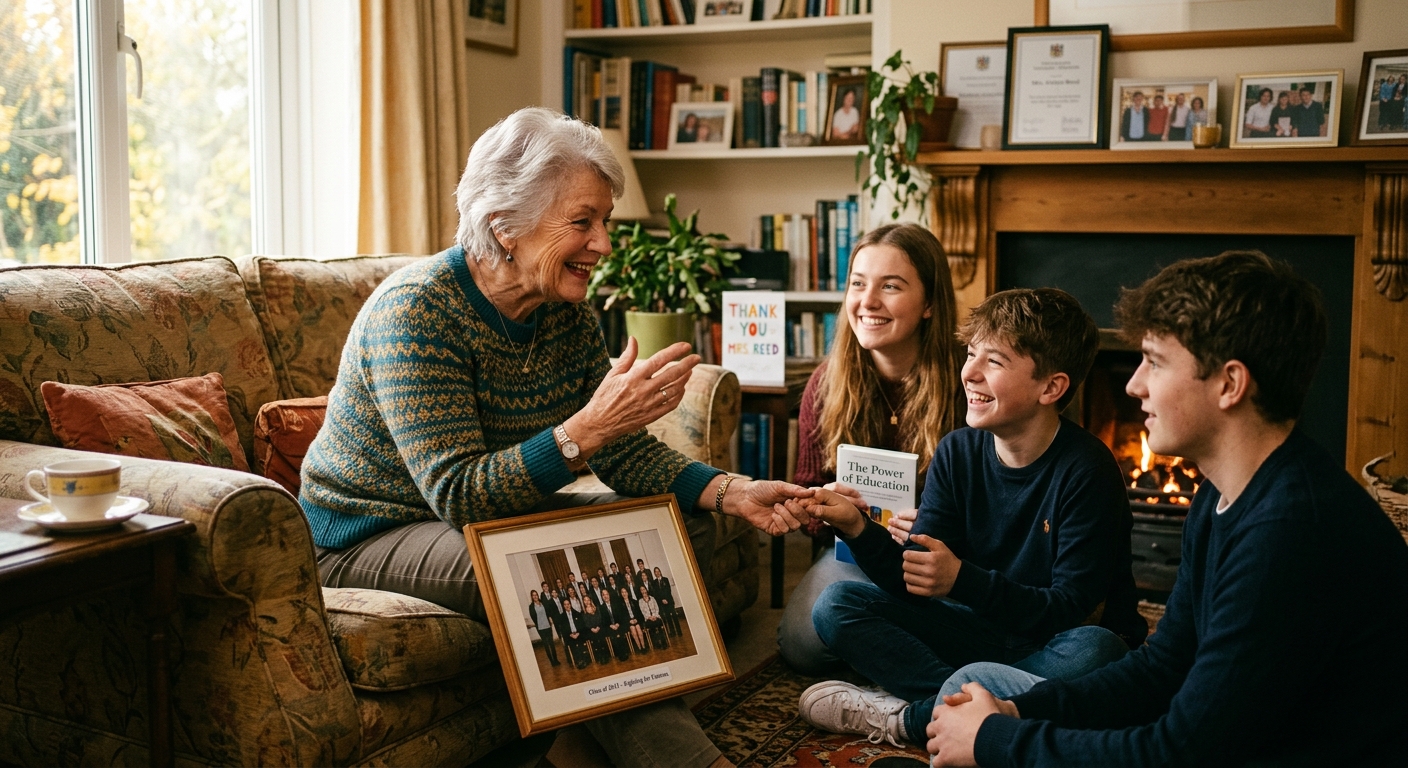
Every August, just as the academic year begins to stir back to life, a small stack of handwritten notes arrives at the home of Margaret Eloise Tanner in Asheville, North Carolina. They are not birthday cards. They are not holiday greetings. They are requests, polite and sometimes anxious, from young people she once taught, asking if she would be willing to write one more letter on their behalf.
Margaret retired from teaching high school English in 2013. She was 62 years old, had spent 34 years in the classroom, and had watched thousands of students walk across graduation stages. By any measure, she had given more than enough. And yet, the letters keep coming. And she keeps writing back.
“I never told anyone I would stop,” she said with a quiet laugh during a recent conversation at her kitchen table, a cup of tea cooling beside a legal pad covered in notes. “I just told them I was retiring from the building. I never retired from caring about what happens to them.”
A Practice That Started Almost by Accident
Margaret did not set out to become the recommendation letter writer she is today. It started simply enough: a former student named DeShawn reached out two years after her retirement, applying to a graduate program in social work and asking if she remembered him. She did, vividly. He had been quiet in class but brilliant in his written observations about the world, the kind of student who made a teacher pause mid-sentence and think.
She wrote him a letter. He got in. He sent her flowers.
Word spread the way word always does among people who once sat in the same classroom. Within three years of her retirement, Margaret was writing an average of eight to twelve recommendation letters per year for former students ranging from recent graduates applying to four-year universities to adults in their thirties returning to school for second careers.
“Some of them I taught twenty years ago,” she said. “They apologize when they reach out, like they’re asking for something unreasonable. I always tell them the same thing: do not apologize. This is the whole point.”
What Goes Into Each Letter
What makes Margaret’s process remarkable is not just her willingness, but her rigor. She does not dash off a generic paragraph and attach a signature. Each letter is a considered piece of writing, often two pages long, specific to the individual and tailored to the program or opportunity they are pursuing.
Before she writes a single word, she asks each student to send her the following:
- A current resume or list of achievements since she last knew them
- A copy of their personal statement or application essay, if applicable
- A brief note about why they want this particular opportunity
- One or two memories from her class that they still carry with them
That last item is the one that surprises people most. “I ask them to remind me of a moment,” she explained. “Not because I’ve forgotten them, but because I want to know what they remember. That tells me everything about who they’ve become and what matters to them. And it almost always gives me the perfect opening line.”
The Students She Remembers
Over the years, the letters have gone out to support applications for nursing programs, law schools, MFA programs in creative writing, culinary institutes, medical schools, and vocational certifications. One letter helped a 41-year-old single mother get accepted into an accounting program at her local community college. Another supported a young man applying to the fire academy who had been in Margaret’s sophomore English class during what he later described as the worst year of his life.
“He told me my class was the one hour of the day where he felt like a person and not a problem,” Margaret said, her voice steady but her eyes bright. “How do you not write that letter? How do you not show up for that?”
A Note on the Ones Who Don’t Ask
Margaret is quick to acknowledge something that weighs on her: the students who need the letters most are often the ones least likely to ask. Students who lacked confidence in school, students who assumed she would not remember them, students who did not have the language or the network to know that reaching out to a former teacher was even an option. She has, over the years, developed a small informal network with two other retired teachers from her school who do the same work, and together they have tried to reach back proactively when they hear through the grapevine that a former student is applying somewhere and struggling to find advocates.
“The playing field for these kids is not level,” she said plainly. “Some students have parents who know how this works, who have connections, who can make calls. Some students have me. And I take that seriously.”
What Other Educators Can Learn From This
Margaret’s story raises a question worth sitting with: what does it actually mean to be done teaching? The formal relationship between a teacher and student has a defined endpoint, a last day of class, a graduation, a final grade submitted. But the influence of a great teacher does not clock out at the same time the contract does.
There are practical lessons here for educators at every stage of their careers:
1. Keep Your Contact Information Accessible
Margaret maintains a simple email address that former students can find easily. She does not require them to track her down through the school district or navigate bureaucratic channels. Accessibility is a form of generosity.
2. Document Your Students While You Still Can
She kept brief notes on memorable moments with students throughout her career, nothing elaborate, just a sentence or two jotted in a notebook at the end of a school day. Those notes have proven invaluable years later when crafting specific, credible letters of support.
3. Let Students Know the Door Stays Open
On the last day of every school year, Margaret told her students the same thing: “If you ever need me, I am not hard to find. Do not let embarrassment or time stop you from reaching out.” That simple permission has made all the difference.
4. Treat the Letter as a Craft, Not a Chore
A recommendation letter written with genuine care reads entirely differently from one written out of obligation. Admissions committees and program directors notice. A letter that tells a specific story, uses precise language, and makes a human argument for a candidate carries weight that a generic endorsement never can.
The Ripple Effect
DeShawn, the former student whose request started all of this, is now a licensed clinical social worker working with at-risk youth in Charlotte. He reached out to Margaret two years ago, not with a request this time, but with news: he had just written his first recommendation letter for a young client applying to a workforce training program. He wanted her to know.
“He said, ‘I learned from the best,'” Margaret recalled, folding her hands around her tea. “That might be the best thing anyone has ever said to me. Not that I taught him English. That I taught him how to show up for someone.”
A Small Act With a Long Reach
Margaret Tanner is not famous. She is not the subject of a documentary or a viral tweet. She is a retired teacher in Asheville who still answers her email, still sharpens her pencil, and still believes that the act of advocating for another person is among the most important things a human being can do.
She wrote six letters last fall. She has already received three requests for the coming season. She will write every single one.
“People ask me when I’m going to stop,” she said, standing to refill her tea. “I tell them the same thing every time. I’ll stop when they stop needing me. And so far, they haven’t.”