🎧 Listen to this story
Narrated by Aoede · 6,753 characters
The Worst Possible Timing
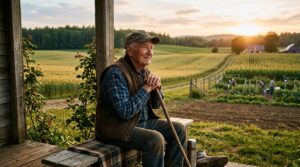
Dale Hutchins had been farming the same 200 acres in rural Grover County for thirty-one years. He knew the land the way most people know their own faces: every dip, every stubborn patch of clay, every row that always gave him trouble in a wet spring. He had buried his father on that land, raised three kids on it, and quietly celebrated more harvests than he could count.
But on the morning of September 14th, three days before his scheduled wheat harvest, his John Deere 9R went silent in the middle of a field. Not a sputter. Not a warning light. Just silence, and then the particular kind of dread that only a farmer knows when the calendar is working against him.
The repair estimate came back fast and brutal: a catastrophic hydraulic pump failure. Parts would need to be ordered. The soonest turnaround, the mechanic told him, was ten to fourteen days. Dale stood in the parking lot of the repair shop and stared at his phone for a long time without calling anyone.
He didn’t ask for help. That part matters. Dale Hutchins is the kind of man who will quietly carry a weight until it breaks him before he’ll let a neighbor see him struggle. His wife, Renee, later said he came home that evening, sat down at the kitchen table, and didn’t say much at all. He just looked out the window at the fields turning gold in the late afternoon light.
The Part Nobody Planned
What happened next did not begin with a phone tree or a church committee or a social media fundraiser. It began with a single offhand comment.
Dale’s neighbor, a retired cattle farmer named Virgil Ames, stopped by the next morning to return a borrowed posthole digger. Renee mentioned the tractor. Virgil said, “Well, that’s something.” He drove away. That was it. No promises, no plans.
But at 6:47 the following morning, Dale walked out to his porch with a cup of coffee and found four tractors parked in his driveway. Not four people. Four tractors, each with a driver already aboard, engines idling in the cold September air, headlights cutting across the frost on his fields.
By 9 a.m., there were eleven.
Virgil had made a few calls the night before. Those people made a few more. Someone’s son drove two hours from the city and back just to drop off a machine he’d borrowed from his uncle. A woman named Carol, who Dale barely knew from the grain co-op in town, showed up with sandwiches and three thermoses of coffee and stayed all day. The high school ag teacher brought six students who needed field hours, and they stayed until after dark.
What a Harvest Can Look Like
Nobody coordinated a schedule. Nobody assigned rows or rotations. People just looked at what needed doing and did it. That, according to Dale, was the part that undid him most.
“I kept trying to direct people,” he said, “and they kept just… already knowing. One guy was running my header like he’d done it a hundred times. Maybe he had. I don’t know. I didn’t even know his name until we shook hands at the end of the day.”
The full harvest that Dale had estimated would take him four days alone was completed in two days with the community’s help. The wheat came off clean. The bins were full. The fields, now cut low and pale in the autumn light, looked like they always did after a good harvest, ordinary and finished and right.
What This Story Is Really About
It would be easy to frame this as a feel-good surprise, a wholesome twist in a hard season. And it is those things. But there are a few deeper threads worth pulling on here.
Community Is a Verb
What those eleven tractors represented was not charity. It was muscle memory. Rural communities have always operated on a kind of unspoken reciprocity, a rotating debt of favors that nobody tracks because tracking would ruin it. Dale had shown up for others over thirty-one years. The community was simply balancing the books in the way it knew how.
Dignity in Receiving
One of the hardest things about this story is also one of its most human: Dale did not ask. For many people, that inability to ask is not stubbornness. It is fear, specifically the fear that asking confirms a vulnerability they are not ready to name. What his neighbors did by showing up without being called was something quietly revolutionary. They removed the cost of asking. They made it impossible for him to say no, and in doing so, gave him something most people struggle to accept gracefully, help without strings, without pity, without transaction.
The Quiet Ones Are Watching
Virgil Ames, the man who started it all, did not call a meeting. He did not post anything online. He simply paid attention and then made a few phone calls. There is something worth sitting with in that. The people who knit communities together are rarely the loudest voices. They are the ones who notice, who remember, and who pick up the phone when something feels wrong.
What We Can Learn From Grover County
- You don’t need a formal structure to show up. Nobody formed a committee. They formed a convoy.
- Attention is its own form of love. Virgil noticed because he was paying attention. That is rarer than it sounds.
- Practical help is profound help. No one gave Dale a sympathy card. They drove heavy machinery across his land at sunrise. Sometimes that is exactly what kindness looks like.
- History matters. Thirty-one years of showing up for others created the conditions for this moment. Generosity compounds quietly over time.
- Not asking is not the same as not needing. The people who find it hardest to ask are often the ones who need grace the most.
After the Harvest
The tractor was eventually repaired. Dale picked it up two weeks later and drove it back across the county road to his farm in the ordinary way, alone in the cab, the fields already empty and resting.
He sent handwritten notes to everyone he could name. For the ones he never caught a name for, he made a donation to the local 4-H chapter and left a standing open invitation: anyone who needed a hand at planting or harvest, he would be there.
Renee said he seemed different after that week. Not softer, exactly. Just, as she put it, “a little less alone in his own head.”
Which might be the most important harvest of all.
A Final Thought
We spend a lot of time talking about loneliness as a modern epidemic, and it is. But stories like this one remind us that the antidote has never been complicated. It is proximity, attention, and the willingness to show up before you’re asked. It is eleven tractors in a driveway at dawn. It is Carol with her thermos and her sandwiches. It is Virgil Ames making a few phone calls on a Tuesday night because something didn’t sit right with him.
You don’t have to save anyone. You just have to notice. And then, sometimes, you just have to show up.