
🎧 Listen to this story
Narrated by Rasalgethi · 7,781 characters
When Nature Breaks Its Own Rules
Every so often, the natural world hands us a story so unexpected, so quietly profound, that it forces us to reconsider everything we thought we knew about animals, belonging, and the instinct to connect. The story of a lone wolf in Finland who formed a genuine, sustained friendship with a young brown bear is exactly that kind of story. It was documented by Finnish photographer Lassi Rautiainen over the course of several weeks, and the images and observations he captured stopped the internet in its tracks when they were first shared with the world.
This was not a one-time encounter at a watering hole. This was not a truce born of desperation or hunger. This was, by every behavioral indicator available to wildlife researchers, a friendship. A real one. And it started when a wolf decided, seemingly of his own accord, that the pack was not where he belonged.
The Lone Wolf and the Young Bear: How It Began
Rautiainen first noticed the pair in the wilderness of northern Finland, near the border of Russia. The wolf, a male, had been traveling alone, which is unusual behavior in itself. Wolves are deeply social animals. They are built for the pack, biologically and psychologically. A wolf without a pack is not just lonely in a human sense; it is genuinely vulnerable, cut off from the cooperative hunting strategies and territorial protection that a pack provides.
The brown bear he encountered was a young female, also traveling alone. Young bears in the process of establishing their own territory often spend time in isolation, but that does not mean they are immune to companionship. When these two animals crossed paths, something clicked.
Over the following weeks, Rautiainen documented the pair spending hours together each evening. They shared food. They played. They rested side by side in the tall grass of the Finnish wilderness as the sun dipped low and golden over the horizon. He estimated they spent anywhere from eight to eleven hours in each other’s company on any given evening.
What the Scientists Said
Wildlife biologists who reviewed Rautiainen’s documentation were genuinely puzzled in the best possible way. Wolves and brown bears are not natural enemies, but they are competitors. They hunt similar prey. They occupy overlapping territories. In most circumstances, a wolf and a bear encountering each other results in caution, posturing, or avoidance. Not companionship.
Researchers offered several possible explanations, none of which fully captured the phenomenon:
- Mutual benefit: Some theorized the pair had developed a loose cooperative hunting strategy, with the wolf’s speed and the bear’s strength complementing each other.
- Emotional need: Both animals were solitary at a stage of life when isolation carries real psychological cost. The theory here is that both animals were responding to a genuine need for social connection.
- Play behavior: Young animals across species are known to engage in play with animals outside their own species, particularly when isolated from peers. The bear’s relative youth made this a credible factor.
- Personality: Perhaps the simplest and most honest explanation is that some animals, like some people, simply have an unusual openness to connection that transcends the expected boundaries.
What the scientists agreed on was this: the behavior was sustained, voluntary, and mutually initiated. Neither animal appeared to be following the other out of desperation. They were choosing each other, day after day.
What It Looks Like to Choose Connection
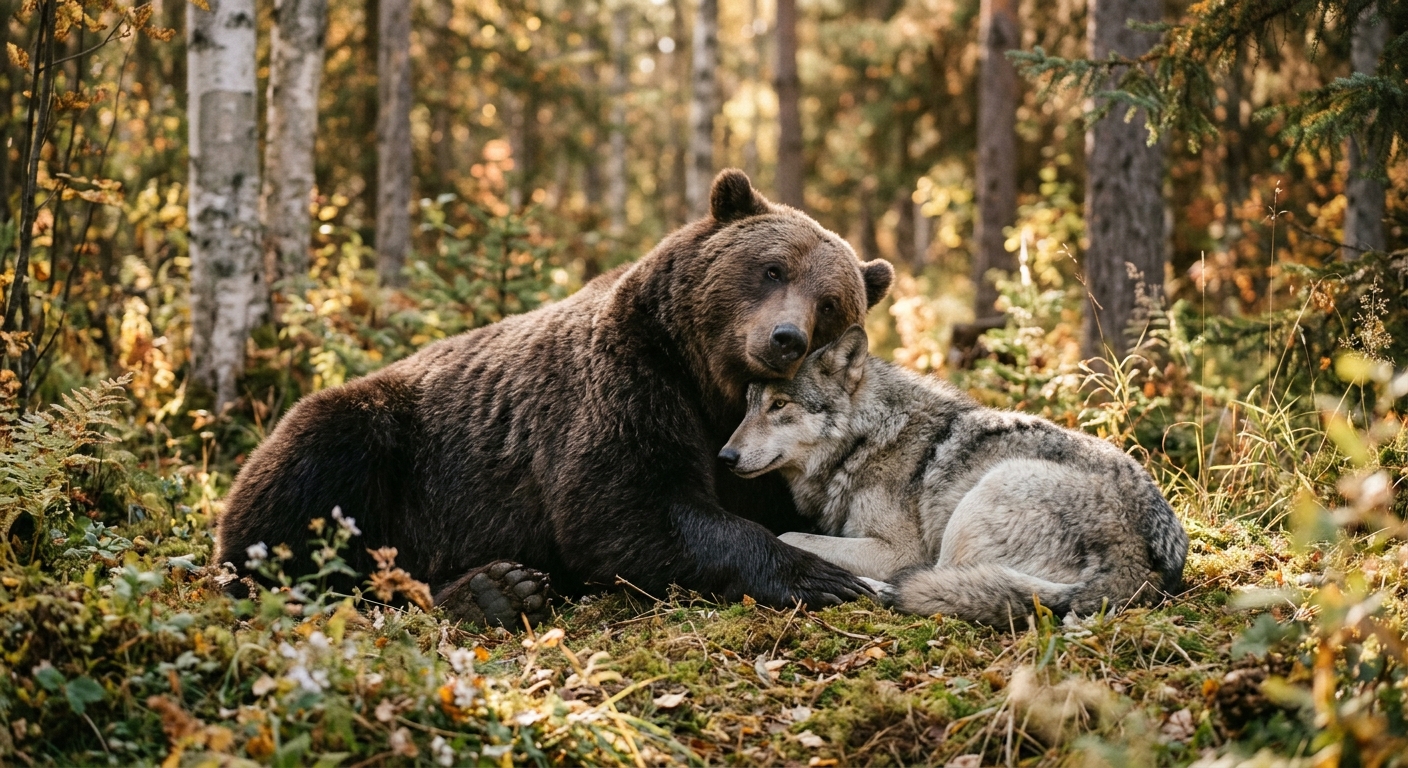
The photographs Rautiainen captured tell a story that no scientific paper could fully translate. There is one image in particular that has circulated widely online. In it, the wolf and the bear are sitting together at the edge of a forest, their bodies relaxed and close, gazing in the same direction. It looks, more than anything else, like two old friends sitting on a porch at the end of a long day. Comfortable. Unhurried. At ease.
That image resonates so deeply with people because it reflects something we recognize in ourselves. The desire to find a companion who simply gets it. Who sits beside you without needing you to explain yourself. Who shares your silence as comfortably as your noise.
The wolf left his pack. That was not a small thing. Packs are safety. Packs are identity. Packs are everything a wolf is supposed to need. And yet this particular wolf walked away from all of that and found something that, at least for a season, seemed to fill the gap in a way his pack could not.
7 Things This Story Teaches Us About Connection
- Connection does not require similarity. A wolf and a bear share almost nothing in terms of biology, communication, or instinct. And yet they found a language of companionship that worked for both of them.
- Leaving the group is not always failure. The wolf leaving his pack could easily be read as a loss. Instead, it opened the door to one of the most extraordinary relationships ever documented in the wild.
- Loneliness is not exclusive to humans. The emotional vulnerability that made this friendship possible is something both animals shared. Recognizing loneliness as a universal experience changes how we respond to it in others.
- Play is a universal bridge. Across species, across cultures, across age groups, play is one of the most powerful ways any creature establishes trust and builds relationship.
- Sustained presence is the definition of friendship. These animals did not interact once. They returned to each other, evening after evening. Friendship is not a moment. It is a habit of showing up.
- The unexpected companion is often the most transformative one. We tend to seek connection among people who already look and sound like us. The bear and the wolf had no such option. And their friendship was richer for the stretch it required.
- Nature is more emotionally complex than we give it credit for. Every time we assume we have mapped the limits of animal emotion and social behavior, a wolf sits down next to a bear and refuses to read the script.
A Lesson Hiding in the Finnish Wilderness
There is a version of this story that gets told as pure wildlife curiosity. A fun fact. A quirky footnote in the long catalog of unusual animal behavior. But that version sells it short.
The wolf who left his pack and made friends with a brown bear is a story about the courage it takes to reach beyond your category. Beyond your species, your tribe, your expected circle. It is about the loneliness that quietly precedes every genuine connection. It is about what becomes possible when two solitary creatures stop circling each other with caution and decide instead to sit together in the grass and share what they have.
We are not so different from that wolf. Most of us spend years inside our packs, comfortable in the familiar, loyal to the expected. And then one day, for reasons we cannot always name, we wander a little further than usual. And something remarkable steps out of the tree line to meet us.
The Friendship That Lasted a Season
Rautiainen’s documentation of the pair eventually came to an end as the seasons changed and both animals moved on. Whether they encountered each other again is unknown. But the weeks they shared were real, recorded, and witnessed. A wolf and a bear, finding something in each other that neither could find anywhere else.
That is enough. Sometimes the most important connections in our lives are not the permanent ones. They are the ones that arrive at the exact moment we most need to be reminded that belonging is not reserved for those who look like us, sound like us, or have always known us. Sometimes belonging shows up wearing fur of a completely different color. And if we are brave enough, we sit down beside it anyway.