🎧 Listen to this story
Narrated by Kore · 8,065 characters
He Never Wore a Lab Coat, But He Never Missed a Shift
His name was Gizmo. He weighed about nine pounds, had amber eyes, a patchy gray coat, and absolutely zero medical training. What he did have, however, was something no stethoscope or prescription pad could replicate: an uncanny ability to know exactly which child needed him most.
For fourteen years, Gizmo served as an unofficial resident at a regional children’s hospital in the Pacific Northwest, padding softly down linoleum corridors, slipping past nurses’ stations, and curling up beside children who were scared, in pain, or simply far from home. By the time he passed away in 2022 at the age of sixteen, staff estimated he had visited thousands of young patients. Some of those patients, now adults, still talk about him.
This is his story, and the story of what one small, purring creature taught an entire hospital about healing.
How It All Started: A Stray With a Plan
Nobody invited Gizmo. He simply arrived one rainy October morning in 2008, sitting calmly outside the hospital’s side entrance as though he had a scheduled appointment. A pediatric nurse named Linda Marsh found him there during her morning shift.
‘He wasn’t crying or begging,’ Linda recalled. ‘He just looked up at me like he was waiting to clock in. I brought him inside to keep him out of the rain, and he immediately walked down the hall toward the children’s ward. Like he knew.’
The hospital administration was, understandably, skeptical. There were allergy concerns, hygiene protocols, and liability questions. But something about Gizmo’s calm, deliberate manner made the staff pause before calling animal control. A few phone calls were made. A few managers looked the other way. And within a week, Gizmo had a food bowl near the nurses’ station and an unofficial job description that nobody could quite put into words.
What the Children Called Him
Over the years, Gizmo accumulated nicknames the way most cats accumulate nap spots. The nursing staff called him ‘Dr. Gizmo.’ The children called him everything from ‘Fuzzy’ to ‘Captain’ to ‘My cat,’ spoken with fierce, proprietary love by kids who needed something to belong to during some of the hardest days of their lives.
A seven-year-old recovering from a bone marrow transplant named him ‘The Mayor’ because, as she told her mother, ‘he’s in charge of making everyone feel better.’ That name stuck for an entire ward for the better part of two years.
The Science Behind the Purr
What Gizmo was doing, it turns out, has a name. Animal-assisted therapy has been studied extensively over the past three decades, and the findings are striking. Interaction with therapy animals has been shown to:
- Lower cortisol levels, the body’s primary stress hormone
- Reduce blood pressure and heart rate in anxious patients
- Increase the release of oxytocin, the bonding and comfort hormone
- Decrease the perception of pain in pediatric patients
- Improve mood and reduce symptoms of depression and anxiety
- Encourage communication in children who have become withdrawn
Dr. Patricia Nguyen, a pediatric psychologist who worked at the hospital for six of Gizmo’s fourteen years, was initially a skeptic. ‘I came from a strictly evidence-based background,’ she said. ‘But I watched Gizmo walk into a room where a child hadn’t spoken in three days after a traumatic surgery, and within ten minutes, that child was whispering to him. I couldn’t explain it clinically at first. Now I can. But back then, it just felt like a miracle.’
He Seemed to Know
The detail that staff members return to again and again, the thing that sets Gizmo apart from a simple mascot or novelty, is his apparent emotional intelligence. Nurses described watching him bypass rooms where children were sleeping peacefully and gravitate toward rooms where a child was awake, anxious, or crying.
‘We started paying attention,’ said charge nurse Rosario Vega. ‘And I would say eight times out of ten, when Gizmo went to a specific room unprompted, something was going on with that patient. Not medically necessarily, but emotionally. He just knew.’
One particularly striking account involves a twelve-year-old named Marcus, who was admitted following a severe accident and had been told he would not regain full use of his left hand. The night after receiving that news, Marcus refused to eat, refused to speak to his family, and asked to be left alone. The night nurse respected his wishes. Gizmo did not.
He pushed the door open, jumped onto the bed, and lay across Marcus’s bandaged arm, purring steadily. Marcus’s mother, sitting in the hallway, heard her son start to cry for the first time since the accident. ‘Before that,’ she said, ‘he was just frozen. Gizmo broke something open in him that we couldn’t reach.’
14 Years: A Timeline of Small Miracles
Fourteen years is a long tenure by any measure. Over that time, Gizmo witnessed the full spectrum of a children’s hospital. He sat with children during chemotherapy. He was present in waiting rooms when parents received difficult news. He attended birthday parties improvised in hospital rooms, wearing tiny paper hats with the resigned dignity only cats can manage. He was photographed thousands of times, appeared in at least two local news segments, and was once the subject of a handmade book written and illustrated by a nine-year-old patient titled ‘The Doctor Who Doesn’t Talk But Helps Anyway.’
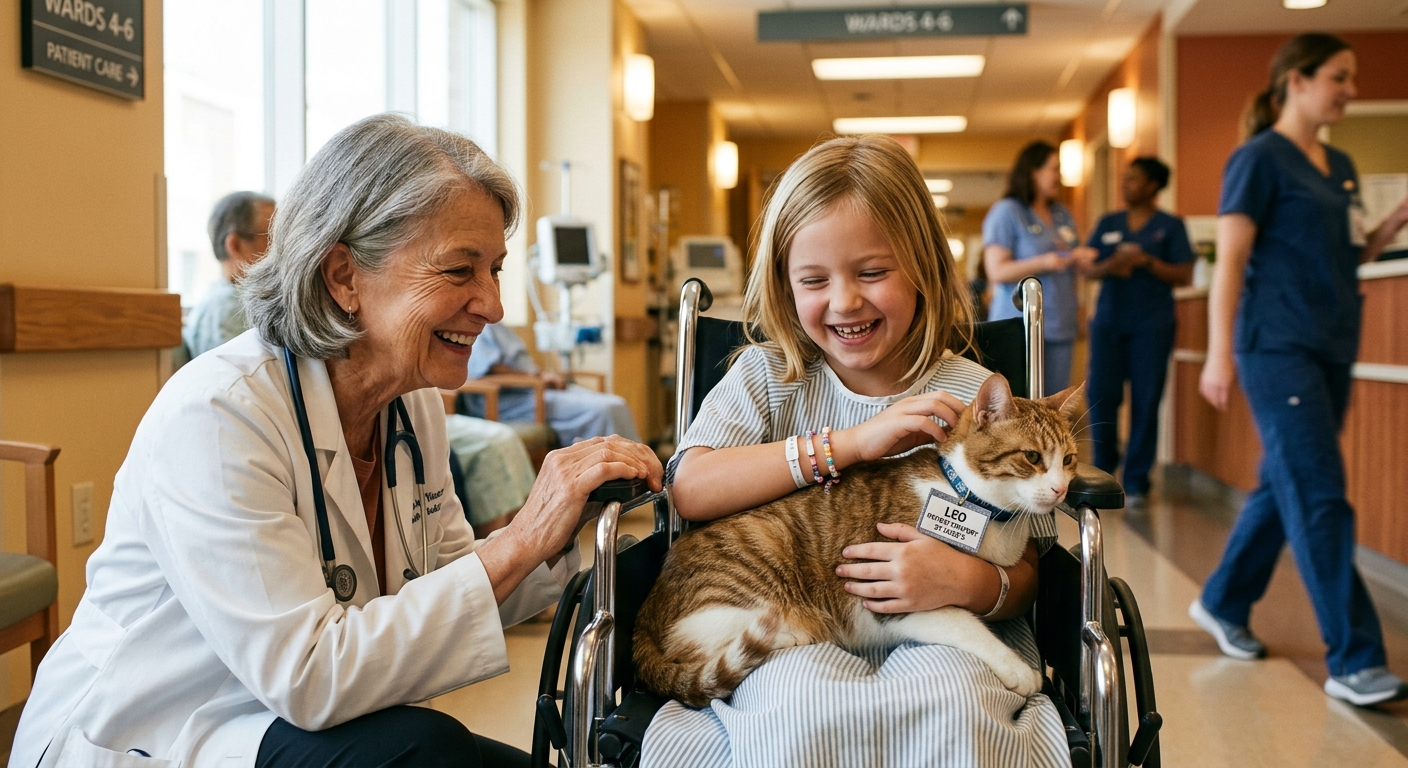
The hospital eventually formalized his status, working with a local veterinarian to ensure he was regularly vaccinated, examined, and certified under the hospital’s animal-assisted therapy program. He wore a small badge. It read: Gizmo, Comfort Specialist.
What Gizmo Taught the Staff
Ask the nurses, doctors, and support staff who worked alongside Gizmo for years, and they will tell you his presence changed how they think about care itself.
‘Medicine can become very task-oriented,’ said Dr. Nguyen. ‘You’re managing symptoms, managing schedules, managing outcomes. Gizmo reminded us that sometimes a patient doesn’t need another intervention. Sometimes they just need someone to sit with them and not need anything from them in return.’
Linda Marsh, the nurse who first let him in from the rain, put it more simply: ‘He taught us to slow down. To just be in the room with a person. Kids, especially, they know when you’re distracted or rushed. Gizmo was never distracted. He was always completely there.’
The Last Shift
Gizmo passed away on a Tuesday in March 2022. He was sixteen years old, which is a full, long life for a cat, especially one who spent it working. He had slowed down considerably in his final year, spending more time in a dedicated bed near the nurses’ station, receiving visitors rather than making rounds. The children still came to him. He still purred.
The hospital held a small memorial. Children’s drawings covered a bulletin board near his favorite window. A handwritten note from a now-adult patient, who had been treated there as a six-year-old, read: ‘I was so scared when I was little. You made it okay. I never forgot you.’
His badge was framed and now hangs in the pediatric ward. Beneath it, a small plaque reads: In memory of Gizmo. Comfort Specialist. 2006 to 2022. He always showed up.
The Lesson That Outlasts Him
There is something quietly radical about Gizmo’s story. He held no degree. He offered no diagnosis. He could not promise outcomes or explain prognoses. What he could do was show up, consistently, for fourteen years, and offer presence without agenda.
In a world that often measures care by its complexity, by its technology, its cost, its credentials, a nine-pound cat with amber eyes reminded a hospital full of brilliant, dedicated people that sometimes the most powerful thing you can offer someone who is suffering is simply this: to stay.
Not every hospital has a Gizmo. But every one of us has the capacity for what he practiced, showing up, paying attention, and sitting with someone in the hard moments without needing them to be okay yet.
That is not a small thing. That is, perhaps, everything.