
🎧 Listen to this story
Narrated by Schedar · 8,959 characters
When the Sky Comes Alive
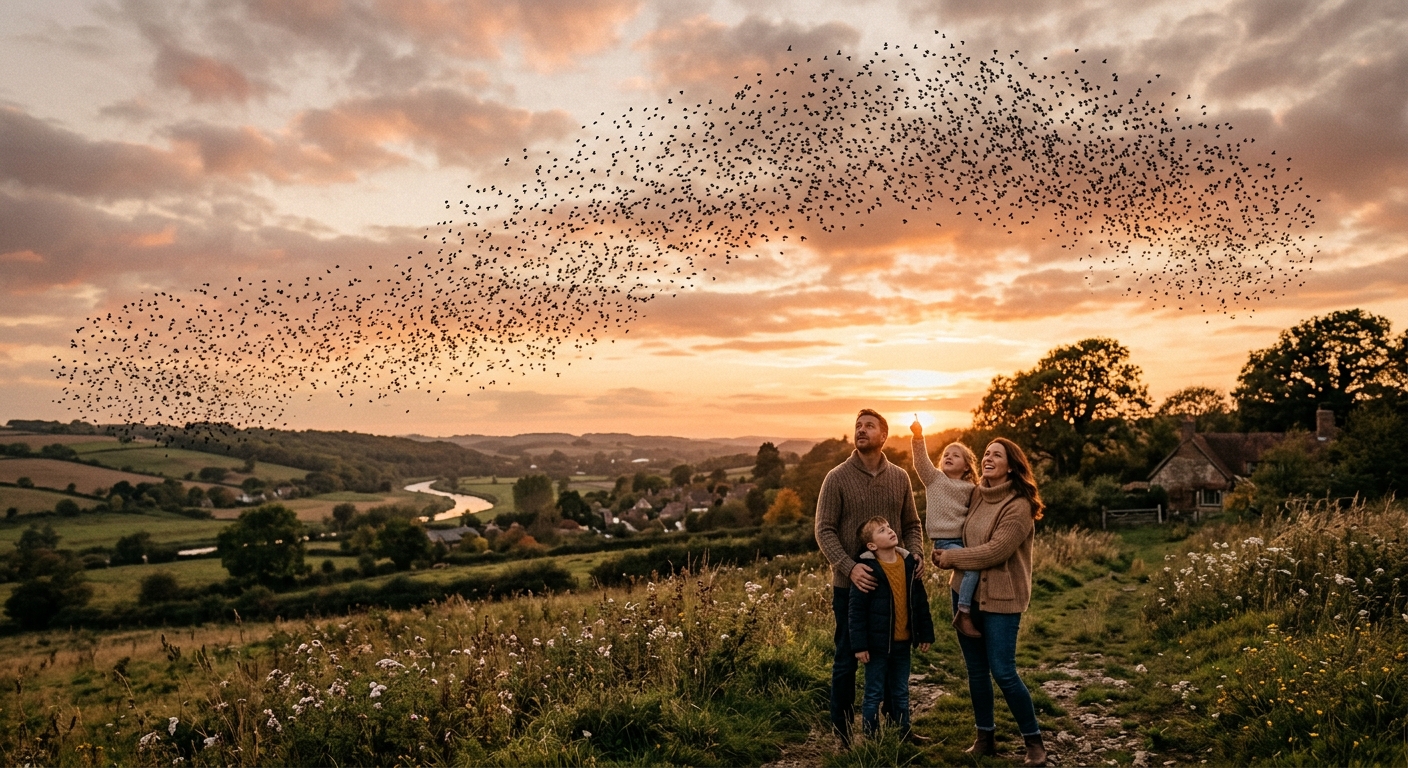
Just before dusk on an autumn evening in Rome, a tourist lifts her phone to take a photo of the sunset. Then she freezes. The sky above the Tiber River is shifting, folding, breathing. A dark ribbon of what looks like smoke twists and expands overhead, then collapses inward like a wave crashing in slow motion. Except it isn’t smoke. It is alive. It is tens of thousands of European starlings performing one of nature’s most spectacular and least understood phenomena: a murmuration.
People have been watching murmurations for centuries and struggling to explain them. Ancient Romans believed the birds were delivering divine omens. Medieval farmers called them ‘devil’s clouds.’ Even today, with high-speed cameras and computational modeling at our fingertips, the full explanation for how starlings do what they do continues to challenge and astonish scientists around the world.
The science behind murmurations is not just beautiful. It is genuinely breathtaking, and it carries lessons that reach far beyond ornithology.
What Exactly Is a Murmuration?
A murmuration is the collective aerial display performed by large flocks of European starlings (Sturnus vulgaris), typically occurring during the late autumn and winter months. The word itself is thought to derive from the soft, rolling sound the flock makes as thousands of wings beat simultaneously in close proximity.
These formations can involve anywhere from a few hundred birds to over a million, and they typically occur in the hour before the flock settles into a roosting site for the night. The display can last anywhere from a few minutes to nearly half an hour, producing shapes and movements that seem to defy physics: the flock stretches into long ribbons, compresses into dense spheres, splits apart, and rejoins, all without a single collision.
What makes this even more remarkable is that there is no leader. No conductor at the front giving instructions. No signal from a central intelligence. And yet the flock moves as if it were a single organism with a single mind.
The Science: It Starts With Six
For decades, researchers assumed starlings must be following their nearest neighbor, reacting like billiard balls to the movements around them. It was a reasonable guess, but it turned out to be wrong.
In the mid-2000s, a team of Italian physicists and biologists led by Andrea Cavagna and Irene Giardina at the University of Rome began attaching stereo cameras to rooftops and reconstructing the three-dimensional positions of individual birds within murmurations. What they found in 2010 changed the field entirely.
Starlings do not respond to their nearest neighbors in terms of distance. They respond to their nearest seven neighbors, regardless of how far away those neighbors are. This seemingly small distinction has enormous consequences. A distance-based rule creates a flock that can only transmit information locally, like a slow ripple. But a neighbor-count-based rule, what scientists call topological interaction, creates a network in which information travels across the entire flock almost instantaneously.
Think of it this way: if you are in a crowd and you only watch the person closest to you, you might not notice something happening on the other side of the room until it is too late. But if you always watch a fixed number of people, no matter where they are, you stay connected to the whole group at all times.
This is how a murmuration can shift direction across half a million birds in under a second.
Turning in Waves: The Physics of Collective Motion
When a predator, usually a peregrine falcon, enters a murmuration, the response ripples outward from the point of disturbance at roughly 20 to 40 meters per second. Researchers have measured these turning waves and found that they travel faster than the birds themselves can fly, which means the information is not being passed by observation alone. It is being passed by a kind of physics-based cascade, similar to how sound travels through a solid faster than through air.
This is where the murmuration starts to sound less like biology and more like quantum mechanics. The field of active matter physics, which studies systems made of self-propelled particles, has adopted starlings as a model system. The mathematics that describes their movements overlaps with equations used to describe the behavior of electrons in certain metals, the alignment of molecules in liquid crystals, and even the dynamics of brain tissue.
In short, starlings are doing something that physicists find deeply useful to understand.
Why Do They Do It? The Survival Logic
The evolutionary reason for murmurations is more straightforward, though no less fascinating. The display serves at least three major purposes:
- Predator confusion: A peregrine falcon can reach speeds of over 240 miles per hour in a stoop. It is one of nature’s most effective killing machines. But a murmuration confounds it. The constant shifting of the flock makes it nearly impossible for a falcon to isolate and track a single target. Studies have shown that falcons attacking a murmuration have a significantly lower success rate than those attacking a scattered group.
- Warmth and roosting coordination: In winter, thousands of birds roosting together share body heat. The murmuration helps coordinate the landing of a vast flock into a single location, ensuring that as many birds as possible benefit from communal warmth.
- Information sharing: Some researchers believe the murmuration also functions as a kind of information market, where birds that have found good feeding sites attract and recruit others through the dynamics of the display.
The Role of Density: Balancing Attraction and Repulsion
One of the most elegant aspects of murmuration physics is the way individual birds balance two competing impulses: the desire to stay close to the group and the need to avoid collision. Researchers describe this as a balance between attraction and topological repulsion.
Each bird is essentially solving a real-time optimization problem, staying close enough to its seven neighbors to remain part of the group, while maintaining just enough distance to avoid crashing into them. The result of millions of these simultaneous micro-decisions is a structure that is simultaneously fluid and cohesive, dense and elastic.
Andrea Cavagna has described murmurations as existing at a state called criticality, a physical condition poised exactly between order and chaos. Systems at criticality are maximally sensitive to perturbations, meaning information travels through them with maximum speed and efficiency. It is the same state, some theorists argue, that the human brain operates in during normal waking consciousness.
The starlings are not just making art. They are, in a very real sense, thinking together.
What We Are Still Learning
Despite decades of research, several mysteries remain. Scientists are still debating exactly how individual birds perceive and process their seven neighbors in real time, particularly when those neighbors are constantly moving. The role of peripheral vision, depth perception, and the structure of the starling eye is an active area of study.
There is also the question of how the flock decides when to land. Murmurations do not simply continue until the birds are exhausted. They end, often quite suddenly, with the entire flock dropping into a roosting site within seconds. The mechanism that triggers this collective decision is still not fully understood.
What is understood is that murmurations represent one of the most sophisticated examples of collective behavior in the animal kingdom, and possibly in nature as a whole.
A Reminder Written in the Sky
There is something quietly profound about the murmuration beyond the science. In a world that constantly celebrates individual achievement and singular leadership, these birds offer a different model. No one bird is in charge. No one bird is more important than another. The beauty, the resilience, the breathtaking intelligence of the whole emerges purely from the quality of connection between its parts.
Scientists studying how human organizations handle crises, how cities manage traffic, and how the internet routes data have all drawn on the mathematics of murmurations. The lesson keeps repeating itself: systems that empower each participant to respond to those around them, rather than waiting for orders from the top, tend to be faster, more adaptive, and more robust.
The starlings have known this for millions of years. They write it across the winter sky every evening, in shapes that no single one of them could ever create alone.
Next time you see a murmuration, even if it is only in a video on your phone, take a moment to stay with it. You are not just watching birds. You are watching one of the universe’s most elegant answers to the question of how individuals become something greater than themselves.