
🎧 Listen to this story
Narrated by Gacrux · 9,412 characters
When a 40-Ton Whale Steps In to Save a Seal
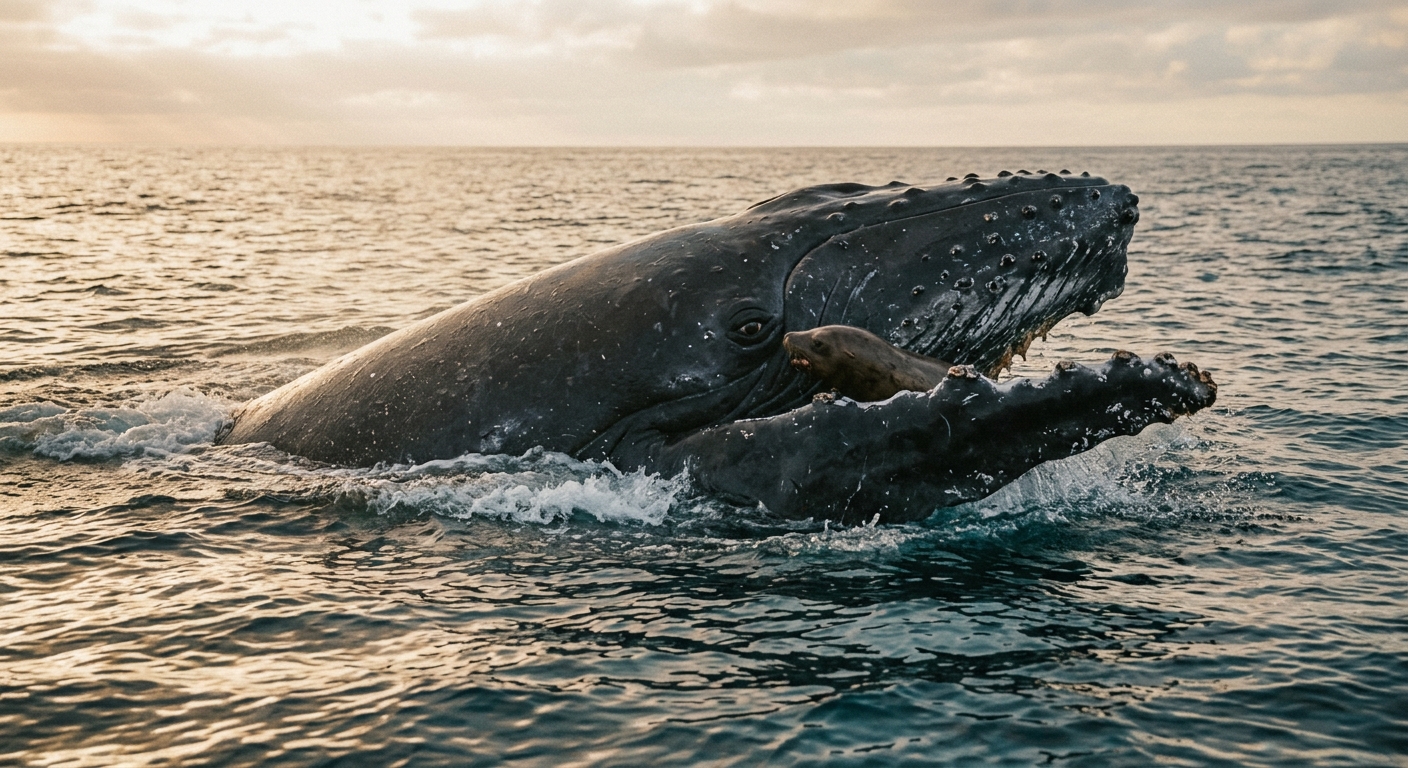
Imagine you are a Weddell seal, small and vulnerable, resting on a tiny ice floe somewhere in the frigid waters of Antarctica. A pod of orcas is circling, calculating, working as a team to wash you off your frozen refuge. The situation looks hopeless. Then, out of nowhere, something massive rises from the deep. A humpback whale, nearly 50 feet long and weighing close to 40 tons, places itself directly between you and the predators. It uses its enormous pectoral fins to scoop you up onto its belly, keeping you out of the water until the orcas give up and move on.
This is not a fable. It is a documented, real-world event that has puzzled marine biologists for decades. And it is not a rare fluke. Humpback whales have been observed interrupting orca attacks on seals, sea lions, sunfish, gray whales, and even other species they have no biological reason to protect. The question that has captivated scientists and wildlife enthusiasts alike is both simple and profound: Why do they do it?
The Research That Changed What We Thought We Knew
Marine biologist Robert Pitman was one of the first researchers to document this behavior systematically. After witnessing a humpback interfere with an orca attack on a Weddell seal near Antarctica in 2009, Pitman began collecting accounts from other researchers around the world. What he found was staggering. Over several decades, there were more than 115 recorded interactions in which humpback whales actively intervened when orcas were attacking other animals, and in the vast majority of cases, the prey species had no connection to the humpbacks whatsoever.
Pitman published his findings in the journal Marine Mammal Science, and the marine biology community took notice. The behavior was not random. It was deliberate, persistent, and in many cases, costly to the humpbacks themselves. These whales were traveling toward danger, not away from it.
What the Data Actually Shows
- 115+ documented interventions have been recorded across multiple ocean regions.
- In approximately 89 percent of cases, the humpbacks intervened even when the prey was not another humpback or even another whale.
- Humpbacks have been observed traveling at high speed toward the sound of orca calls, even when no attack was actively in progress.
- Both male and female humpbacks engage in this behavior, suggesting it is not tied to maternal instinct alone.
- The behavior has been recorded in the Pacific, Atlantic, Southern Ocean, and Indian Ocean, making it a global phenomenon rather than a regional quirk.
Three Leading Theories Behind the Behavior
Theory 1: It Is Personal, Not Altruistic
One of the most compelling explanations is rooted in self-interest, or more precisely, species memory. Humpback whales are among the primary prey targets of orca pods when they are calves. Adult humpbacks have very likely survived orca attacks themselves or watched other members of their pod fall victim. From this perspective, intervening when they hear the acoustic signature of an orca attack may be a hardwired defensive response, a way of disrupting a potential threat before it can be directed at them or their young.
This theory is sometimes called the conditioned interference hypothesis. The idea is that the reflex to disrupt an orca hunt is so deeply embedded in humpback behavior that it fires even when the target of the attack is not another humpback. The whale is not necessarily thinking about saving a seal. It is reacting to the presence of a dangerous predator and doing what it has always done: fight back.
Theory 2: Empathy and Emotional Response
A growing number of researchers are willing to consider something that would have been dismissed outright a generation ago: that humpback whales may possess a form of empathy. Cetaceans have large, complex brains with developed limbic systems, the structures associated with emotional processing in mammals. Humpbacks are also deeply social animals with long memories and complex communication systems.
Could it be that when a humpback whale witnesses a distressed animal being attacked, it responds emotionally rather than just instinctually? Some scientists argue this is not as far-fetched as it sounds. We already know that elephants grieve their dead, that ravens plan for the future, and that dolphins demonstrate self-awareness. Placing empathy-like responses within the cognitive repertoire of a highly intelligent whale is not a radical leap, though it remains difficult to prove conclusively.
Theory 3: Cultural Learning Passed Through Generations
Humpback whales are known to be cultural learners. Their famous songs change over time and spread across populations in ways that closely parallel how human cultural trends spread. It is possible that intervening in orca attacks is itself a learned cultural behavior, one that was discovered by individual whales, proved effective enough to become reinforced, and was then passed along through observation and imitation within whale communities over generations.
This theory raises even more remarkable questions. If humpback whales can teach each other how to respond to predators, what else might they be passing down through their communities? And what does it say about the depth of their social bonds that a behavior this costly in terms of energy and personal risk has been preserved and propagated across entire ocean basins?
The Extraordinary Cost of Intervening
It is worth pausing to appreciate what these interventions actually demand of the whale. Humpbacks do not swim casually over to a conflict and take a look around. They charge. They surface explosively between the orca and its prey. They thrash the water with their tail flukes and pectoral fins, creating a wall of noise and turbulence. Some humpbacks have been observed sustaining injuries during these encounters, fresh rake marks from orca teeth on their flanks telling the story of a fight they chose to enter.
They also burn enormous amounts of energy. Humpback whales are in a near-constant biological negotiation between the calories they consume and the calories they spend. Every intervention represents a real physiological cost. And yet, they do it anyway, repeatedly, for creatures that cannot repay them, cannot thank them, and will likely never interact with them again.
Migration Routes and Why Distance Is Part of the Story
Humpback whales are among the longest-distance migrants of any animal on Earth. Many populations travel more than 5,000 miles each way between their feeding grounds in polar regions and their breeding grounds in tropical waters. This means that at almost any moment, somewhere in the ocean, a humpback is in transit through waters shared by orcas and their prey.
Their migration routes essentially make them omnipresent across ocean ecosystems. Unlike a land predator confined to a territory, a humpback whale is a roaming constant, crossing the territories of dozens of other species in a single journey. Researchers believe this geographic reach may explain why humpback interventions have been documented across so many different ocean regions. These whales are simply everywhere, and where there are orcas hunting, there may well be a humpback close enough to respond.
What This Tells Us About the Ocean, and About Ourselves
The humpback whale story is not just a wildlife curiosity. It is a window into questions we have long reserved for human philosophy: What is the origin of altruism? Can kindness exist without intention? Is protection of the vulnerable a uniquely human value, or is it something older and wider than our species?
Science does not yet have definitive answers to why humpback whales defend other species. It may be instinct wrapped in the shape of empathy. It may be culture dressed up as reflex. It may be something we do not have the language or the framework to describe yet. But the behavior itself is undeniable, and it is breathtaking.
In a world that often feels small and competitive, there is something deeply moving about a 40-ton animal crossing thousands of miles of open ocean and then, when the moment calls for it, placing its body between a predator and a creature it has never met. Whether that whale feels anything in the way we understand feeling, it acts as though something matters beyond itself.
Perhaps that is enough to call it remarkable. Perhaps it is enough to call it inspiring.
How You Can Help Protect These Remarkable Animals
Humpback whales were once hunted nearly to extinction. Today, they face ongoing threats from ship strikes, fishing gear entanglement, ocean noise pollution, and the effects of climate change on their food sources. If their story has moved you, here are a few ways to make a difference:
- Support organizations like the Ocean Conservation Society or WDC (Whale and Dolphin Conservation) that fund cetacean research and protection.
- Reduce your plastic use, as ocean plastic pollution directly harms marine mammals.
- Choose sustainable seafood certified by programs that minimize bycatch.
- Advocate for stricter regulations on vessel speed in known whale migration corridors.
- Share their story, because public awareness is one of the most powerful conservation tools we have.
The ocean’s unexpected guardians have been quietly protecting other species for longer than humans have been watching. The least we can do is return the favor.