🎧 Listen to this story
Narrated by Aoede · 9,676 characters
The Quiet Revolution Happening in Stables Across America
There are no whiteboards in this therapy room. No clipboards, no fluorescent lights, no carefully arranged chairs facing each other across a neutral-colored carpet. Instead, there is hay underfoot, the smell of earth and animal, and a 1,200-pound creature who has absolutely no interest in pretending everything is fine.
That, as it turns out, is exactly the point.
Across the United States, a growing number of veterans are finding healing in an unexpected place: the stable. Equine-assisted therapy, once considered an alternative or fringe approach to trauma treatment, is now being taken seriously by researchers, VA-affiliated programs, and mental health professionals who have watched it succeed where other interventions have struggled. For veterans living with post-traumatic stress disorder, the results are sometimes nothing short of extraordinary.
What PTSD Actually Does to a Person
To understand why horses work, it helps to understand what PTSD does to the brain and body. Post-traumatic stress disorder is not simply feeling sad about something that happened. It is a physiological rewiring. The nervous system becomes stuck in a state of high alert, scanning constantly for threats that may not exist. Sleep is disrupted. Relationships fracture. Emotions become either overwhelming floods or complete numbness.
Traditional talk therapy, including cognitive behavioral therapy and prolonged exposure therapy, has helped many veterans significantly. But for others, the act of sitting across from another human being and narrating their trauma is itself re-traumatizing. The brain, flooded with stress hormones, cannot process language the way it normally would. Words fail. And yet the pain remains.
This is where horses enter the picture in a way that feels almost scientific in its elegance.
Why Horses, Specifically?
Horses are prey animals. Their survival, for millions of years, has depended on their ability to read the emotional and physical states of every creature around them. They are exquisitely sensitive to body language, breathing patterns, muscle tension, and the subtle energy a person radiates. They do not respond to what you say. They respond to what you are.
For a veteran who has learned to mask emotions, to perform normalcy, to say “I’m fine” when they are anything but, a horse offers something no human therapist fully can: a mirror that cannot be deceived.
“The horse doesn’t care about your rank, your record, or your story,” said one program facilitator at a veteran equine therapy center in Colorado. “If you walk in carrying tension and fear, the horse reflects it back immediately. And if you find a moment of calm, the horse shows you that too. It becomes this real-time biofeedback loop.”
What a Session Actually Looks Like
Equine-assisted therapy for veterans takes several forms. Some programs focus on groundwork, where veterans work with horses without ever riding them. Activities might include leading a horse through an obstacle course, grooming, or simply standing in a paddock and practicing stillness. Other programs incorporate riding as a tool for balance, focus, and physical grounding.
What makes these sessions therapeutic is less the activity itself and more what happens internally during it. Consider the following documented experiences shared by veterans in various programs:
- Regulation of the nervous system: Matching the calm, rhythmic breathing of a horse can help downregulate the fight-or-flight response. The body learns, often for the first time in years, what safety actually feels like.
- Non-verbal communication: Veterans who struggle to articulate their trauma verbally find that working with horses requires a completely different kind of language. Body language, intention, and presence take over, bypassing the verbal processing centers of the brain that often lock up under stress.
- Trust built incrementally: A horse’s trust must be earned slowly and honestly. This mirrors the kind of trust-building that many veterans need to practice in human relationships but find nearly impossible to approach directly.
- A sense of purpose and mastery: Successfully communicating with and guiding a large animal produces a measurable sense of accomplishment. For veterans who feel stripped of purpose after leaving the military, this can be quietly life-changing.
- Reduced isolation: Many programs place veterans in groups, and the shared experience of working with animals creates bonds between participants without requiring direct emotional disclosure.
The Research Is Catching Up
For years, equine therapy existed largely on the strength of anecdotal evidence. That is changing. A 2019 study published in the Journal of Traumatic Stress found that veterans who participated in equine-assisted therapy showed significant reductions in PTSD symptoms compared to control groups. A separate study from Purdue University found measurable decreases in depression and improvement in overall quality of life among veterans who participated in therapeutic horseback riding programs.
The VA has also begun exploring equine therapy more formally. Several VA medical centers have partnered with certified equine therapy organizations, and the SAVES (Saratoga War Horse) program, the PTSD Foundation of America’s equine program, and PATH International-certified centers have all documented meaningful outcomes among veteran participants.
Researchers believe the mechanism involves what is sometimes called “bottom-up” processing. Traditional talk therapy works “top-down,” engaging the rational, verbal mind to process trauma. Equine therapy, like other somatic approaches, works bottom-up, engaging the body and the nervous system first. For veterans whose trauma lives deep in the physical body, this approach reaches places that words simply cannot.
One Veteran’s Story
Marcus served two tours in Afghanistan before returning home to a life that felt foreign and unbearable. He struggled with nightmares, hypervigilance, and an inability to be in crowded spaces. He tried group therapy, individual counseling, and medication. Some of it helped a little. None of it helped enough.
A friend told him about a ranch outside of Tucson running a weekend equine program for veterans. He almost didn’t go. “I thought it was going to be some kind of hippie thing,” he admitted later. “I couldn’t picture what a horse was going to do for me.”
What happened during his first session surprised him. He was asked simply to stand near a horse named Copper and breathe. The horse kept moving away from him, circling, unsettled. A facilitator gently pointed out that Marcus’s jaw was clenched, his shoulders raised, his breathing shallow. “She said, ‘He’s reading everything you’re not saying.'”
Marcus spent the next forty minutes simply working on his own body. Releasing his jaw. Dropping his shoulders. Slowing his breath. And gradually, Copper stopped moving away. The horse walked toward him, lowered its head, and stood quietly beside him.
“I hadn’t felt that kind of calm in six years,” Marcus said. “Not from any pill. Not from any conversation. Just from learning to be still.”
Not a Replacement, But a Missing Piece
It is important to note that equine therapy is not presented by its practitioners as a cure or a replacement for other forms of PTSD treatment. Most programs work in conjunction with traditional therapy, offering veterans a complementary approach that addresses dimensions of trauma that talk-based therapies may not reach.
What equine therapy offers is access to a different kind of healing, one rooted in the body, in nature, in non-verbal connection, and in the humbling experience of earning the trust of an animal that cannot be fooled. For veterans who have been let down by words, whether their own or those offered by well-meaning therapists, the stable offers something rare: a place where being authentic is not optional. The horse demands it.
How to Find Equine Therapy Programs for Veterans
If you or a veteran you know is interested in exploring equine-assisted therapy, there are several resources worth exploring:
- PATH International (pathintl.org): Maintains a directory of certified equine therapy centers across the country, many of which offer programs specifically for veterans.
- The PTSD Foundation of America: Operates Camp HOPE and several equine-specific initiatives for combat veterans and their families.
- Saratoga War Horse: A nationally recognized program offering intensive equine experiences for veterans dealing with PTSD and moral injury.
- Local VA Medical Centers: Increasingly partnering with equine programs. Ask a VA social worker or mental health coordinator about referral options in your area.
Many programs offer their services at no cost to veterans, supported by donations, grants, and the conviction of the people running them that no one who served should have to suffer without access to every possible tool for healing.
The Horse Doesn’t Know You Were a Soldier
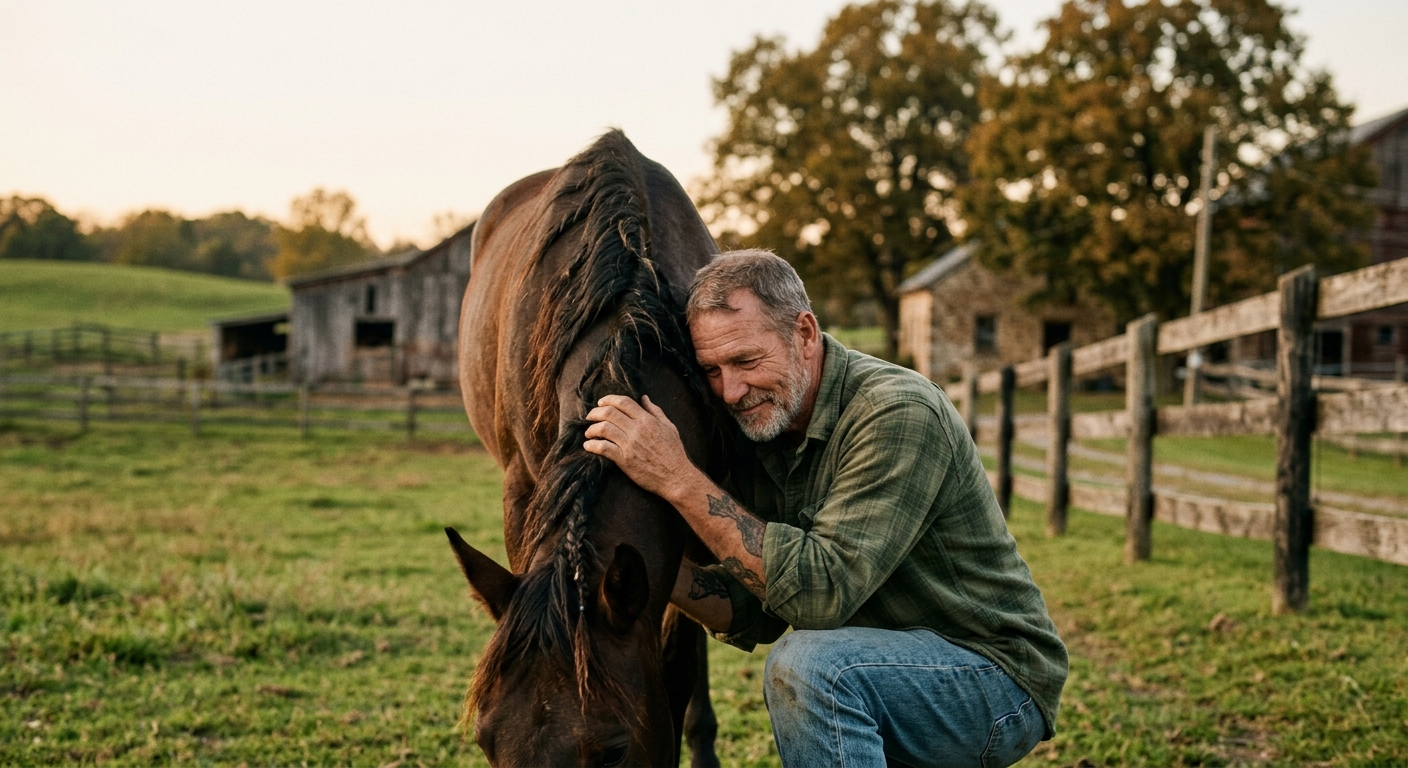
Perhaps the most quietly powerful thing about equine therapy is what the horse does not know. It does not know your rank. It does not know what you saw or what you did. It does not bring pity or awkwardness to the encounter. It simply responds to who you are in this moment, right now, in this paddock, with the sun coming through the stable door.
For veterans who have spent years trapped in the past, that present-moment response can feel like a lifeline. Not a cure, not a guarantee, but a door that many of them thought had been permanently closed, opened just enough to let the light in.
And sometimes, that is exactly enough to begin.