🎧 Listen to this story
Narrated by Callirrhoe · 9,072 characters
A Different Kind of Stage
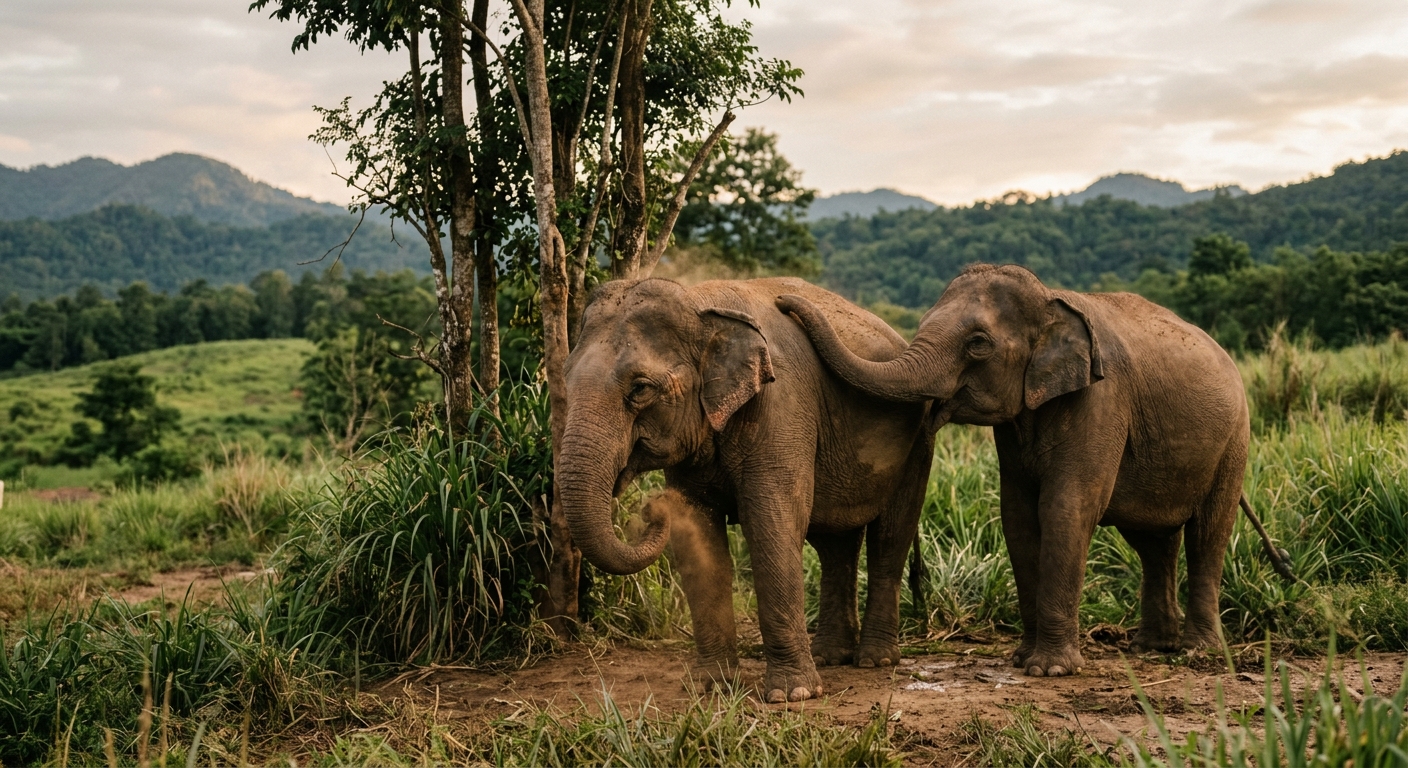
There are no bleachers here. No spotlights. No ringmaster counting down the seconds before the music swells and the crowd roars. At the Elephant Sanctuary in Hohenwald, Tennessee, the only sound that matters is the low, resonant rumble of elephants communicating across a field, the soft thud of enormous feet on soft earth, and the occasional splash of a creature finally learning what it feels like to simply play.
For the dozen-plus elephants currently living across its nearly 3,000 acres of natural habitat, this place is not a performance. It is, at last, a life.
Founded in 1995 by Carol Buckley and Scott Blais, The Elephant Sanctuary was built on a radical idea: that elephants who had spent their entire lives in service to human entertainment deserved the chance to retire with dignity, privacy, and the freedom to make choices. Today, it stands as the largest natural habitat elephant refuge in the United States, and it has become a model for sanctuaries around the world.
Where These Elephants Came From
The residents of the sanctuary did not arrive with clean histories. They came carrying decades of trauma, physical injury, and deeply conditioned behaviors born from lives spent in captivity. Each one has a story that is difficult to sit with, and also impossible to look away from.
Shirley, one of the sanctuary’s most beloved residents, spent 22 years in a circus before a leg injury ended her performing career. She lived alone in a zoo for two more decades after that, a social animal kept in profound isolation. When she arrived at the sanctuary in 1999, staff witnessed something that stopped everyone in their tracks: her reunion with another elephant named Jenny, who had briefly been in the same circus as Shirley more than 20 years earlier. The two animals recognized each other instantly. They roared, they rumbled, they wrapped their trunks around each other in what every observer described as a tearful reunion, though the tears were entirely human.
Tarra, one of the sanctuary’s founding residents, spent years as a performing elephant in circuses and exhibitions across North America. She became famous not just for her gentle spirit, but for her unlikely friendship with a stray dog named Bella, a bond so extraordinary it was featured on CBS News and sparked a children’s book. The friendship became a symbol of what animals are capable of when they are given peace and safety: connection, trust, and joy that crosses every expected boundary.
What Rehabilitation Actually Looks Like
It would be easy to imagine that arriving at a sanctuary instantly heals the animals who come through its gates. The reality is more complicated, and more instructive.
Many elephants arrive with chronic foot problems caused by standing on hard concrete floors for years. Some have arthritis. Many display stereotypic behaviors, repetitive movements like swaying or head-bobbing, that are recognized as psychological responses to long-term stress and confinement. Staff at the sanctuary do not rush the process of healing. They let the animals set the pace.
The Three Habitats
The sanctuary is divided into three separate natural habitats to allow elephants to self-select their companionship and environment. This is not a small detail. It reflects a foundational philosophy: that these animals have spent enough of their lives being told where to go and what to do. Here, they choose.
- The Asian Habitat: Home to the sanctuary’s Asian elephants, covering rolling Tennessee hills, wetlands, and forested areas that offer shade, exploration, and a range of terrain types that naturally exercise joints and promote physical wellbeing.
- The African Habitat: Established later to accommodate the different needs of African elephants, who are a distinct species with different social structures and environmental preferences.
- Quarantine and Transition Areas: New arrivals are slowly introduced to the land and to other elephants, allowing time for adjustment without the stress of immediate social pressure.
Veterinary care is available but unobtrusive. Feeding stations are spread across the habitat to encourage natural foraging behavior. Mud wallows and ponds allow for the kind of bathing that keeps elephant skin healthy and, by all observable accounts, deeply satisfying.
The Science of Elephant Memory and What It Means Here
It has become something of a cliche to say that elephants never forget. But the research behind that phrase is real, and it carries significant weight when you understand what these animals are recovering from.
Elephants have highly developed hippocampi, the region of the brain associated with memory and emotional processing. They recognize individual humans and other elephants after years of separation. They grieve their dead. They demonstrate what researchers increasingly describe as complex emotional lives, including the capacity for both trauma and recovery.
A 2019 study published in the journal Animal Cognition found that elephants in sanctuary settings showed marked decreases in cortisol levels, a key stress hormone, within their first year of residency. Behavioral markers of chronic stress also declined significantly over time. The animals were not just physically safer. They were, by measurable indicators, less afraid.
Dr. Joyce Poole, one of the world’s foremost elephant researchers, has noted that elephants in natural or semi-natural settings begin to display social behaviors within months that they had never been observed performing in captivity, including play, cooperative problem-solving, and what she describes as apparent expressions of positive emotional states.
What Visitors Never See, and Why That Matters
Here is something that surprises almost everyone who hears it: you cannot visit the elephants at the sanctuary in person.
The decision to keep the sanctuary closed to the public is intentional and philosophically consistent. For the first time in their lives, these animals do not have to perform for an audience. They do not have to be observed, touched, photographed, or evaluated. They are free, within the generous boundaries of the habitat, to simply exist without human demand placed on them.
Instead, the sanctuary offers a live EleCam feed on its website, allowing the public to observe the elephants at a respectful distance. The cameras are fixed. The elephants wander in and out of frame on their own schedule. Sometimes you catch something extraordinary: two elephants greeting each other across a ridge, a group splashing in a pond, a lone elephant standing still in a field of tall grass, doing nothing at all except being alive.
It is, many viewers report, one of the most moving things they have ever watched.
Lessons the Sanctuary Teaches Without Trying
Beyond the specific stories of the elephants themselves, the sanctuary quietly models a set of values that extend far beyond wildlife care.
- Recovery is not linear. Some elephants thrive quickly. Others take years to show signs of relaxation. Neither timeline is wrong.
- Rest is not laziness. Watching elephants spend hours grazing, bathing, or simply standing is a reminder that existence does not always need to be productive to be worthwhile.
- Friendship heals. The bonds that form between sanctuary residents, especially between animals who have never had the opportunity to form lasting relationships before, are among the most documented and cited outcomes of the sanctuary model.
- Space matters. Both physical and emotional space are prerequisites for healing. You cannot recover from a life of confinement in a slightly larger cage.
- Dignity is not a luxury. It is, these elephants remind us, a basic requirement for a life worth living.
The Ongoing Work
The Elephant Sanctuary is a nonprofit organization that relies on donations, memberships, and the support of people who may never see an elephant in person but believe in their right to peace. The work is ongoing, and it is expensive. Caring for a single elephant costs hundreds of thousands of dollars per year when veterinary care, habitat maintenance, and staffing are accounted for.
New residents continue to arrive as circuses close, as zoos reassess their elephant programs, and as the cultural conversation around captive animal entertainment continues to shift. Each arrival brings new challenges and new stories.
But the core mission has not changed since 1995: provide a place where elephants who have given enough to the human world can finally, quietly, live for themselves.
A Final Image
There is a photograph that circulates occasionally online, taken by sanctuary staff on a gray Tennessee morning. In it, an elderly Asian elephant named Dulary stands at the edge of a pond, her reflection broken by a slow ripple on the water’s surface. She is not performing. She is not being watched by a crowd. She is simply standing in the rain, trunk slightly raised, ears at ease.
She looks, in the most uncomplicated way possible, like she belongs there.
After more than 40 years in captivity, that is exactly where she is.