🎧 Listen to this story
Narrated by Callirrhoe · 8,644 characters
A Loyalty That Defied Every Explanation
There are stories that make you pause mid-scroll, set down your phone, and just sit with the feeling they leave behind. This is one of those stories. It is not dramatic in the way movies are dramatic. There are no explosions, no last-minute rescues, no triumphant speeches. There is only a dog, a hillside, and a kind of devotion that most humans will spend their entire lives trying to understand.
His name was Capitan. He was a German Shepherd, and for eleven years, from 2006 until his death in 2018, he slept beside the grave of his owner, Miguel Guzman, in a cemetery in Villa Carlos Paz, a small city nestled in the hills of Cordoba, Argentina. Every single night, without fail, Capitan returned to that grave. And in doing so, he quietly became one of the most talked-about animals in the world.
But here is the part of the story that does not always make the headlines: the town did not leave him there alone.
The Beginning: A Man, a Dog, and a Bond Built in Ordinary Moments
Miguel Guzman purchased Capitan as a gift for his teenage son, Damian, in 2005. By all accounts, Miguel and Capitan formed an unusually close bond in the short time they had together. Miguel died unexpectedly in 2006, leaving behind his wife Veronica, his son Damian, and a German Shepherd who seemed to have no roadmap for a world without his person in it.
The family brought Capitan to the funeral. At some point after the burial, the dog disappeared. The family searched. Days passed. Then, astonishingly, cemetery staff contacted the Guzman family with a message that stopped them cold: Capitan had found Miguel’s grave on his own. He was lying beside it. He had apparently located a place he had never been taken to before, in a cemetery he had never visited, and settled in as though he had always known exactly where he needed to be.
“We searched for him, but he had gone to the cemetery on his own,” Damian told reporters years later. “It is a mystery how he managed to find the place.”
That mystery is part of what made Capitan’s story travel so far. But what happened next is what made it truly extraordinary.
Eleven Years on a Hillside: What Daily Devotion Really Looks Like
Capitan settled into a routine that he would maintain for over a decade. During the day, he sometimes wandered or was visited by the Guzman family, who came regularly to check on him and bring him food. But as evening approached, something in Capitan seemed to shift. He would return to Miguel’s grave. Cemetery workers reported that he arrived reliably at around six o’clock each evening, circled the grave, and lay down for the night.
“He is very quiet,” said cemetery director Hector Baccega in an interview that circulated internationally around 2012, when Capitan’s story first gained widespread attention. “He walks around the cemetery quietly, then goes and lies down on top of the grave. We feed him, bathe him, and take care of him. He is part of our family now.”
That line deserves a second read. He is part of our family now.
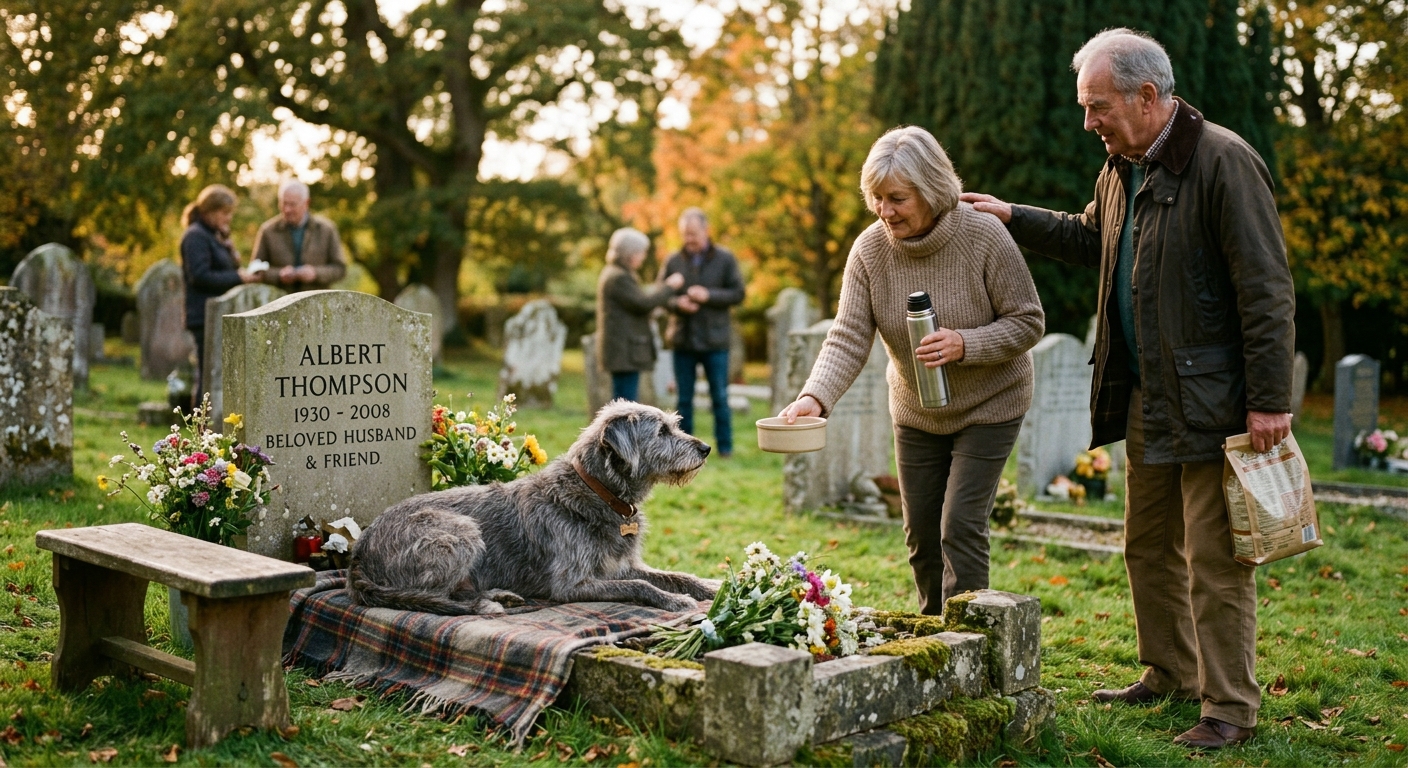
The cemetery staff had collectively, without fanfare or public announcement, adopted a grieving dog. They fed him. They gave him water. They made sure he was comfortable through the cold Argentine winters and the hot summers. They did not chase him away or remove him as an inconvenience. They built their workdays around his presence and their care around his grief.
The Town That Wrapped Around a Grieving Dog
Word spread slowly at first, then all at once. Visitors to the cemetery began leaving food near Miguel’s grave. Children from nearby schools visited Capitan on class trips. Local families brought him treats and sat with him. The Guzman family continued their regular visits, and Damian was often photographed sitting beside Capitan at his father’s grave, the two of them sharing something that language does not quite cover.
Villa Carlos Paz, a city known primarily as a tourist destination along the Cosquin River, had quietly become the home of something much bigger than a local news story. Capitan had become a symbol, though of what exactly depended on who you asked.
- For dog lovers: He was proof of what they had always believed about the emotional depth of animals.
- For the grieving: He was a mirror for the kind of love that does not know how to stop.
- For the people of Villa Carlos Paz: He was theirs, a living piece of their community’s daily fabric.
- For the Guzman family: He was a living extension of Miguel himself, a presence that kept something of him close.
When international media picked up the story in 2012, letters and messages poured in from across the world. People sent food. They asked after his health. A few asked if they could adopt him, and those requests were gently declined. Capitan, it was clear, was already home.
What Science Has to Say (And What It Cannot Explain)
Animal behavior researchers have long documented the capacity of dogs to grieve. Studies show that dogs display observable signs of mourning after the loss of a companion, including lethargy, loss of appetite, searching behaviors, and vocalizations. Some dogs have been documented returning repeatedly to places associated with deceased owners.
But Capitan’s case puzzled experts for a specific reason: he found a grave he had never been taken to. The leading theories suggest that dogs may follow scent trails from funeral processions, or that they possess a spatial memory and directional awareness that humans dramatically underestimate. Some researchers pointed to the possibility that Capitan followed family members to the cemetery at some point without being noticed, cementing the location in his memory.
None of these explanations feel entirely satisfying. And perhaps that is fine. Perhaps some loyalty is allowed to remain unexplained.
The Final Chapter: A Peaceful Ending in a Familiar Place
Capitan passed away in 2018, at approximately fifteen years of age, an excellent lifespan for a large-breed dog. He had lived with health issues in his final years, and cemetery staff coordinated with local veterinarians to manage his care. He spent his last days in comfort, surrounded by the people and the place he had chosen.
He was buried in the cemetery, near Miguel’s grave.
It is difficult to write that sentence without feeling something shift in your chest. A dog who spent eleven years refusing to leave was ultimately given the only ending that would have made sense: he stayed.
The cemetery staff gathered. The Guzman family said goodbye to a creature who had helped them grieve and heal across more than a decade. Damian, now an adult, spoke publicly about what Capitan had meant to him and to his family. He described visits to the cemetery not as heavy, painful obligations but as something closer to comfort, because Capitan was always there, always steady, always present in his quiet and unassuming way.
What Capitan Teaches Us About Showing Up
It would be easy to reduce Capitan’s story to sentimentality, to use it as a simple emotional hook and move on. But there is something genuinely instructive here, if we are willing to sit with it.
Capitan did not show up for Miguel once. He showed up every day for eleven years. That is not a gesture. That is a practice. That is a discipline of presence that most of us, if we are honest, struggle to maintain even in our closest human relationships.
And the town of Villa Carlos Paz did not celebrate Capitan with a viral social media post and forget about him the next week. The cemetery workers showed up for him every day too, with food and water and quiet companionship. They did not make it a spectacle. They simply did the next right thing, day after day, for over a decade.
There is a lesson in both of those facts. It is not a complicated lesson. It might be the oldest lesson there is:
Love is not a feeling you announce. It is a place you return to, over and over, even when no one is watching.
A Story That Keeps on Giving
Capitan’s story continues to circulate online years after his death. New readers discover it regularly and react the same way nearly every time: with a kind of quiet awe and a renewed appreciation for the animals in their own lives. Teachers use it in classrooms to discuss loyalty and grief. Grief counselors have referenced it with clients who struggle to articulate their own losses.
It endures because it is real, because it happened, because a dog in a hillside cemetery in Argentina just kept showing up, and a community of humans kept showing up for him, and together they made something that neither could have made alone.
That is the whole story. That is also everything.