🎧 Listen to this story
Narrated by Kore · 8,606 characters
The Sweet Smell of Tradition
On Magnolia Street in a quiet Ohio suburb, Christmas Eve did not officially begin with church bells or the lighting of the town square. It began with the smell of brown butter and vanilla drifting through the cold December air sometime around 4 a.m., when Harold and Evelyn Marsh switched on the oven lights in their yellow kitchen and got to work.
For 31 consecutive years, the Marshes baked cookies for every household on their street, the two adjacent cul-de-sacs, and eventually, as the neighborhood grew, anyone within reasonable walking distance who had ever waved hello. What started as a small gesture between new neighbors became one of the most quietly beloved traditions in their corner of the Midwest.
This is not a story about grand heroics. There are no dramatic rescues or life-altering speeches. This is a story about butter, sugar, two sets of aging hands, and what it means to love the place where you live.
How It Started: A Plate of Snickerdoodles and a New Beginning
Harold and Evelyn moved to Magnolia Street in December of 1991. They were both in their mid-fifties, recently retired, and adjusting to the strange quiet that follows a lifetime of raising four children who had now scattered to different states. The house felt big. The street felt unfamiliar. Evelyn, by her own description, was lonely in a way she had not expected to be.
“I didn’t know what to do with myself that first Christmas,” she recalled in a 2019 interview with her local community newsletter. “Harold suggested we bring cookies to the neighbors we hadn’t properly met yet. I thought we’d make maybe three or four plates. We ended up making twelve.”
The response was immediate and warm. Neighbors who had barely exchanged names stopped to talk on doorsteps. A widower two houses down invited them in for coffee. A young family across the street asked Evelyn for her snickerdoodle recipe. Something clicked, and the tradition was set in motion.
The Operation Behind the Magic
By the mid-2000s, the Marsh Christmas Eve baking operation had taken on a scale that required genuine logistical planning. Harold built a second set of wire cooling racks specifically for the occasion. Evelyn kept a running list in a spiral notebook of every household and their known preferences, allergies, and any special notes she had gathered through the year.
A Typical Christmas Eve at the Marsh House Looked Like This:
- 4:00 a.m. First batches enter the oven. Harold handles the mixing. Evelyn handles the decorating.
- 6:30 a.m. Coffee and a brief rest while the second round cools.
- 9:00 a.m. Packaging begins. Each household receives a hand-labeled cellophane bag tied with a red ribbon.
- 11:00 a.m. Delivery starts. Harold drives slowly. Evelyn walks the closer houses.
- 1:00 p.m. They are home, exhausted, and eating leftover cookie scraps for lunch.
At their peak, they produced 47 dozen cookies in a single day. The flavors rotated yearly but always included snickerdoodles, because “that’s how it started and that’s how it’ll always be,” Evelyn insisted. Regulars could also expect ginger molasses, lemon glazed shortbread, chocolate peppermint, and a rotating wild card that became a source of annual neighborhood speculation.
What the Neighbors Remember
Ask anyone on Magnolia Street what they associate with Christmas and the answer comes quickly and consistently: the Marsh cookies.
Diane, who moved into the neighborhood in 2003 with her husband and toddler twins, describes the moment her first bag arrived at the door as unexpectedly emotional. “I had just moved away from my whole family to follow my husband’s job,” she said. “I was holding this little bag of cookies from two people I barely knew, and I just started crying. I didn’t feel so far from home anymore.”
Tom, a retired firefighter who lives at the end of the street, kept every one of Evelyn’s hand-written labels for fifteen years. He has them in a shoebox in his closet. “I’m not a sentimental guy,” he admitted, “but those labels are the most Christmas thing I own.”
For children who grew up on the street, the Marsh cookies were simply a fixed feature of the universe, as reliable as snow and morning cartoons. Several of those children are now adults with children of their own, and they still talk about those bags the way you talk about things that quietly shaped who you are.
The Year Everything Changed
In the winter of 2022, Harold was diagnosed with a degenerative joint condition that made standing for long periods genuinely painful. Evelyn had dealt with a shoulder injury the previous spring that had not fully healed. They were both in their mid-eighties. The kitchen that had produced thousands of cookies over three decades was suddenly a more complicated place.
They did not announce they were stopping. They simply went quiet, and by mid-December, the neighborhood had begun to notice the absence of the usual small signals: the pre-Christmas grocery haul, the smell in the air, the ribbon spools visible through the front window.
What happened next is the part of this story that Harold says he still cannot talk about without needing a moment.
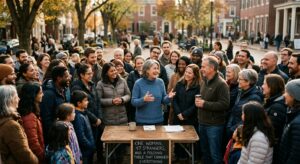
On December 23rd, there was a knock at the Marsh front door. On the porch stood eight of their neighbors, including Diane, Tom, a college student named Marcus who had grown up three houses down, and a woman named Rosa who had moved to the street only two years prior but had already absorbed the full mythology of the tradition. They were holding grocery bags, mixing bowls borrowed from their own kitchens, and a handwritten list of Evelyn’s known recipes, pieced together from years of observation and a few politely extracted hints.
They asked if they could come in and bake with them.
A Kitchen Full of People
What followed was, by every account, chaotic, loud, occasionally disastrous, and completely wonderful. Batches were slightly over-mixed. The ginger molasses cookies came out thinner than Evelyn preferred. Someone put the shortbread in at the wrong temperature and had to start over. Harold sat at the kitchen table directing traffic and offering commentary that was, depending on whom you ask, either helpful or entirely unhelpful.
Evelyn cried twice. She said it was the steam from the oven.
By early afternoon, 44 dozen cookies were cooling on every available surface in the house. The deliveries were made by rotating groups of neighbors, some of whom had never previously spoken to each other for more than two minutes. New introductions were made on doorsteps. Numbers were exchanged. One family invited the delivery crew in for hot cider and they stayed for an hour.
The Marsh cookies went out that year. And the year after. And the year after that.
What This Small Tradition Actually Teaches Us
It would be easy to frame this story as simply a charming holiday anecdote. But there is something worth sitting with here, something that applies well beyond Christmas Eve and the smell of snickerdoodles.
A few things the Marsh tradition quietly models:
- Consistency is its own form of love. Harold and Evelyn did not do anything once. They did it 31 times, in good years and hard ones, and that repetition is what transformed a gesture into a bond.
- You do not need a reason to show up for your neighbors. Nobody on Magnolia Street had earned those cookies. There was no crisis, no debt, no occasion. The Marshes simply decided that the people nearby were worth the effort.
- Traditions are not owned, they are passed forward. The most generous thing Harold and Evelyn ever did may not have been 31 years of baking. It may have been letting their neighbors walk through the door and learn the recipe.
- Small rituals hold communities together. In an era of garage doors and glowing screens, a bag of cookies and a hand-written label can do more for belonging than most well-intentioned programs ever will.
Still Going
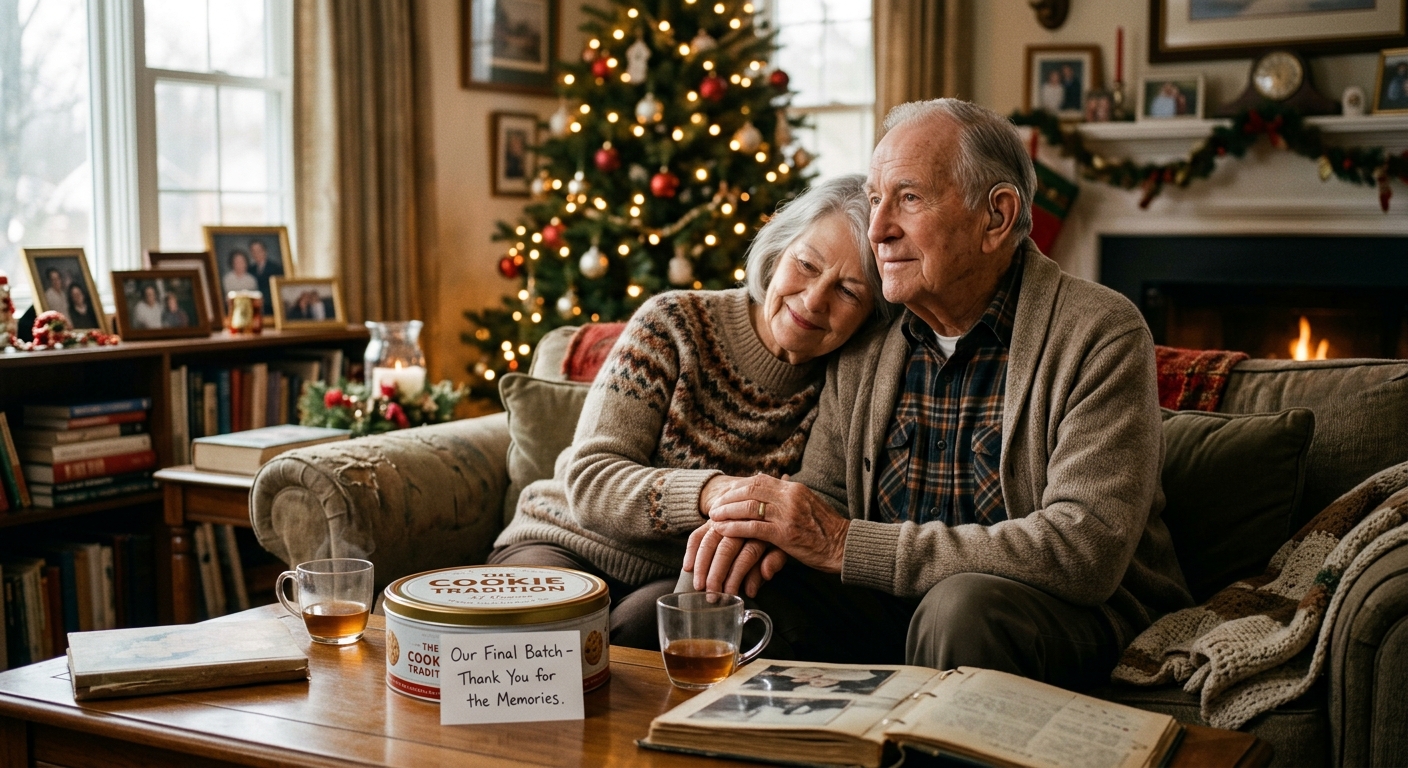
Harold and Evelyn still participate every year. Evelyn still insists on making the snickerdoodles herself, with some assistance now from whoever is nearby and willing to hand her ingredients. Harold still writes the delivery list, though he has passed the car keys to Marcus, who has apparently become an excellent driver of elderly couples bearing cookies.
The neighborhood has grown. The list has too. Last year, 51 households received a bag.
On Magnolia Street, Christmas Eve still begins before sunrise, with the smell of brown butter and vanilla moving quietly through the cold air. And somewhere in a warm yellow kitchen, surrounded by people who showed up because someone once showed up for them, the oven light is on.