🎧 Listen to this story
Narrated by Aoede · 8,112 characters
The Unlikely Counselor of Kindness
At the Humane Society of Indianapolis, there is a cat named Gus who has never read a single book on animal behavior, never attended a training session, and has absolutely no formal credentials in emotional support therapy. And yet, staff members will tell you, without hesitation, that he is the most effective comfort animal they have ever encountered. Not for humans, but for the terrified, trembling dogs that arrive at the shelter every single week.
Gus was himself a rescue. He came in as a skinny, matted, three-year-old tabby with a torn ear and a distrust of loud noises. He spent his first two weeks hiding behind a litter box, refusing eye contact, and flinching at the sound of the intake door opening. Nobody expected much from him. Nobody could have predicted what he would become.
How It Started: A Shaking Pit Bull and a Determined Cat
The first dog Gus ever approached was a brindle pit bull mix named Rosie. She had arrived at the shelter after being removed from a hoarding situation, and she was, in the words of shelter volunteer Diane Kowalczyk, “a dog who had forgotten that the world could be safe.” Rosie refused food, refused touch, and spent the first three days pressed into the far corner of her kennel, shaking.
Staff had tried everything. Soft voices. Gentle hands. High-value treats. Nothing worked. Then, on the fourth morning, a volunteer noticed something unusual. Gus, who had recently been granted free-roam status in the shelter’s east wing, was sitting directly outside Rosie’s kennel door. Not meowing. Not demanding anything. Just sitting. Present.
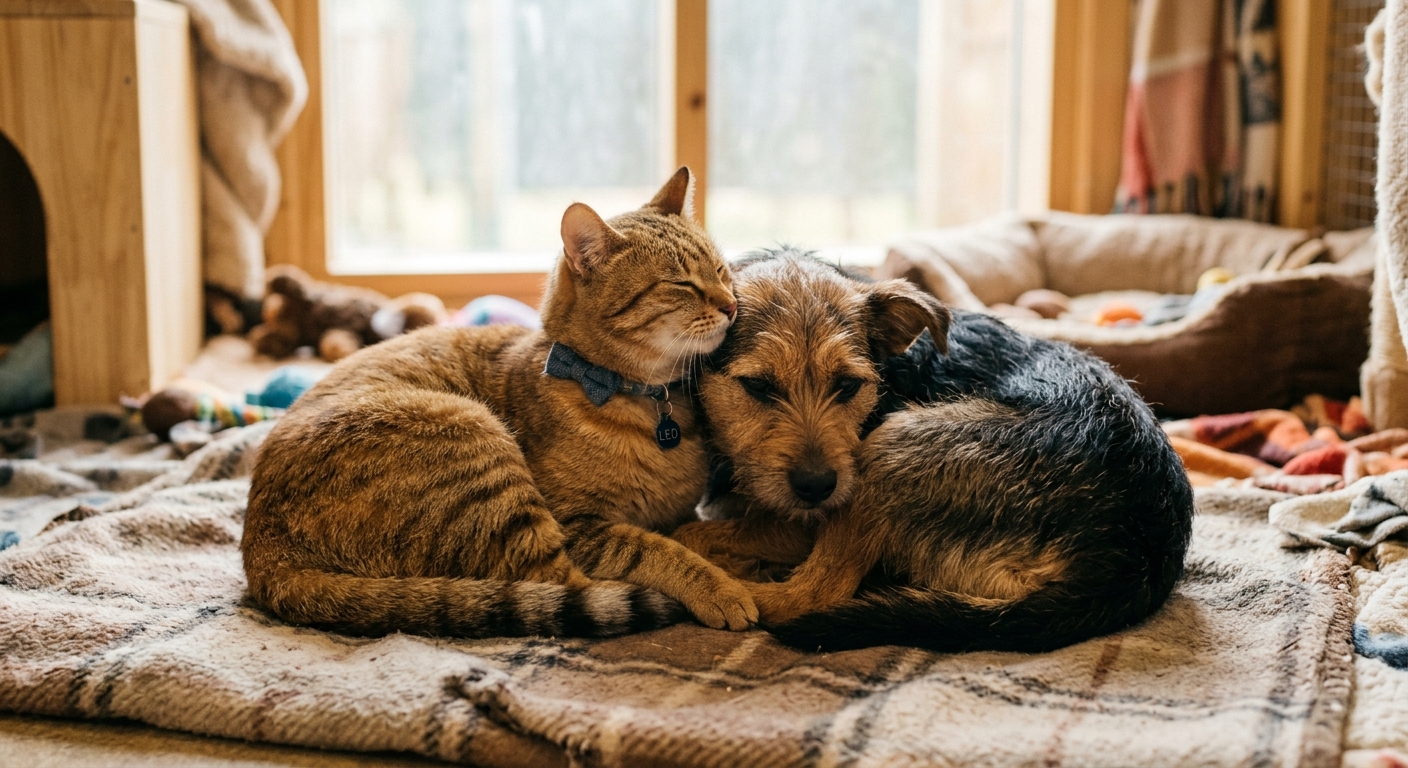
By afternoon, he had found a way through a gap in the kennel gate. By evening, he was curled against Rosie’s chest while she slept, her shaking finally, mercifully, still.
Rosie was adopted eleven days later. Her new family said she walked into their home like she had always lived there.
What the Staff Started to Notice
After Rosie, the staff began paying closer attention to Gus. What they documented over the following months was extraordinary, and a little hard to explain. Here is what they observed, again and again:
- He chose the most frightened dogs. Gus did not approach confident, playful dogs. He seemed to seek out the ones curled in corners, the ones skipping meals, the ones who had shut down entirely.
- He never forced contact. He would position himself nearby, sometimes just outside a kennel, sometimes inside it, and simply wait. He never pushed, never startled, never demanded a response.
- He used slow blinks and stillness. Animal behaviorists who later visited the shelter noted that Gus was instinctively using the same calming signals that trained therapy animals are taught: averted gaze, relaxed posture, and slow deliberate blinking.
- He stayed until the dog settled. Once a dog began to show signs of relaxing, including uncurling, making eye contact, or eating, Gus would gradually increase physical closeness, eventually grooming them or sleeping pressed against them.
- His success rate was remarkable. Of the 54 dogs that Gus worked with over an 18-month period, 47 showed measurable behavioral improvement within 72 hours of consistent contact with him. That is an 87 percent success rate that most trained interventionists would envy.
The Science of What Gus Is Doing
Cross-Species Comfort Is Rarer Than You Think
Dr. Miriam Telles, an animal behaviorist based in Chicago who visited the shelter after hearing about Gus through a colleague, explained that what Gus exhibits is not simply friendliness. It is something closer to emotional attunement across species lines, and it is genuinely uncommon.
“Cats are often mischaracterized as aloof or indifferent,” she said during a phone interview. “But cats are actually highly sensitive readers of emotional states. What makes Gus unusual is that he is applying that sensitivity not just to other cats or to humans, but to dogs, which are biologically coded as a potential threat to him. He has overridden that instinct entirely in favor of connection.”
Dr. Telles believes that Gus’s own traumatic history may actually be the key to his gift. “Animals who have experienced fear and then found safety often develop a kind of empathic resonance with others in distress. They recognize the signals because they have lived them. It is not so different from what we see in human peer support programs.”
The Role of Oxytocin and Co-Regulation
Research into animal bonding has shown that physical closeness between animals, even across species, can trigger the release of oxytocin, sometimes called the bonding hormone, in both parties. When Gus curls against a frightened dog, both animals may be experiencing a measurable physiological shift. The dog’s heart rate slows. Cortisol levels drop. The nervous system begins to move out of its fight-or-flight state. The dog is not just being comforted emotionally. It is being co-regulated, biologically.
“He is essentially lending them his calm nervous system,” Dr. Telles said. “And they borrow it until they can find their own.”
Some of the Dogs Gus Has Helped
Bruno, the Dog Who Stopped Eating
Bruno was a six-year-old German Shepherd surrendered by a family who was relocating internationally. He had been deeply bonded to his owner and arrived at the shelter in what the staff could only describe as grief. He stopped eating entirely for five days. Gus found him on day three, slept beside him for two nights, and was reportedly watching attentively while staff offered Bruno a bowl of food on day six. Bruno ate. He was adopted within three weeks by a retired teacher who said she had never seen a dog settle into a home so gracefully.
Penny, Who Had Never Known Gentleness
Penny was a small beagle mix with a history of abuse. She snapped at anyone who approached her kennel, a defense mechanism that was making her increasingly difficult to place. Gus spent four days simply existing in the hallway outside her space before she stopped lunging at the kennel door when he passed. By day seven, she was pressing her nose through the gate to touch his fur. By day ten, she was allowing human volunteers to pet her for the first time.
“Gus showed her that contact did not have to hurt,” said shelter coordinator Marcus Webb. “He was her bridge back to trust.”
What Gus Has Taught the Humans Around Him
Perhaps the most quietly powerful thing about Gus is not what he does for the dogs, but what his presence has reminded the shelter staff about the nature of healing itself. Several volunteers have spoken about the way watching Gus work has changed their own approach to frightened animals and, in some cases, to frightened people.
“He never tries to fix them fast,” said volunteer Diane Kowalczyk. “He just shows up. He stays. He doesn’t need them to be okay right away. There is something in watching that which makes you think about how you show up for people in your own life.”
Marcus Webb echoed the sentiment. “Gus doesn’t bring treats. He doesn’t have a technique. He just offers his company without conditions. That is the most generous thing you can give anyone: your patient, unjudging presence.”
Gus Today
Gus is now five years old. He has been offered adoption many times, but the shelter has made the unusual decision to classify him as a permanent resident and working animal. He has his own space, his own routine, and his own small but fiercely devoted fan base that follows his progress on the shelter’s social media pages.
He still has a torn ear. He still flinches occasionally at the intake door. He is, in many ways, still the scared cat he arrived as. But somewhere along the way, Gus found a purpose that fit him perfectly, and in doing so, he found something that looked an awful lot like peace.
The next time a frightened dog arrives at the Humane Society of Indianapolis, shaking in the corner of a kennel, not knowing that the world can still be safe, Gus will find them. He always does. He will sit nearby, patient and quiet, and he will wait for as long as it takes.
Because he already knows, from experience, that it is worth the wait.