🎧 Listen to this story
Narrated by Iapetus · 7,738 characters
A Discovery That Rewrote the Map
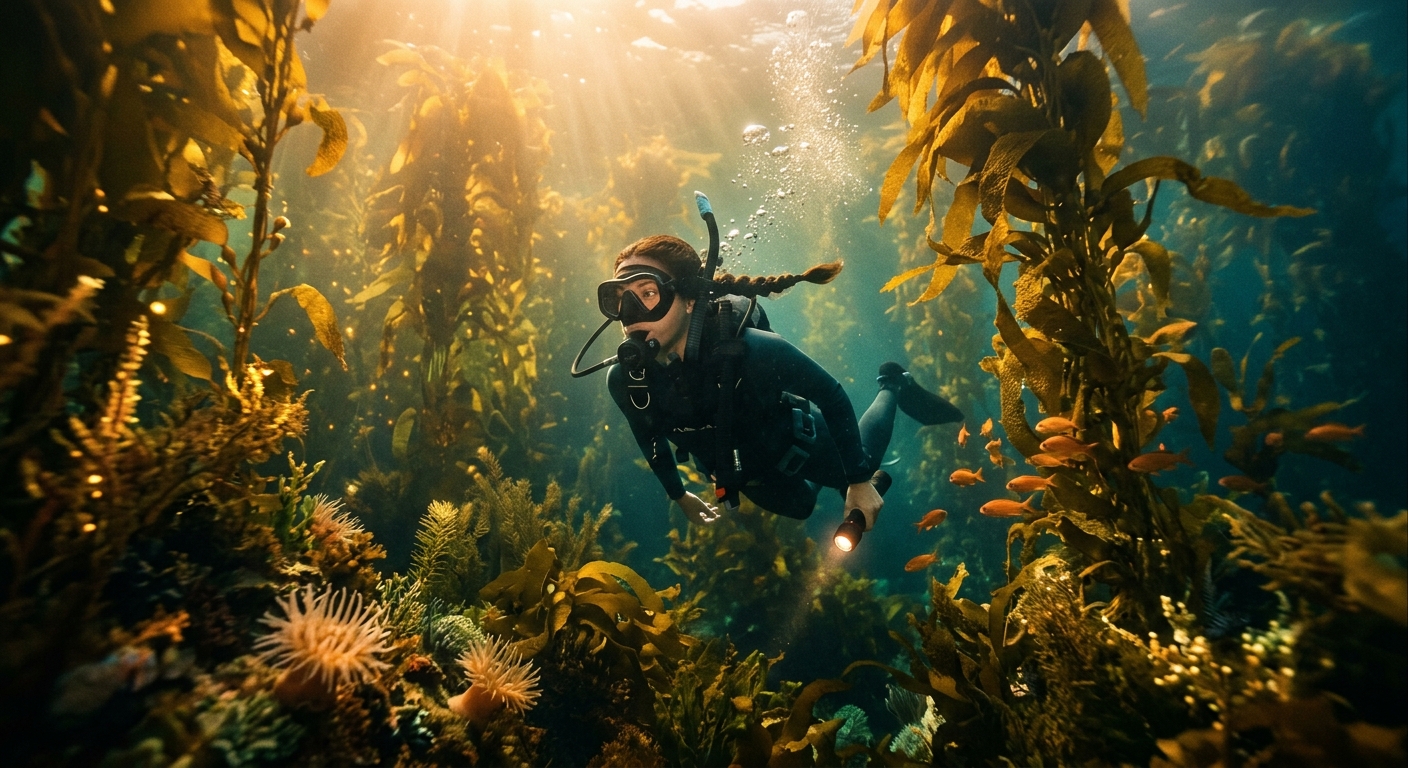
In the spring of 2022, marine biologist Dr. Cara Parsons strapped on her oxygen tank, checked her dive computer, and slipped beneath the surface of the Atlantic Ocean off the coast of southern Portugal. She had done this thousands of times. But this time, roughly forty meters below the surface, she saw something that made her stop breathing for a moment, not from lack of air, but from pure, unfiltered wonder.
An underwater forest stretched before her, vast and swaying, populated by towering kelp and ancient coral formations draped in sea fans that nobody had ever catalogued. It was alive in every direction. Fish darted through cathedral-like columns of seaweed. Crabs picked their way across the rocky floor. And somewhere in the middle of it all, Dr. Parsons floated completely still, realizing that she was the first human being to ever look at this place.
“I just hovered there for a long time,” she later told a gathering of researchers at the Oceanic Institute in Lisbon. “I kept thinking: how long has this been here? Who else has this kept secret?”
The Journey That Led to the Discovery
Dr. Parsons did not set out to find a hidden forest. She was three years into a longitudinal study tracking temperature changes in deep Atlantic waters, a slow and often tedious project funded by a small coastal conservation nonprofit. The discovery was, in her own words, “a beautiful accident born from stubborn curiosity.”
Her research vessel had been anchored in an area typically bypassed by commercial shipping routes, which partly explained why the region had never been thoroughly surveyed. Sonar readings had flagged an unusual density of organic matter on the seafloor, which Parsons initially dismissed as equipment interference. But something nagged at her.
“There was a pattern to the readings,” she said. “Interference looks random. This looked deliberate. Like something was growing.”
She convinced her small crew of two to hold position for an extra day. She dove alone, which was technically against protocol but completely in character for a scientist who had once camped on a research buoy for six days to observe blue whale feeding patterns. What she found at the bottom was not just a patch of kelp. It was an ecosystem spanning what she later estimated to be nearly four square kilometers, completely hidden from satellite mapping by its depth and the unusual light-diffusing properties of the water column above it.
What Lives in the Hidden Forest
Over the following six months, Dr. Parsons returned to the site eleven more times, bringing marine ecologists, underwater photographers, and taxonomists. The cataloguing process revealed something remarkable: the forest was not just unknown to humans. In many ways, it appeared to be operating on its own entirely isolated evolutionary track.
Species New to Science
Among the most startling findings were three species believed to be entirely new to science:
- A translucent eel-like fish roughly sixty centimeters long, with bioluminescent markings along its spine that pulsed in a rhythm scientists have not yet fully decoded
- A species of soft coral with a structural composition unlike anything in existing taxonomic records, its skeleton made partially of a silica-based compound not previously observed in Atlantic coral
- A type of isopod, a small crustacean relative, found clustered around the base of the kelp columns in numbers that suggest they may be a keystone species in the ecosystem’s food web
The Age of the Forest
Core samples taken from the oldest coral formations suggest that sections of this underwater forest may be between 180 and 230 years old, meaning it has existed through industrial revolutions, world wars, and decades of aggressive deep-sea trawling that has devastated similar ecosystems elsewhere. The question researchers are now asking is not just what this forest is, but why it survived when so many others did not.
The leading theory involves the geography of the surrounding seafloor, which creates a natural current buffer around the site, essentially a calm eddy within an otherwise churning ocean environment. This may have protected the forest from both physical disturbance and the warming water temperatures that have bleached and collapsed reef systems across the globe.
What This Means for Ocean Conservation
The discovery has rippled through the marine science community with an energy that feels almost like relief. In an era defined by loss, by vanishing species and collapsing ecosystems and oceanic dead zones, the existence of an untouched underwater forest feels like a message from the planet. Something like: there is still more here than you know.
Dr. Sylvie Marceau, a coral reef ecologist at the University of Bordeaux who was not involved in the initial discovery, put it plainly: “This is not just a scientific find. It is a conservation argument. If this can exist undiscovered and undisturbed, then we have to ask how many others are out there, and what we can do to make sure they stay that way.”
The Portuguese government, in response to the discovery, has moved quickly to designate the area as a Marine Protected Zone, a classification that restricts commercial fishing, deep-sea mining exploration, and unauthorized diving. Conservation organizations are now lobbying for an expanded buffer zone around the perimeter.
Dr. Parsons on What the Ocean Still Hides
In a recent interview, Dr. Parsons was asked whether she thought discoveries like this would become more or less common as ocean exploration technology advanced. She paused for a long moment before answering.
“Both,” she said. “Better technology means we will find things faster. But the ocean is so large, and funding for exploration is so small, that honestly, I think we are just scratching the surface. There are places on this planet that no human eye has ever reached. Not a diver, not a submarine, not a camera. And in those places, life is just going about its business, completely indifferent to whether we ever find it or not.”
She smiled. “I find that incredibly comforting.”
7 Things We Can Learn From This Discovery
- Curiosity is a scientific instrument. The discovery happened because one researcher followed a nagging feeling rather than dismissing it.
- The unknown is not the same as the nonexistent. Just because something has not been mapped does not mean it is not there.
- Isolation can be protection. The forest survived precisely because it was overlooked, a lesson that applies to ecosystems and communities alike.
- Small teams with limited funding can make enormous discoveries. This was not a billion-dollar expedition. It was a stubborn scientist and a two-person crew who stayed one extra day.
- Nature does not wait for our permission to be extraordinary. Life has been building this forest for two centuries without any human involvement whatsoever.
- Conservation arguments are strongest when they are concrete. An actual living forest is a more powerful case than any statistic.
- Wonder is renewable. Even after thousands of dives, Dr. Parsons was still capable of being stopped cold by something beautiful.
The Forest Goes On
Today, the underwater forest that Dr. Cara Parsons stumbled into continues to grow, as it has for centuries, unhurried and unaware. The translucent fish pulse their lights through the kelp columns. The coral builds itself slowly upward in its strange silica architecture. The isopods tend the roots.
And occasionally, a small research team descends carefully through forty meters of cold Atlantic water and spends an hour watching in silence, trying to understand a world that has been here the whole time, patient enough to wait until someone finally looked.