🎧 Listen to this story
Narrated by Iapetus · 9,682 characters
A Classroom Behind Bars, A Life Beyond Them
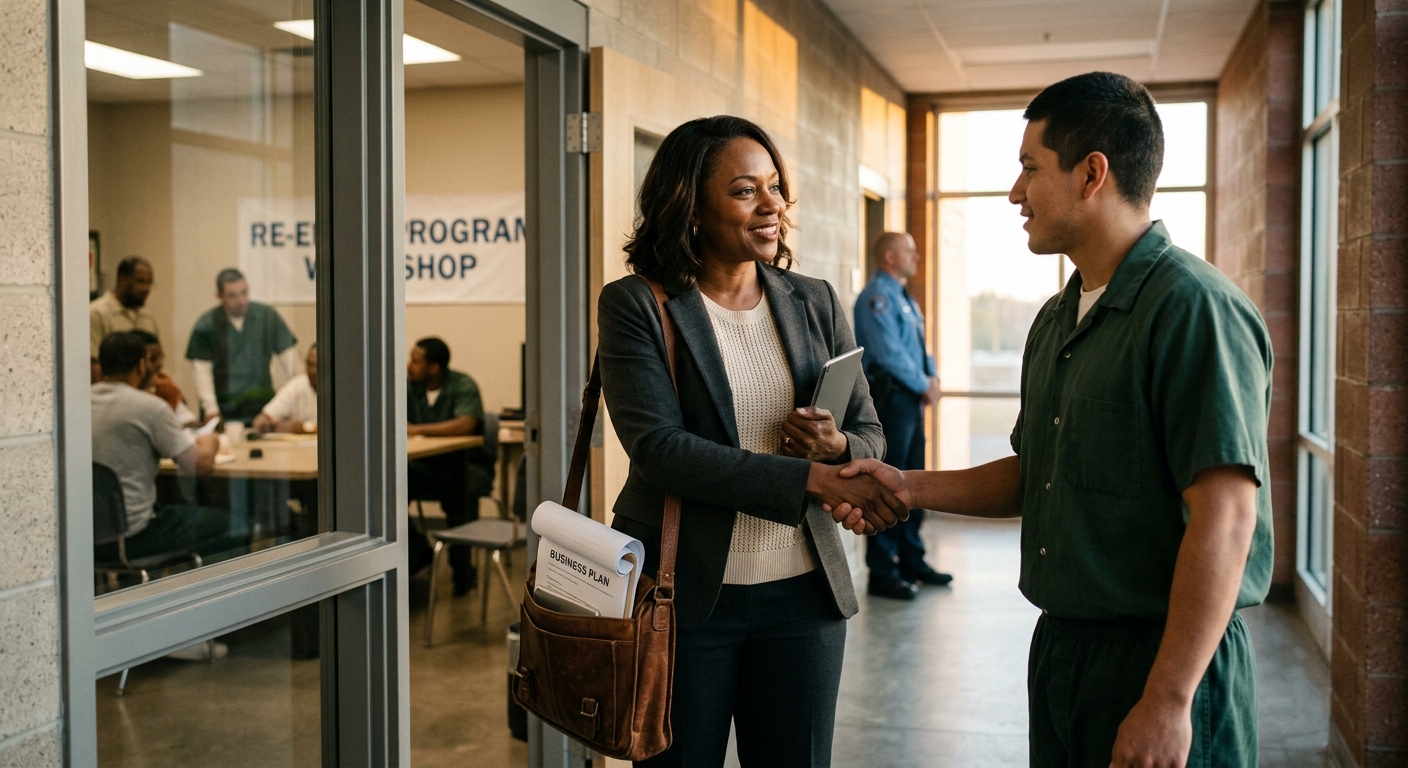
Every Tuesday morning, Linda Vasquez packs a canvas tote with printed worksheets, a portable whiteboard marker set, and a thermos of coffee she knows she will barely touch. She drives forty minutes from her home in Sacramento to the California Institution for Women in Corona, where she spends the next six hours teaching a room full of incarcerated women how to write a business plan, open a bank account, register an LLC, and pitch an idea to a room full of strangers.
She does not get paid for this. She has been doing it for eleven years.
“People ask me why I keep going back,” Linda says, leaning forward in her chair during a recent conversation at a coffee shop near her home. “I tell them, because I know what it feels like to walk out of those gates with nothing but a bus ticket and a trash bag full of your stuff. I know what that moment does to a person. And I decided a long time ago that I was not going to let another woman face that alone.”
Linda was released from a federal correctional facility in 2013 after serving four years on a nonviolent drug charge. She had two daughters waiting for her, no job, no savings, and a record that slammed doors shut before she could even knock. What she did have was a stubborn refusal to accept that her story was finished.
From Inmate to Instructor: How the Program Was Born
Within eighteen months of her release, Linda had launched a small cleaning and home organization business out of her apartment. It was not glamorous work, but it was hers. She built a client list through word of mouth, reinvested every dollar she could, and within two years had hired three employees, two of whom were also formerly incarcerated women.
The idea for the program, which she eventually named Rebuilt, came from a conversation with a case manager at a transitional housing facility where she was briefly staying after her release. The case manager offhandedly mentioned that most women who cycled through the system had no financial literacy whatsoever, no understanding of credit, taxes, business registration, or even how to open a checking account without getting hit with fees they could not afford.
“I thought, someone should fix that,” Linda says. “And then I thought, why not me?”
She spent eight months developing a curriculum, consulting with a small business development center, a nonprofit attorney, and a licensed financial counselor who agreed to volunteer her time. She called in every favor she had. She photocopied workbooks at a library when she could not afford to print them. She wrote letters to the warden of the facility where she had served her sentence and asked for thirty minutes to make her case.
She got the meeting. She got approved. She started with eight students.
What the Curriculum Actually Teaches
The Rebuilt program runs for twelve weeks and covers far more than the basics of entrepreneurship. Linda designed it with the specific barriers facing formerly incarcerated women in mind, which means the curriculum addresses topics that most business courses never mention.
Module Highlights Include:
- Legal identity restoration: How to obtain a state ID, replace a Social Security card, and navigate background check disclosures when applying for licenses or loans.
- Banking for people with ChexSystems flags: Many incarcerated women have old debts or closed accounts that prevent them from opening a standard bank account. The program teaches second-chance banking options and credit union alternatives.
- Business structure basics: The difference between a sole proprietorship, LLC, and S-corp explained in plain language, with a focus on liability protection and tax implications relevant to small operators.
- Micro-loan access: An overview of CDFI lenders, nonprofit microlenders, and community development funds that do not automatically disqualify applicants based on criminal history.
- Pitching with confidence: Every cohort ends with a mock pitch competition judged by local small business owners who volunteer their time. Winners receive a small seed grant funded through private donations to Rebuilt.
“A lot of these women have been told their whole lives that they are not smart enough, not good enough, not trustworthy enough,” Linda says. “The pitch competition is not really about the money. It is about standing in front of people and saying: this is my idea, this is my plan, and I am worth betting on.”
The Women Behind the Whiteboards
In a recent cohort, participants ranged in age from twenty-three to sixty-one. Their business ideas were equally varied, including a food truck concept built around family recipes passed down from a grandmother in Oaxaca, a mobile nail salon designed to serve elderly clients in assisted living facilities, an online resale boutique, and a bookkeeping service targeting small contractors.
One participant, a woman named Deja who agreed to be interviewed but asked that her last name not be used, described the program as the first time in her life anyone had taken her ambitions seriously.
“I had this idea about starting a daycare for years,” she says. “But every time I said it out loud, people looked at me like I was joking. Linda sat with me for almost two hours one afternoon going over state licensing requirements, insurance costs, zoning rules. She did not once look at me like my dream was stupid. She looked at me like it was a math problem we just needed to solve together.”
Deja is scheduled for release later this year. She already has a business name, a draft of her licensing application, and a savings goal she has been working toward for the past eight months.
The Numbers That Matter
Recidivism statistics in the United States are grim. Roughly two thirds of released prisoners are rearrested within three years. For women specifically, economic instability is one of the strongest predictors of reincarceration. Studies consistently show that stable employment and financial agency are among the most powerful protective factors against reoffending.
Linda does not claim that Rebuilt alone solves a systemic problem. She is the first person to acknowledge the limits of what one program can do inside a machine as large as the American carceral system. But the program’s own data, tracked by a volunteer evaluator who works in social policy research, tells a meaningful story.
Of the 214 women who have completed the Rebuilt curriculum since its founding, 61 have launched a business that was still operating twelve months after release. Another 44 are employed in a field directly related to the skills they developed in the program. The three-year recidivism rate among program graduates is 19 percent, compared to a national average that hovers above 60 percent for women in similar demographic categories.
“These are not miracle numbers,” Linda says carefully. “These are women who worked incredibly hard under incredibly unfair conditions. I just handed them a map. They did the walking.”
What Gets in the Way
The program is not without friction. Facility schedules change without warning. Lockdowns cancel sessions mid-semester. Transfers move students to different facilities days before graduation. Budget constraints mean Linda still funds a significant portion of program materials out of her own pocket, supplemented by small grants and individual donors she cultivates through a modest newsletter and social media presence.
There is also the emotional weight of the work itself. Linda forms real bonds with the women in her cohorts, and not every story ends well. She has watched graduates relapse, return to abusive relationships, and in some cases, return to prison. She keeps a journal. She has a therapist. She has learned, slowly and imperfectly, how to hold hope and grief at the same time.
“You cannot do this work if you need every story to have a happy ending,” she says. “You have to love people at the beginning, not just when they succeed. That is the hardest part. It is also the most important part.”
How to Support Programs Like Rebuilt
If Linda Vasquez’s work resonates with you, here are concrete ways to support similar initiatives in your own community:
- Search for reentry entrepreneurship programs through your local Small Business Development Center or SCORE chapter and ask how you can volunteer as a mentor or pitch judge.
- Donate to organizations like Prison Entrepreneurship Program, Defy Ventures, or The Center for Employment Opportunities, all of which operate evidence-based models with measurable outcomes.
- If you are a business owner, consider explicitly welcoming applications from individuals with criminal records and posting your hiring policy publicly.
- Advocate for fair chance licensing reform in your state, which would remove automatic occupational license bans for people with past convictions.
A Future That Belongs to Them
On the last day of each cohort, Linda does something she has done since the very first graduating class: she asks every woman to write one sentence on a notecard describing what she is going to build. The notecards go into a box she keeps on a shelf in her home office. She does not read them right away. She saves them for the days when the funding falls through, or a woman she believed in does not make it, or the bureaucracy feels too large and too indifferent to fight.
On those days, she opens the box and reads.
“I am going to open a bakery and hire my sister.”
“I am going to be the first person in my family to own something.”
“I am going to show my kids what I am made of.”
Linda folds each card carefully and puts it back. Then she picks up her tote bag, fills her thermos, and gets ready for Tuesday.