
🎧 Listen to this story
Narrated by Vindemiatrix · 7,443 characters
The Phone Rings at 6 AM. He Always Answers.
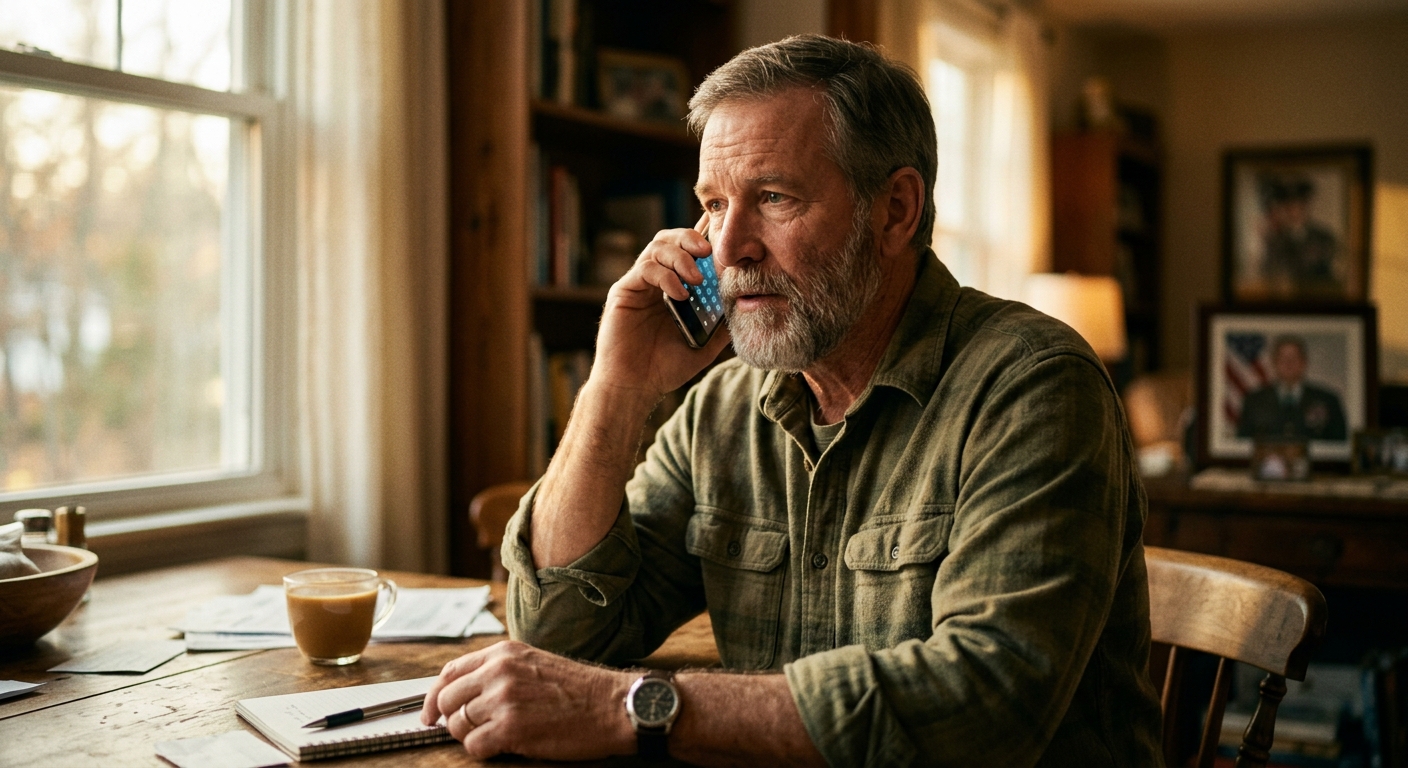
Most people silence their phones before bed. Earl Hutchins, 67, a retired Army staff sergeant from Knoxville, Tennessee, keeps his ringer on full volume, all night, every night. He has for the past eleven years.
“I know what it feels like to call for help and get a voicemail,” he says, sitting at a small kitchen table covered in sticky notes, printed forms, and a well-worn copy of the VA Benefits Manual. “So I made a decision a long time ago. If a veteran calls me, I pick up.”
Earl is not a licensed counselor. He does not work for the Department of Veterans Affairs. He holds no official government position and receives no salary for the hundreds of hours he spends each year guiding other veterans through one of the most notoriously complex bureaucracies in the United States. He is simply a man who learned the hard way, and decided that no one else should have to.
A System That Humbles Even the Toughest Soldiers
Earl served two tours in Vietnam and one in the Gulf War. By his own account, he came home each time carrying things that were never fully unpacked. For years, he did what many veterans of his generation did: he pushed through, stayed quiet, and convinced himself he was fine.
When he finally sought help from the VA in 2003, he was anything but prepared for what awaited him.
“I walked in thinking, I served my country, they’ll take care of me,” he recalls. “What I got was a stack of paperwork three inches thick, appointments scheduled six months out, and a clerk who looked at me like I was bothering her.”
Earl’s first claim for disability benefits was denied. His second was partially approved, then stalled. He missed deadlines he didn’t know existed. He filed forms in the wrong order. He sat in waiting rooms for hours only to be told he needed a different form from a different office in a different building across town.
“It took me four years to get what I was owed,” he says quietly. “Four years. And I’m an educated man. I can read. I can advocate for myself. What about the guys who can’t?”
That question changed the direction of Earl’s life.
One Veteran, One Phone Number, One Promise
It started informally, the way most meaningful things do. A neighbor’s son came home from Iraq in 2008 with a traumatic brain injury and no idea how to file for VA benefits. Earl helped him. Word spread. Another veteran called. Then another.
Earl printed business cards at the local office supply store. They read, simply: Earl Hutchins, Veteran. Call me. I’ll help.
Today, he estimates he has personally assisted over 400 veterans in navigating the VA system. He helps them file initial claims, understand denial letters, request appeals, locate specific medical programs, and connect with legal aid organizations when their cases require formal representation. He spends an average of three to four hours per veteran, across multiple calls and sessions.
He keeps a binder on every person he works with.
“I don’t forget anyone,” he says, tapping a shelf lined with identical blue binders. “These are real people. They gave years of their lives. The least I can give them is my attention.”
What He Has Learned About Navigating the VA
Over more than a decade of hands-on advocacy, Earl has developed a practical, hard-won understanding of how to move through the VA system effectively. When asked to share his most important lessons, he offered the following:
- Document everything, always. Every call, every appointment, every letter received or sent. “The VA loses paperwork. That’s just a fact. If you don’t have a copy, it didn’t happen.”
- Know the difference between a claim and an appeal. Many veterans give up after a denial without realizing they have the right to appeal, and that the appeals process has a higher success rate than the initial claim for many conditions.
- Use your VSO. Veterans Service Organizations like the American Legion, VFW, and Disabled American Veterans provide free accredited claims agents who can file on your behalf. “Most veterans don’t even know this exists.”
- Request a copy of your own C-file. This is the VA’s complete record of your case. Reviewing it often reveals errors, missing documents, or overlooked service records that explain a denial.
- Mental health benefits are real benefits. Earl says this is the one he repeats most often. “So many guys come to me saying they only want to file for a physical injury. And I ask them, how are you sleeping? How are your relationships? PTSD is a compensable condition. You deserve that help too.”
- Don’t wait for a crisis to reach out. The earlier a veteran engages with the system, the better the outcome tends to be. Waiting until things fall apart makes everything harder.
The Calls That Stay With Him
Earl is careful about privacy and never shares names. But he speaks freely about the nature of the calls that hit hardest.
“I’ve had veterans call me from their cars because they didn’t want their families to hear them asking for help,” he says. “I’ve had guys call me at two in the morning, not because they had a VA question, but because they needed someone to talk to first. And I’ve had calls where I stayed on the phone for two hours because I didn’t want to be the last person who didn’t answer.”
He pauses for a moment before continuing.
“We train these men and women to never show weakness, to push through, to keep moving. And then we hand them a 40-page form and say good luck. Something is wrong with that picture.”
Earl connects veterans in crisis with the Veterans Crisis Line, 988 then press 1, and keeps the number written on a card taped to the wall beside his phone.
What the Veterans He Has Helped Say
Marcus, 34, a Marine Corps veteran from Georgia, found Earl through a Facebook group for veterans in 2021. He had been trying to appeal a denied PTSD claim for two years and was ready to give up.
“He walked me through every single step,” Marcus says. “He knew which forms to file, in what order, with what supporting evidence. He even helped me understand how to describe my own symptoms in a way that matched the VA’s rating criteria. I got approved six months later. Sixty percent disability rating. That monthly compensation is the difference between keeping my apartment and not.”
For Marcus, and for so many others, Earl’s help was not just practical. It was personal.
“He never made me feel like a burden,” Marcus says. “He made me feel like someone who deserved to be taken care of. That sounds simple, but after years of fighting that system alone, it meant everything.”
A Legacy Built One Conversation at a Time
Earl has no plans to stop. His wife, Loretta, long ago accepted that the kitchen table belongs half to their marriage and half to veterans she will never meet. She jokes that she married a man and ended up sharing him with the United States Army, twice.
He has started mentoring a small group of younger veterans who want to learn how to do what he does, building a quiet, informal network of people who know the system and are willing to share that knowledge freely.
“The VA is not the enemy,” he says, a point he makes carefully. “It’s a system, and systems can be navigated if you know how. My job is to help people know how.”
He glances at his phone, habit more than distraction.
“Somebody out there is about to make a call they’re terrified to make. And when they do, I want them to hear a real voice on the other end.”
The ringer stays on.