
🎧 Listen to this story
Narrated by Iapetus · 8,288 characters
Every Summer, She Shows Up
For most people, summer is a season of vacation, rest, and escape. For Linda Graves, it has meant something else entirely for the past two decades: folding tables, sunscreen donations, borrowed canoes, and the sound of children laughing who might not have had much else to laugh about that season.
Linda, a retired schoolteacher from rural Tennessee, has organized a completely free summer camp for low-income children every single year for 20 consecutive years. No corporate sponsor anchoring the whole operation. No government grant keeping the lights on. Just one woman, a community that slowly learned to believe in her, and an unshakable conviction that every child deserves a real summer.
This is her story, told through the years, the setbacks, and the small miracles that kept it all alive.
How It Started: A Conversation She Could Not Forget
Linda traces everything back to a single moment in the summer of 2004. She was still teaching fifth grade at the time and ran into one of her students at the local grocery store in late July. The boy, Marcus, was still in his pajamas at noon, looking bored and a little lost.
“I asked him what he’d been up to all summer,” Linda recalls. “He said, ‘Nothing, Ms. Graves. There’s nothing to do.’ And the way he said it, it wasn’t complaining. It was just a fact. Like he’d accepted it.”
That conversation sat with her. She started asking around and learned what many educators quietly already knew: for children in low-income households, summer is often less of a break and more of a gap. A gap in meals, in structure, in stimulation, in safety. Research backs this up, showing that low-income students can lose significant academic ground over the summer months, a phenomenon known as the “summer slide.” But Linda was not thinking about data that afternoon. She was thinking about Marcus’s face.
By the following spring, she had secured use of a local church’s outdoor grounds, gathered supplies from donations, recruited three friends to volunteer, and registered 14 children for what she called Camp Brightfield. She had no idea it would still be running 20 years later.
What Camp Brightfield Actually Looks Like
Do not picture a polished, well-funded retreat with matching T-shirts and a glossy brochure. Camp Brightfield is something better: it is scrappy, warm, and real.
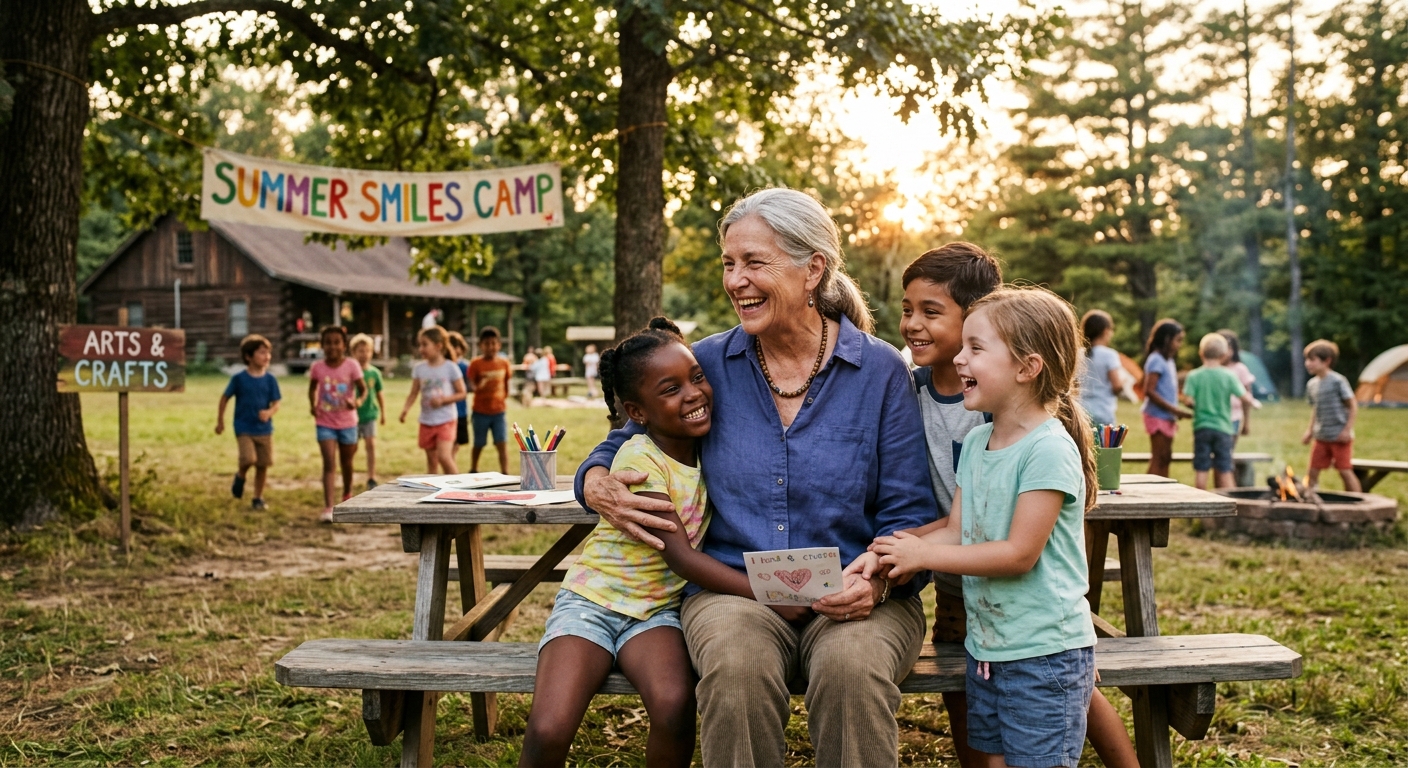
Each summer, the camp runs for three weeks in July, Monday through Friday, from 8 a.m. to 4 p.m. Children between the ages of 6 and 14 attend at absolutely no cost. Lunch is provided every day, funded through donations from local restaurants and grocery stores. Over the years, the camp has grown from those original 14 children to an average of 85 to 100 campers each session.
A Typical Day at Camp Brightfield
- Morning Circle: The day begins with everyone gathered together, sharing something they are grateful for or looking forward to. Linda says this ritual took years to feel natural, but now the kids remind the counselors if it gets skipped.
- Skill Workshops: These rotate weekly and have included woodworking, watercolor painting, basic coding, cooking, gardening, and even beginner journalism where kids write a one-page camp newspaper.
- Outdoor Activity Block: Swimming (at a local pool whose manager has donated time for 15 years), hiking, relay races, and nature walks.
- Reading Hour: Every child chooses a book from a donated lending library and keeps it at the end of the summer.
- Afternoon Free Time: Unstructured play, which Linda considers just as important as anything else on the schedule.
“Kids need to be bored sometimes,” she says with a laugh. “Real boredom, not the kind that comes from having nothing and nowhere. The kind where you figure out how to make something out of what’s around you. That’s where imagination lives.”
The Year It Almost Ended
Not every summer came easily. In 2011, the church that had hosted Camp Brightfield for seven years underwent major construction and could no longer offer the space. Linda found out in March, giving her just three months to find a new venue, reassure families, and keep her volunteer team from scattering.
“I cried for about two days,” she admits. “Then I made a list.”
That list became a series of phone calls, knocks on doors, and conversations with anyone who would listen. A local farmer named Gene Whitfield heard about her situation through a mutual acquaintance and offered six acres of his property, including a barn that could serve as a rain shelter, for the rest of the summer, free of charge. He has renewed that offer every year since.
“Gene saved this camp,” Linda says flatly. “He didn’t make a big deal about it. He just said yes.”
The Volunteers Who Make It Work
Linda is quick, almost insistent, about one thing: she did not do this alone. Over 20 years, more than 300 volunteers have served at Camp Brightfield. High school students earning service hours. College students studying education or social work. Retired nurses who run basic health workshops. Local tradespeople who show up on weekends to teach the woodworking sessions.
Several former campers have returned as teen counselors, which Linda calls the detail that makes her most proud.
“When a kid who came here at age seven shows back up at seventeen to help run the swimming activities, that tells you everything,” she says. “It means something stuck. It means they felt something here worth coming back to.”
What Volunteers Say About the Experience
We spoke to three long-term volunteers to understand what keeps people coming back year after year.
Diane, a retired nurse who has volunteered for 11 years: “I started because a friend dragged me along one summer. I stayed because of the kids. You see a child who came in shy and closed off by the end of week one doing a little performance in front of the whole camp. You don’t walk away from that.”
James, a high school teacher who volunteers each July: “It recharges me every year. I get to see kids engage with learning in a setting where there’s no pressure, no grade, no consequence. Just curiosity. I try to carry that energy back into my classroom in September.”
Priya, a former camper turned junior counselor: “I came here when I was eight because my mom couldn’t afford anything else for the summer. I didn’t know that then. I just knew it was the best part of my year. Now I want to be that for someone else.”
What 20 Years of Summers Has Taught Her
Linda turned 67 this spring. She still runs every logistics meeting, still personally calls every family on the registration list to make sure no one slips through, and still shows up on day one with homemade banana bread for the volunteers. But she also knows the camp needs a future beyond her.
She has spent the past two years quietly training a small leadership team to eventually take over operations. There are now bylaws, a nonprofit filing, and a modest savings account built from community fundraisers. The scrappy charm of Camp Brightfield is not going anywhere. But its survival will not hinge on one person’s energy anymore.
When asked what she has learned from two decades of doing this, Linda pauses for a long moment before answering.
“I’ve learned that most people want to help. They just need someone to show them where to stand. I’ve learned that kids are far more resilient and creative than we give them credit for, but that doesn’t mean they don’t need support. And I’ve learned that the small things matter more than the grand gestures. A book a kid gets to keep. A week where they ate lunch every day without worrying. A summer where someone looked them in the eye and said, ‘You belong here.'”
A Legacy Counted in Summers, Not Statistics
It would be easy to frame Linda Graves’s work in numbers. Roughly 1,600 children served. Over 300 volunteers mobilized. 20 consecutive years without cancellation. But the real measure of Camp Brightfield lives somewhere harder to quantify: in the adults those children are becoming, in the memories that outlasted the summer heat, in the simple, radical idea that no child should spend three months feeling like they are on the outside of something good.
Linda does not think of herself as extraordinary. She thinks of herself as someone who made a list and kept showing up.
Sometimes, that is exactly enough.