
🎧 Listen to this story
Narrated by Sadachbia · 9,969 characters
The Moment Everything Changed
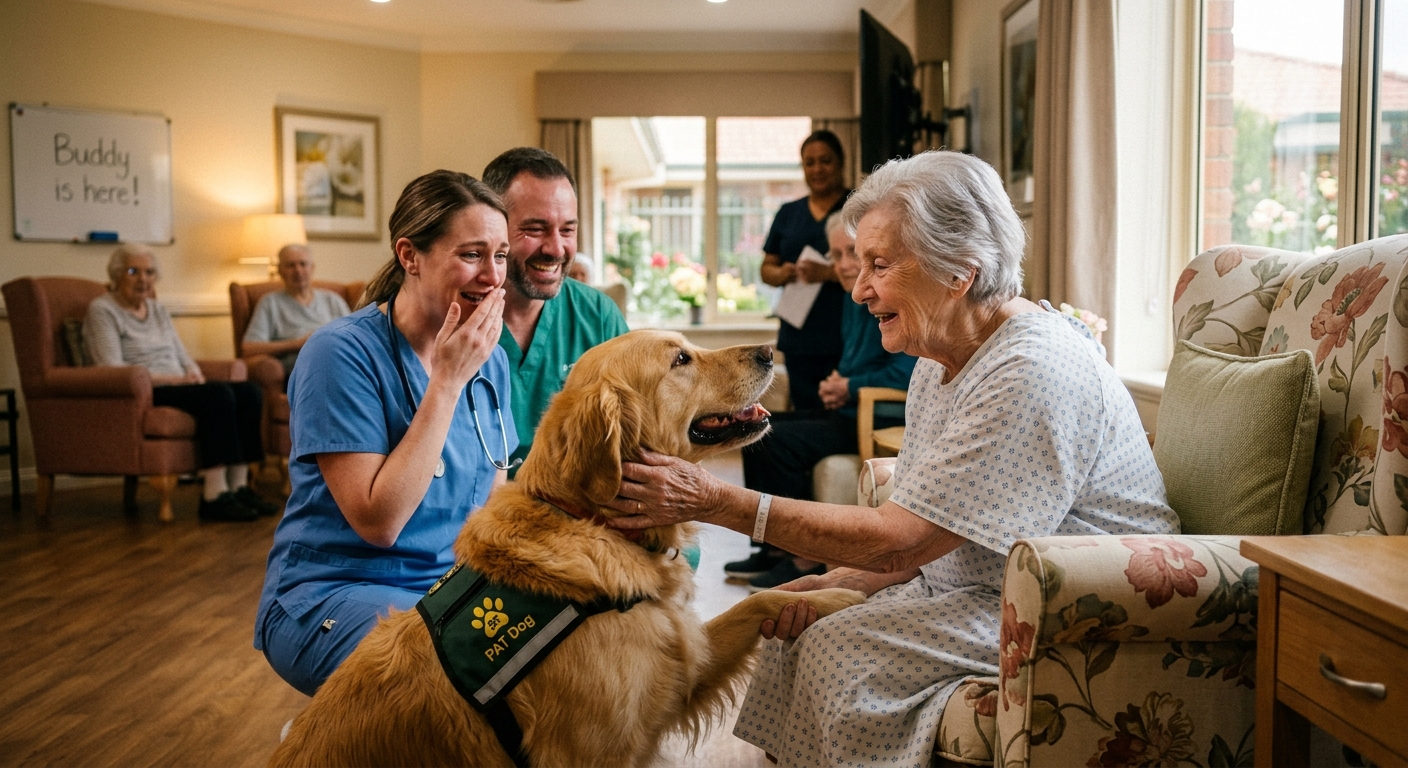
It started on a Tuesday morning in a memory care unit in Portland, Oregon. A certified therapy dog named Biscuit, a three-year-old golden retriever with a perpetually wagging tail and an almost supernatural calm, walked through the doors of Cedarwood Nursing and Rehabilitation Center for the first time. The staff had modest expectations. Maybe a few residents would smile. Maybe someone would reach out to pet him.
What they did not expect was for Margaret, an 84-year-old woman with advanced dementia who had not spoken a coherent sentence in nearly eight months, to look directly at Biscuit, reach out her hand, and say clearly: ‘Beautiful dog. I had one just like you.’
The charge nurse, who witnessed it, said she had to step into the hallway to collect herself. ‘We had tried everything,’ she recalled. ‘Music, photographs, familiar objects. Nothing reached her the way that dog did in under thirty seconds.’
This was not a miracle. It was science.
What Researchers Have Actually Found
Animal-assisted therapy, or AAT, has been the subject of growing academic interest over the past two decades. What began as anecdotal observation has evolved into a robust body of peer-reviewed research with findings that continue to surprise even seasoned clinicians.
The Oxytocin Connection
One of the most significant discoveries involves oxytocin, sometimes called the ‘bonding hormone.’ Research published in the journal Frontiers in Psychology confirmed that human-animal interaction triggers measurable releases of oxytocin in both the person and the animal. For elderly residents who may experience limited physical affection or meaningful social contact, this neurochemical response is not trivial. It is physiologically transformative.
Dr. Sandra Barker, director of the Center for Human-Animal Interaction at Virginia Commonwealth University, has spent decades studying this phenomenon. Her team found that even brief, structured interactions with therapy animals produced significant reductions in anxiety and measurable increases in positive affect among nursing home residents. ‘The body responds,’ she explained in one interview. ‘It does not forget how to respond, even when the mind has begun to fade.’
Cortisol and the Stress Response
Equally compelling is what happens to cortisol levels. Cortisol is the body’s primary stress hormone, and chronically elevated cortisol is linked to immune suppression, cardiovascular strain, disrupted sleep, and accelerated cognitive decline. Multiple studies, including a landmark 2019 review in the journal Gerontologist, found that residents in facilities with regular animal visitation programs had measurably lower baseline cortisol levels compared to control groups.
Lower stress. Stronger immune response. Better sleep. From a dog visit. The numbers make a compelling case that no administrator or policymaker can easily dismiss.
The Dementia Factor: When Nothing Else Works
Perhaps the most stunning research surrounds dementia care specifically. Alzheimer’s disease and related dementias affect an estimated 55 million people worldwide, and behavioral and psychological symptoms such as agitation, aggression, wandering, and depression remain among the most difficult to manage.
Pharmacological interventions carry significant risks for elderly populations, including increased fall risk, sedation, and paradoxical agitation. Non-pharmacological alternatives are desperately needed. This is where animal-assisted therapy has stepped into the gap in ways that are genuinely remarkable.
Key Research Findings in Dementia Care
- Reduced agitation: A study in the journal Dementia found that residents with moderate to severe dementia showed a 40 percent reduction in agitation behaviors during and after animal therapy sessions compared to baseline measurements.
- Improved appetite and nutrition: Facilities that placed aquariums with brightly colored fish in dining rooms observed significant increases in food intake among residents with dementia, a finding replicated in multiple independent studies.
- Greater social engagement: The presence of an animal consistently acts as a social catalyst, prompting residents who are otherwise withdrawn to initiate conversation, make eye contact, and engage with both the animal and the people around them.
- Autobiographical memory activation: Animals, particularly dogs and cats, frequently trigger long-term autobiographical memories in dementia patients, unlocking recollections of childhood pets and family life that remain surprisingly intact even as short-term memory deteriorates.
It Is Not Just Dogs
While therapy dogs receive most of the attention, the research extends well beyond canines. Programs involving cats, rabbits, birds, and even miniature horses have all produced documented benefits in elder care settings. Robotic animals, surprisingly, have also shown measurable effects. Studies on PARO, a therapeutic robotic seal developed in Japan, found that residents with advanced dementia who interacted with PARO showed reductions in pain indicators and improvements in mood comparable to those produced by real animal interaction. The implication is profound: something deep in human neurological wiring is activated by the presence of an animal, or even the convincing simulation of one.
The Human Side of the Equation
Numbers and studies are one thing. The daily reality inside these facilities is another. Consider what nursing home staff consistently report after animal therapy programs are introduced:
- Residents who previously refused to leave their rooms begin looking forward to visiting days.
- Family members arrive to find their loved ones more alert, more communicative, and more like their former selves.
- Staff morale improves, with caregivers reporting that witnessing resident joy during animal visits is one of the most meaningful parts of their workday.
- Difficult moments, like medication administration or physical therapy, become easier when a therapy animal is present as a calming focal point.
One certified nursing assistant at a facility in Ohio described it simply: ‘When the therapy dog is here, the whole floor changes. You can feel it. Everyone is lighter.’
The Challenges Nobody Talks About
It would be dishonest to present animal-assisted therapy as a perfect, frictionless solution. There are real logistical and ethical considerations that facilities must navigate carefully.
Allergies and phobias must be respected. Not every resident has a positive history with animals, and the program must be voluntary and sensitive to individual backgrounds. Infection control is a legitimate concern, particularly in immunocompromised populations, which is why certified therapy animal programs include rigorous health and hygiene protocols for their animals. Insurance liability, scheduling, and the volunteer coordination required to sustain these programs also place real demands on already-stretched facilities.
Animal welfare is the other side of the coin. The animals involved in these programs must be carefully monitored for stress and fatigue. Responsible programs limit session lengths, require regular health assessments, and ensure that therapy animals have ample rest and decompression time. The wellbeing of the animal is not secondary. It is foundational to the integrity of the program.
What Facilities That Get It Right Have in Common
After surveying dozens of successful animal-assisted therapy programs across North America, several consistent factors emerge among the facilities producing the best outcomes:
- Consistency: Regular, predictable visits create anticipation and routine, both of which are deeply beneficial for elderly residents, particularly those with cognitive impairments.
- Staff integration: The most effective programs train staff to continue engaging residents around their animal interactions between visits, referencing memories the resident shared and reinforcing the emotional experience.
- Family involvement: Facilities that invite family members to participate in animal therapy sessions report stronger family-facility relationships and improved family satisfaction scores.
- Resident ownership: Some forward-thinking facilities have introduced resident pets, animals that live in the facility full-time. The evidence suggests that the sustained, daily presence of an animal produces even more powerful long-term outcomes than periodic visits alone.
The Bigger Question This Raises
If the science is this clear, and the human evidence is this compelling, the natural question becomes: why is animal-assisted therapy not standard practice in every nursing home and memory care facility in the country?
The answer involves a frustrating mix of insurance coding gaps, regulatory inconsistency, underfunding, and simple institutional inertia. Advocates in the field have been pushing for formal recognition and reimbursement pathways for years. Progress is slow but real. The American Veterinary Medical Association and numerous elder care advocacy organizations have been vocal supporters of expanding access to these programs.
In the meantime, the work continues, visit by visit, dog by dog, tail wag by tail wag.
Back to Margaret
Margaret’s moment with Biscuit was not an isolated event. Over the months that followed his regular Tuesday visits, staff documented a consistent pattern. On Tuesdays, Margaret’s anxiety scores dropped. She ate more at lunch. She made eye contact with other residents. She talked about her childhood dog, a beagle named Chester, in vivid detail that astonished her family.
Her daughter, who had watched her mother disappear into the fog of dementia for three years, sat with her one Tuesday afternoon as Biscuit slept at Margaret’s feet. ‘She looked at me,’ her daughter said, ‘and she said, ‘Isn’t he wonderful?’ And for a moment, she was just my mom again.’
That is not a statistic. But it is exactly what the statistics are trying to say.