
🎧 Listen to this story
Narrated by Sadachbia · 7,705 characters
The Box That Started Everything
It began with a single cardboard box and a handwritten sign taped to the front door of a community center in Columbus, Ohio. The sign read: “Leave a gift here. A child in foster care will open it on Christmas morning.” That was eight years ago. Today, Renata Osei coordinates what has grown into a full-scale holiday gift drive that collects and distributes over 2,000 wrapped presents each December to children in the foster care system across three counties.
But ask Renata how it all started, and she will not give you the answer you expect. She will not tell you she had a master plan. She will not reference a nonprofit strategy or a mission statement. She will tell you about a girl named Maya.
The Child She Could Not Forget
Renata worked as a case manager for a county child services agency for nearly a decade. In her second year on the job, she was assigned to check in on an eight-year-old girl named Maya who had recently been placed with a new foster family. The visit was routine. The outcome was not.
“I knocked on the door on December 26th,” Renata recalls. “Maya answered in her pajamas and I asked her what Santa brought her. She looked at me very seriously and said, ‘Santa doesn’t know where I live right now.'” Renata pauses when she tells this story. “I went home that night and I couldn’t stop thinking about that sentence. Santa doesn’t know where I live right now. Because that is the reality for so many of these kids. Every time they move, the world has to find them again.”
That January, Renata started making phone calls. She reached out to churches, local businesses, school PTAs, and neighbors. She was not asking for money. She was asking for one wrapped gift per family, with a note inside. By the following December, her one cardboard box had become a collection point with 47 drop-off locations across the city.
How the Drive Works Today
What Renata built is beautifully simple in its design, which is part of why it has scaled so successfully. Here is how the annual gift drive operates each year:
- October: Renata partners with local foster care agencies to collect age ranges and general interest notes for children currently in placement. No personal information is shared, only details like “girl, age 9, loves art” or “boy, age 14, interested in music.”
- November: Drop-off locations are announced across social media, at libraries, schools, and community boards. Donors are encouraged to match a specific child profile and include a handwritten card.
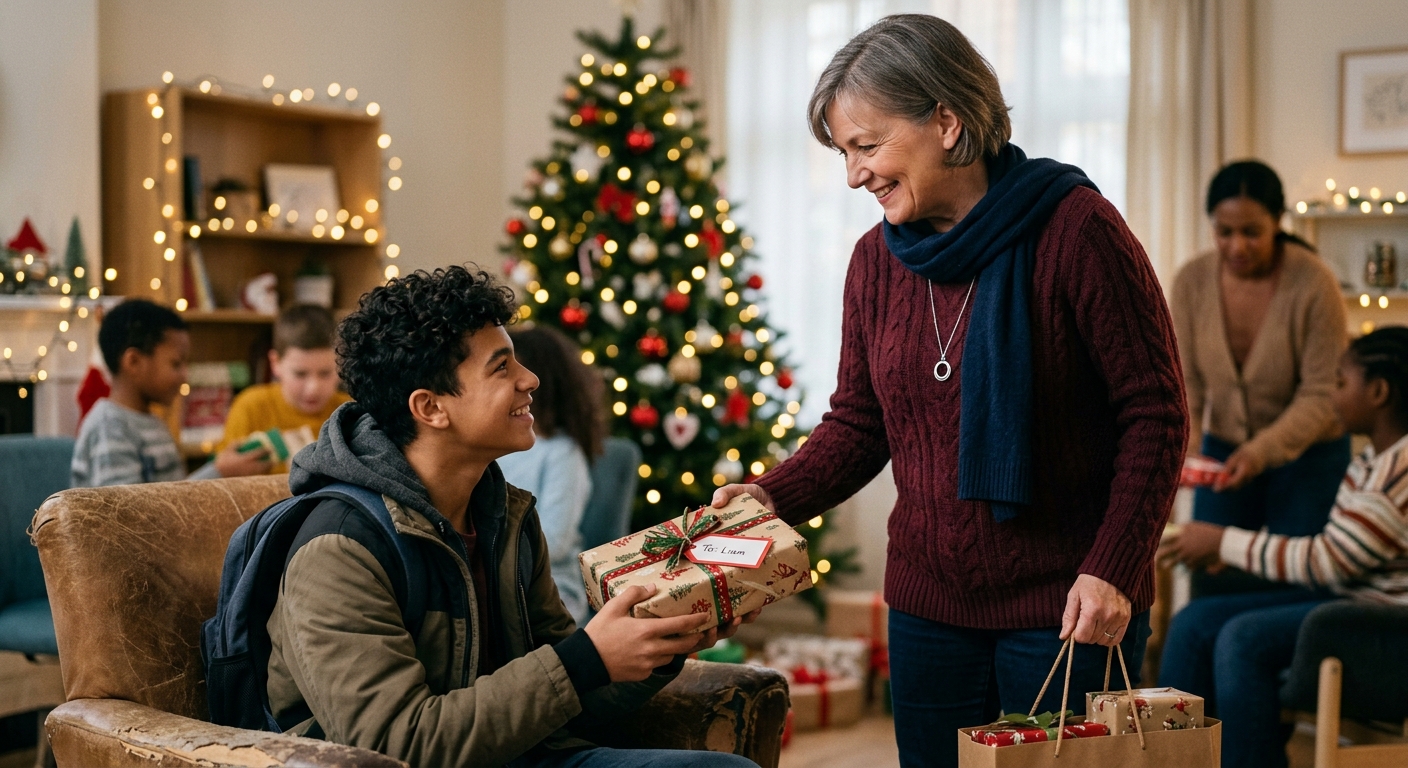
- Early December: A volunteer team of more than 80 people organizes, sorts, wraps, and labels every single gift by hand at a local warehouse space donated by a family-owned logistics company.
- December 20-22: Gifts are delivered directly to foster families and group homes, coordinated through agency liaisons who ensure every child receives at least one present.
What makes the drive different from a standard toy donation program is the intentionality behind each gift. Renata insists on the handwritten cards. She insists on the personal profiles. “I don’t want a child to feel like they got a leftover toy from a bin,” she says firmly. “I want them to feel like someone picked that gift out specifically for them. Because someone did.”
The Ripple Effect Nobody Predicted
Over the years, something unexpected began happening. Some of the donors started asking if they could do more. Volunteers who wrapped gifts in December started showing up in March to donate school supplies. A local bakery that dropped off cookies during the December sort now delivers birthday cakes to foster children throughout the year, coordinated through the same agency network Renata built.
A retired teacher named Harold, who dropped off his first gift three years ago after seeing a flyer at his barbershop, now mentors two teenagers currently in the foster system. He met them at a holiday distribution event. “I just kept coming back,” Harold says with a shrug and a grin. “Renata has a way of making you feel like your one small thing matters enormously. And then you realize it does.”
What Foster Families Want You to Know
Jennifer, a licensed foster parent who has cared for eleven children over the past six years, has received gifts from Renata’s drive multiple times. She wants the donors to understand something they might not realize from the outside.
“When a child comes into placement, especially close to the holidays, there is often very little time to prepare,” Jennifer explains. “You might get a call on December 18th that a sibling group of three is coming to stay with you. You do not have presents. You do not have stockings with their names on them. Renata’s drive fills that gap in a way that is dignified and thoughtful. The kids feel special. That matters more than people know.”
Jennifer recalls one particular morning when a seven-year-old boy in her care unwrapped a gift and found a small remote control car along with a card that read: “I hope this makes you smile. You deserve to have a great holiday. Merry Christmas, from a neighbor who cares.” The boy read the card three times. Then he folded it carefully and put it in his pocket. He carried it with him for weeks.
The Harder Truth Behind the Tinsel
Renata is warm and energetic, but she is also unflinchingly honest about the systemic realities her drive exists within. She is clear that wrapping presents does not fix foster care. It does not address the trauma, the instability, or the grief that many of these children carry quietly through their childhoods.
“I am not naive,” she says. “A gift is not a solution. But belonging matters. Being seen matters. And for one morning, I want every one of these kids to wake up and know that this community sees them. That is the only thing I am trying to do.”
She advocates vocally for increased foster family recruitment, better support services for foster parents, and policy changes that would stabilize placements. The holiday drive, she says, is just the most visible piece of a much larger conversation she is trying to keep alive all year.
How You Can Help, Right Now
You do not have to be in Columbus to start something like this. Renata has fielded calls from people in fourteen different states who want to replicate her model. Her advice is always the same:
- Contact your local child services agency first and ask how they prefer to receive donations for children in care.
- Start smaller than you think you need to. One drop-off location. One agency partner. One December.
- Make it personal. The handwritten card is not optional. It is the whole point.
- Show up the following year. Consistency is what transforms a gesture into a tradition.
- Invite one other person to help you. Community compounds quickly.
If you want to connect with Renata’s drive directly, her organization accepts gift donations locally and financial contributions year-round through their community giving page, which funds birthday gifts, school supply kits, and the operational costs of the December distribution.
A Letter She Never Expected
Last February, Renata received a handwritten letter in the mail with no return address. It was from a young woman named Dani, now 19, who had spent four years in foster care as a child. She wrote that she remembered receiving a wrapped gift with a card during what she described as “the hardest Christmas of my life.” She did not remember what was in the box. She remembered the card. She had kept it.
“I just wanted you to know,” Dani wrote, “that someone found me that year. Even when I felt lost, someone found me.”
Renata keeps that letter in the top drawer of her desk. She reads it every October, right before she starts making calls again.