🎧 Listen to this story
Narrated by Vindemiatrix · 8,175 characters
A Quiet Revolution, One Seed at a Time
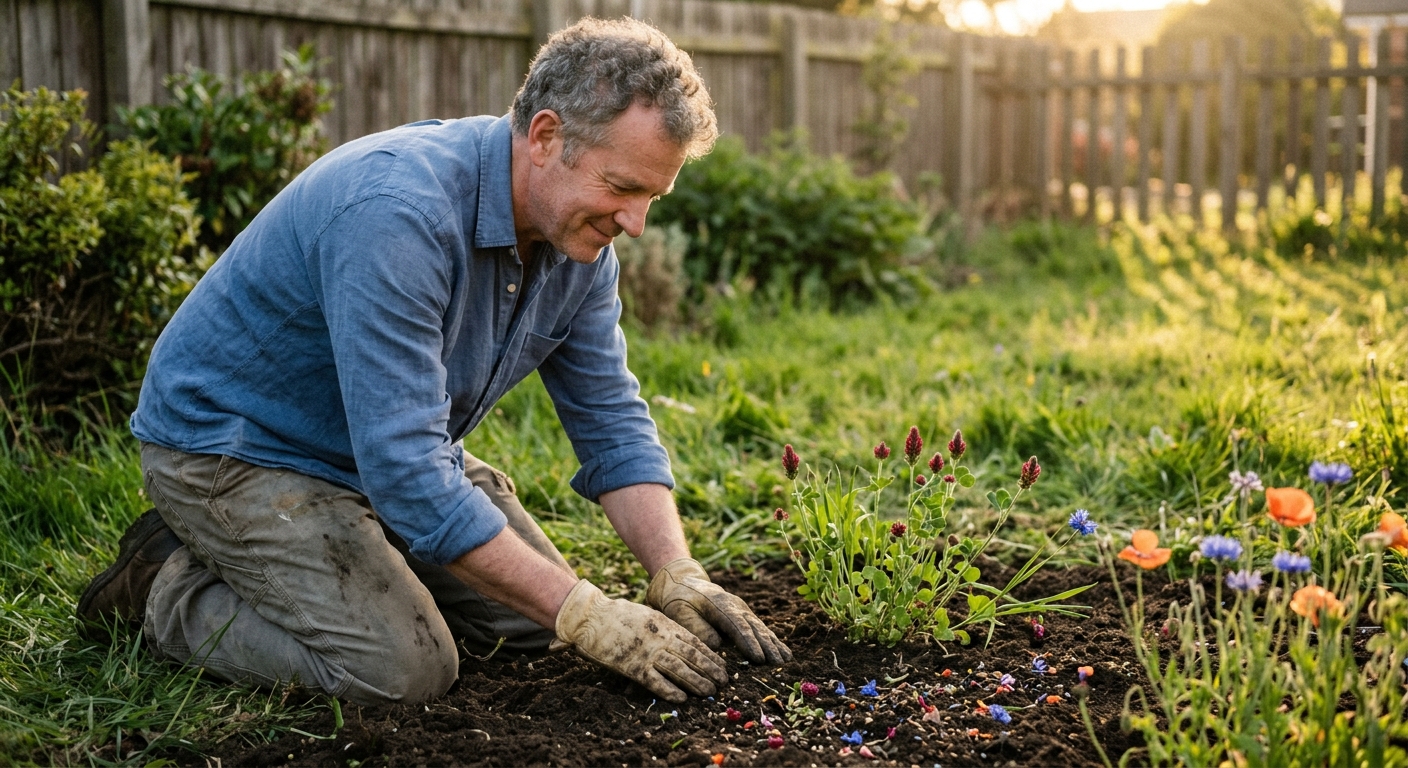
In the spring of 2019, retired schoolteacher David Calloway stood at the edge of his half-acre lot in rural Somerset, England, and made a decision that his neighbors would initially mock and eventually celebrate. He was going to tear out his manicured lawn, every blade of it, and replace it with wildflowers.
His wife thought he had too much time on his hands. His neighbor called it ‘a glorified weed patch.’ The local gardening club raised a few polite eyebrows. But David, who had spent thirty years teaching biology to teenagers, had a very specific vision in mind. He wasn’t just planting flowers. He was trying to bring something back.
‘I watched the bees disappear over the years,’ David told the Somerset Gazette in 2022. ‘When I was young, you couldn’t walk through a field without hearing them. By 2018, I’d go weeks without seeing a single honeybee in my garden. Something had to change, and I figured it had to start somewhere.’
What David Actually Did: A Step-by-Step Transformation
David’s project wasn’t random. Drawing on his biology background, he researched which native wildflowers had historically grown in his region of Somerset before industrialized agriculture changed the landscape. He consulted with conservation groups, read ecological studies, and even reached out to the UK’s Royal Horticultural Society for guidance.
His process unfolded over three growing seasons:
- Year One: Preparation. David removed the existing lawn using a combination of manual digging and a no-dig method involving layered cardboard and compost. He tested the soil for nutrients, deliberately avoiding fertilizers, since wildflowers actually thrive in low-nutrient soil that most garden plants would reject.
- Year Two: Seeding. He planted a carefully chosen mix of native species including red clover, ox-eye daisy, common knapweed, field scabious, yellow rattle, and wild marjoram. Yellow rattle was particularly strategic, as it parasitizes grasses and prevents them from overtaking the wildflowers.
- Year Three: Watching. David kept a detailed journal, photographing every new species of insect, bird, and plant that arrived without any invitation. By autumn of that third year, the journal had grown to over four hundred pages.
The Ecosystem Responded Faster Than Anyone Expected
What happened in David’s garden over those three years reads less like a gardening diary and more like a nature documentary. The wildflowers didn’t just attract bees. They triggered a cascading chain reaction that transformed the half-acre plot into something ecologists would later describe as a ‘micro-habitat corridor.’
Within the first summer, six species of bumblebee were recorded in the garden, including the rare short-haired bumblebee that conservationists had been trying to reintroduce to southern England. Butterflies followed, with David eventually documenting twenty-three different species, including the marbled white and the rare brown hairstreak.
Then came the birds. Goldfinches discovered that knapweed and teasel heads were full of seeds. Song thrushes moved in when the longer grass created habitat for earthworms and beetles. A pair of yellowhammers, a species in serious decline across the UK, nested in a hedgerow bordering the property. David watched through binoculars, barely breathing, the first time he spotted them.
‘I sat down on the ground and just cried,’ he said. ‘Not from sadness. From the feeling that you’ve actually done something that matters.’
The Science Behind Why It Worked
Dr. Sarah Hinton, an ecologist at the University of Bristol who later studied David’s garden as part of a wider research project on urban and peri-urban rewilding, explains why the results were so dramatic so quickly.
‘What David instinctively understood is that ecosystems don’t need to be rebuilt from scratch. They need the door to be opened,’ she said. ‘Native wildflowers are keystone resources. They provide nectar, pollen, seed, and shelter for dozens of species simultaneously. Once you restore that base layer, the web of life has a foundation to rebuild on.’
Dr. Hinton’s team found that David’s garden supported over three hundred species of invertebrate by its fourth year. That’s a staggering number for a plot of land that was, just years earlier, a chemically maintained lawn with almost zero biodiversity value.
The research also highlighted something particularly important: the garden didn’t exist in isolation. It became a stepping stone. Insects and birds moved between David’s plot and neighboring hedgerows, woodland edges, and even other gardens whose owners had begun to make changes after watching what was happening next door.
A Neighborhood Transformed
That ripple effect might be the most remarkable part of the story. By 2021, seven of David’s neighbors had started their own wildflower patches, inspired by what they could see happening over the fence. A local primary school created a ‘wildflower learning garden’ with David’s guidance. The village parish council voted to stop mowing two sections of the village green and let them grow wild.
What began as one retired teacher’s personal experiment had become a community movement.
‘I never set out to convince anyone of anything,’ David says. ‘I just opened the gate and let the wildlife do the talking. Turns out, watching a painted lady butterfly land on your child’s hand is a better argument than any I could have made with words.’
7 Things David’s Story Teaches Us About Restoration
- Start small, but start. Half an acre made a measurable difference. A window box can too.
- Research your local native species. Plants native to your region will always outperform exotic imports for supporting local wildlife.
- Resist the urge to tidy. Dead stems, fallen leaves, and ‘messy’ patches are exactly what insects need for shelter and overwintering.
- Be patient with the process. The most significant changes in David’s garden came in year three, not year one.
- Invite your community. Sharing what you’re doing accelerates the impact far beyond your own boundaries.
- Keep records. David’s journal became scientific data. Your observations matter.
- Trust the ecology. You don’t need to manage every detail. Plant the right things and step back.
Why This Matters Beyond One Garden
David’s story arrives at a moment when the news about biodiversity is largely grim. The United Nations estimates that one million species are currently at risk of extinction. Insect populations in parts of Europe have declined by more than seventy-five percent in the last fifty years. The causes are complex, involving industrial agriculture, pesticide use, climate change, and habitat destruction at scale.
But what David’s garden demonstrates is something that large-scale statistics can obscure: individual action, when multiplied and connected, creates real ecological change. Conservation doesn’t only happen in national parks or nature reserves. It happens in back gardens, on roadside verges, in the grass strips between parking lots, and in the flower beds outside office buildings.
‘People feel paralyzed because the problem feels so enormous,’ Dr. Hinton says. ‘But every patch of wildflowers is a genuine contribution to a network that spans the whole country. David’s garden is connected to yours, which is connected to the hedgerow down the lane, which is connected to a nature reserve fifty miles away. It all talks to each other.’
What You Can Do Starting This Weekend
You don’t need half an acre. You don’t need a biology degree. What you need is a small patch of ground, a packet of native wildflower seeds, and the willingness to let things get a little wild.
David Calloway, now in his late sixties, spends most mornings in his garden with a cup of tea and a notebook. The sound of bees is constant from late spring through autumn. Last summer, he counted thirty-one species of butterfly in a single season. The yellowhammers came back for a fifth consecutive year.
He still gets the occasional comment about his ‘weed patch.’ He doesn’t mind. He just smiles and points to the clouds of butterflies lifting off the knapweed, and lets them speak for themselves.