
🎧 Listen to this story
Narrated by Sulafat · 8,018 characters
When a Giant Falls Silent
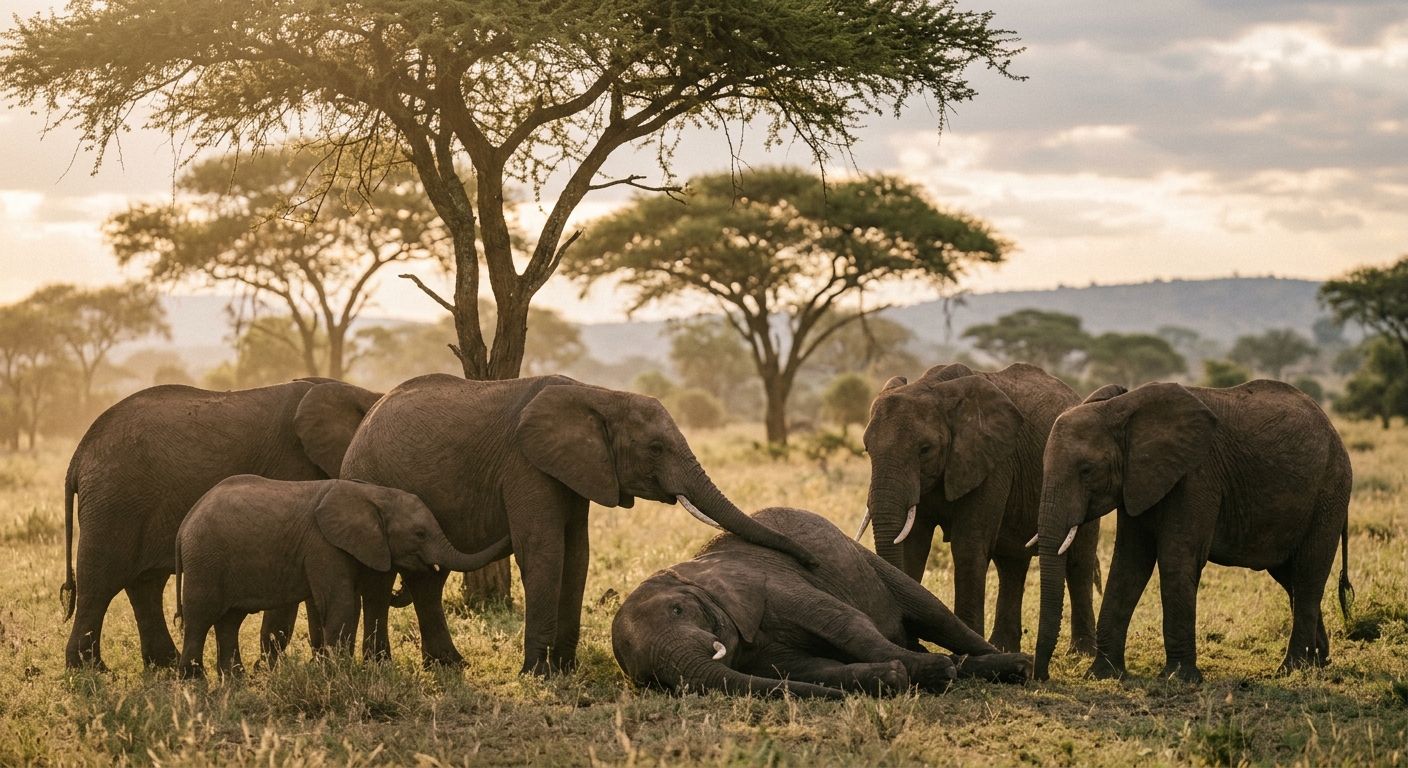
In the golden light of a late African afternoon, a matriarch collapses. She has led her herd for decades, guided them to water sources during droughts, protected calves from predators, and carried the living memory of her family’s history inside her extraordinary mind. Now she is still.
What happens next is not what most people would expect from animals. It is not a scene of chaos or indifference. What unfolds is something that wildlife researchers, biologists, and everyday observers have described as nothing short of a funeral, and it is forcing scientists to rethink everything they believed about grief, consciousness, and the emotional lives of non-human animals.
What Do Elephant Funerals Actually Look Like?
The behaviors documented around elephant death are consistent enough across species, geography, and family groups that researchers no longer dismiss them as coincidence. Here is what has been observed, repeatedly, across decades of field research:
- Standing vigil: Herd members gather around the body of the deceased and remain there, sometimes for hours or even days, refusing to leave.
- Touching the body: Elephants use their trunks and feet to gently touch and caress the bones, skin, and face of the dead. They pay particular attention to the tusks and skull.
- Vocalizations: Deep rumbles, often below the range of human hearing, are produced near the body. These infrasound calls may be a form of communication about the loss.
- Covering the body: In several documented cases, elephants have been observed covering dead companions with branches, leaves, and dirt, behavior that has no clear survival advantage.
- Returning to bones: Even years after a death, elephants that pass near the remains of a family member will stop, investigate, and linger. They do not treat random animal bones the same way.
These are not isolated incidents reported by one passionate researcher. They are documented in the work of Joyce Poole, Cynthia Moss, Karen McComb, and dozens of other scientists who have spent careers observing elephant behavior in the wild.
The Science of Elephant Grief
Dr. Karen McComb of the University of Sussex conducted a landmark study in which she presented elephants with objects including the skulls and ivory of deceased elephants alongside the remains of other animals and objects of no significance. The results were striking. Elephants showed a clear and statistically significant preference for interacting with the remains of their own species, and even more specifically, with the remains of individuals they had known.
What does this tell us? It suggests that elephants have a concept of death that is tied to identity. They are not simply responding to a familiar smell or an unusual shape. They appear to recognize that the bones in front of them once belonged to someone, a specific individual who mattered to them.
Dr. Joyce Poole, who has studied elephants in Kenya for over four decades, describes witnessing a mother elephant carry the body of her dead calf for days, refusing to abandon it. She described the mother’s behavior as indistinguishable, emotionally, from human grief. The slow movements, the repeated returning, the way the rest of the herd quietly kept pace with the grieving mother, all of it pointed to a shared experience of loss.
The Role of Memory in Elephant Mourning
To understand why elephants grieve the way they do, you have to understand their memories. Elephant brains are large, deeply folded, and rich in spindle neurons, the same type of nerve cells found in humans, great apes, and cetaceans, and widely associated with complex social behavior and self-awareness.
Elephants live in tight-knit matriarchal family groups. They know each other intimately. They remember individuals they have not seen in years. A matriarch carries a mental map of her range that can span hundreds of miles, including the locations of water, food, safe corridors, and the graves of those she has lost.
This deep memory is not just useful for survival. It is the foundation of grief. You cannot truly mourn someone you do not remember. The same capacity that makes elephants extraordinary navigators and social beings also makes them capable of profound loss.
Do Elephants Recognize Death?
This is the question that sits at the heart of the debate. And the evidence increasingly suggests the answer is yes.
Researchers have noted that elephants behave differently around the bodies of the recently dead compared to the long-dead. They are more agitated, more vocal, and more likely to attempt to rouse the body when the death is fresh. With older remains, the behavior shifts to something quieter and more deliberate, almost contemplative.
Young elephants who have not yet experienced death in their family will sometimes approach a deceased elder with what can only be described as curiosity mixed with confusion. Older members of the herd will often gently steer them closer, as if guiding them through an experience the elders have navigated before.
This transmission of behavior, passing on how to respond to death, hints at something remarkable: a cultural practice. Not instinct alone, but learned, shared, and passed from one generation to the next.
Cross-Species Grief: You Are Not as Alone as You Think
Elephants are not the only animals documented to engage in death rituals. Chimpanzees have been observed cleaning the bodies of deceased group members. Dolphins have been seen supporting the bodies of dead calves at the surface of the water for extended periods. Crows hold what researchers call “cacophonous gatherings” around fallen members of their species, which appear to serve a social and possibly emotional function.
But elephant behavior stands out for its combination of duration, complexity, and the clear emotional weight that accompanies it. No other non-human animal has been documented returning to the remains of their dead over the course of years with such consistent tenderness and attention.
What This Means for How We Treat Elephants
The implications of all this research are not just philosophical. They are deeply practical and urgent.
Poaching kills roughly 20,000 elephants every year in Africa. When a matriarch is killed for her ivory, her herd does not simply lose a leader. They lose the living archive of their collective memory, the individual who knew where to find water in a drought, who remembered safe migration routes, who had guided the family through previous losses. And they grieve that loss. Visibly. Measurably.
Research has shown that herds that have experienced heavy poaching display elevated stress hormone levels and heightened aggression for years afterward, similar to post-traumatic stress responses in humans. The trauma of loss is real, and it lingers.
Understanding that elephants grieve is not just a matter of scientific curiosity. It is a moral call. If these animals experience loss with the depth that evidence suggests, then the suffering caused by habitat destruction, poaching, and captivity carries a weight that extends far beyond numbers on a conservation spreadsheet.
What We Can Learn from the Way Elephants Say Goodbye
There is something quietly humbling about watching footage of an elephant herd standing in silence around one of their own. In a world that often rushes past death, that treats grief as an inconvenience to be managed and minimized, these massive creatures model something different.
They stop. They stay. They touch. They return.
They do not pretend the loss did not happen. They do not move on before they are ready. They honor the life that was lived by giving time and presence to its ending.
Perhaps the most profound lesson from elephant funerals is not about animals at all. It is about what it means to truly witness loss, to let grief be what it needs to be, and to carry the memory of those we love forward into the years that follow.
The elephants have been doing this for millions of years. Maybe we are only just catching up.