🎧 Listen to this story
Narrated by Kore · 7,073 characters
When the Storm Passed, One Man Refused to Wait for Someone Else to Help
The sky had finally cleared over the coastal neighborhood of Gulfport, Mississippi, but the damage Hurricane Ida left behind was anything but calm. Fallen branches blanketed front yards. Debris was scattered across driveways. Overgrown grass, mud-caked and matted with storm refuse, made streets look like something out of a disaster film. Most people were still in shock, still calling insurance companies, still trying to figure out where to begin.
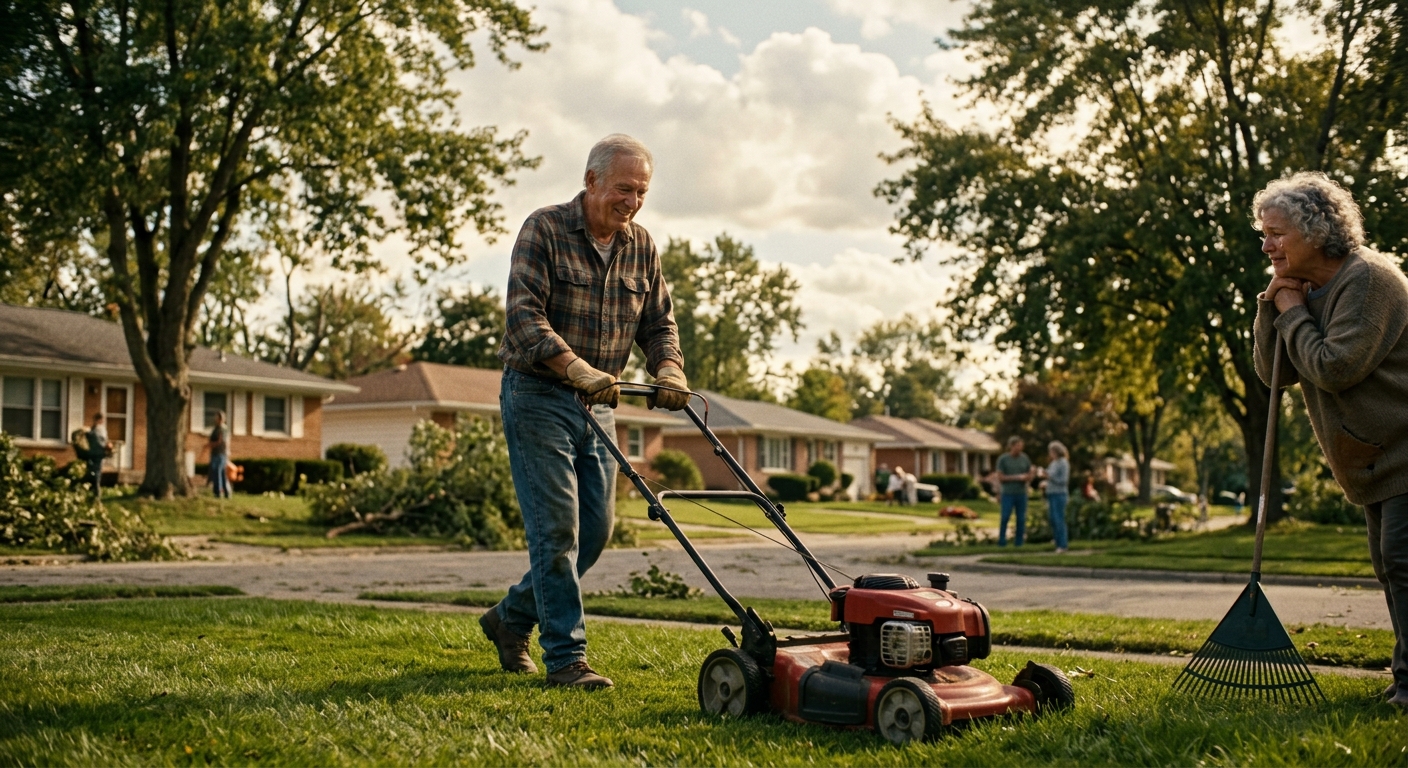
Marcus Webb, a 54-year-old retired postal worker, looked out his window at the chaos and made a quiet decision. He walked to his garage, pulled out his riding lawn mower, and got to work. Not on his own lawn. On his neighbor’s.
Then the next neighbor’s. Then the one after that.
Ninety lawns later, three weeks after the storm, Marcus finally parked his mower back in his garage. He had not charged a single person a single cent.
A Small Gesture With an Enormous Ripple
What Marcus did was not announced on social media. He did not set up a donation page or seek media attention. A local reporter only found out about it because a neighbor, Patricia Simmons, 71, posted a tearful thank-you note in a neighborhood Facebook group that simply read: “To the man who mowed my yard today when I couldn’t afford to pay anyone and couldn’t do it myself, you have no idea what that meant to me. God bless you.”
When asked why he did it, Marcus gave an answer that stopped the reporter mid-sentence.
“I had the equipment. I had the time. I had my health. What was I supposed to do, just sit inside?”
That sentence has since been shared tens of thousands of times online. And while the shares and likes are nice, Marcus says they miss the real point entirely.
The Logistics of Kindness: How He Actually Pulled It Off
Mowing ninety lawns is not a small undertaking. For Marcus, it became something close to a full-time job for nearly three weeks straight. Here is how he structured his days during that stretch:
- Early starts: Marcus was outside by 6:30 every morning, before the heat became unbearable and before most neighbors had even had their coffee.
- Fuel costs covered himself: He spent roughly $180 of his own money on gasoline over the course of the project, refusing any reimbursement offered.
- He brought his own tools: A riding mower for large yards, a push mower for tight corners, and a weed trimmer for edging. All his own equipment.
- He kept no list: Marcus went street by street, knocking on doors and simply asking if they needed help. If no one answered, he used his judgment.
- He recruited no one: This was, by his own design, a solo effort. “I wasn’t trying to start a movement,” he said. “I was just trying to help my neighbors.”
The People Behind the Lawns
To understand why this matters so much, you have to understand who lives in Marcus’s neighborhood. It is not a wealthy area. Many of his neighbors are elderly, disabled, or working multiple jobs just to keep the lights on. After a hurricane, the gap between what people need and what they can afford grows into a canyon.
There was Mr. and Mrs. Tran, both in their late seventies, whose yard had become so overgrown with storm debris that they could not safely reach their own mailbox. There was Destiny, a 32-year-old single mother of three, whose hours at the hospital had doubled since the storm and who had not slept more than five hours a night in two weeks. There was Gerald, a veteran with limited mobility who watched from his front porch as Marcus spent an hour and a half clearing his yard and then waved a quiet thank-you from his wheelchair.
“He didn’t make a big deal of it,” Gerald said later. “He just came and did it like it was the most natural thing in the world. That’s rarer than people think.”
What This Story Actually Teaches Us
It would be easy to read this story, feel warm and fuzzy, and scroll on. But there are some genuine lessons buried in what Marcus did that are worth sitting with for a moment.
1. Proximity is power.
Marcus did not go to the other side of the country to help disaster victims. He walked next door. The people closest to us are often the ones most overlooked when it comes to acts of service. Sometimes the most radical thing you can do is pay attention to the person three houses down.
2. Skills and tools are a form of generosity.
Marcus did not donate money. He donated what he had: a mower, a strong back, and a willingness to show up. This reframes the entire concept of giving. You do not need a bank account to be generous. You need to ask yourself what you have that someone else needs right now.
3. Quiet kindness is not lesser kindness.
In an age where every act of goodwill seems to come with a camera crew and a hashtag, Marcus’s approach is almost countercultural. He was not performing generosity. He was practicing it. There is a profound difference, and more people are starting to notice.
4. Recovery is not just physical.
After a disaster, people lose more than property. They lose their sense of safety, their routine, and often their feeling that anyone is looking out for them. A mowed lawn is not just a mowed lawn. It is a signal: someone sees you. Someone cares. That signal, sent to ninety households in a battered neighborhood, carries a weight that is almost impossible to measure.
What Happened After the Story Got Out
Once the story spread, the community tried to give back to Marcus in every way they could imagine. Neighbors left groceries on his porch. A local hardware store offered to replace his mower blades for free. A group of teenagers from a nearby church showed up at his door one Saturday asking if they could help him with anything, anything at all.
He put them to work clearing a storm drain that had been blocked for weeks.
The hardware store eventually did more than replace his blades. They quietly established a small fund in his name to provide free lawn care for elderly and disabled residents in the area year-round, not just after disasters. Marcus sits on the advisory committee and reportedly attends every meeting with a thermos of coffee and exactly zero interest in being thanked.
A Final Word From the Man Himself
When the local reporter asked Marcus if he considered himself a hero, he laughed. A real, genuine laugh, not the humble deflection you might expect from someone performing modesty.
“A hero?” he said. “I mowed some grass. You want to call me a hero, go find a nurse or a firefighter. I’m just a man with a mower and some free time who got tired of watching people struggle when I could do something about it.”
Maybe that is exactly the point. Maybe heroism does not always arrive in a cape or a headline. Sometimes it arrives in a cloud of gasoline exhaust, before the sun gets too high, moving steadily from one yard to the next, asking nothing in return.
The storm is long gone. The lawns are trimmed. And somewhere in Gulfport, Mississippi, a retired postal worker is probably already scoping out who on his block might need a little help before the next one comes.