
🎧 Listen to this story
Narrated by Aoede · 7,349 characters
The Moment Science Stopped and Stared
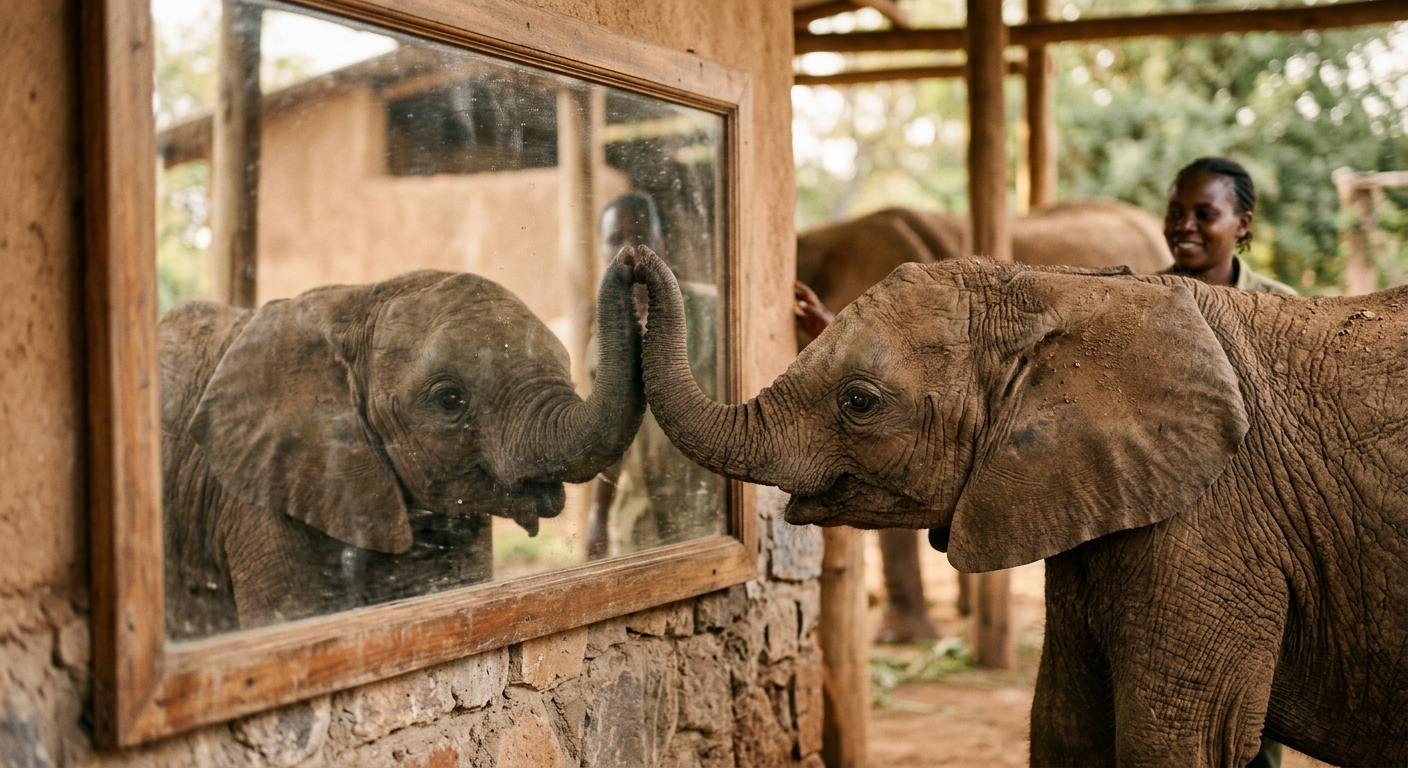
In 2006, researchers at the Bronx Zoo placed a large mirror in front of three Asian elephants named Happy, Maxine, and Patty. What happened next quietly rewrote the rulebook on animal intelligence. The elephants did not trumpet in alarm. They did not treat the reflection as a stranger or a rival. Instead, they explored it, investigated it with curiosity, and in Happy’s case, used it to examine a white X that scientists had painted on the side of her head, a spot she could only see in the mirror.
Happy reached up, touched the mark on her face, and looked back at her reflection. She understood she was looking at herself.
This was not a trick. This was not a coincidence. This was one of the most profound confirmations in the history of animal cognition research: elephants possess self-awareness.
The Mirror Test: What It Is and Why It Matters
The mirror self-recognition test, or MSR test, was first developed by psychologist Gordon Gallup Jr. in 1970. The concept is elegantly simple. A mark is placed on an animal’s body in a location it cannot see directly. The animal is then given access to a mirror. If it uses the mirror to investigate or remove the mark, rather than reacting to the reflection as though it were another animal, the test is considered a pass.
Before the elephant study, only a short and remarkable list of species had passed:
- Great apes, including chimpanzees, bonobos, gorillas, and orangutans
- Bottlenose dolphins
- Orca whales
- Eurasian magpies
- And more recently, certain fish species under specific conditions
Elephants joined this exclusive group with a result that stunned even seasoned researchers. The fact that an animal with such a different brain structure and evolutionary history could achieve the same cognitive milestone suggests that self-awareness is not a quirk of one lineage. It may be a feature that emerges wherever intelligence reaches a certain depth.
What Self-Recognition Actually Tells Us
Here is where the story becomes more than just a laboratory curiosity. Mirror self-recognition is widely considered a marker of a broader set of cognitive and emotional capacities. Scientists believe it correlates with:
Empathy and Theory of Mind
To recognize yourself, you must have a concept of “self” as distinct from “other.” That same distinction is the foundation of empathy, the ability to understand that others have experiences, feelings, and perspectives different from your own. Elephants have long been observed consoling distressed herd members, mourning their dead, and protecting injured companions. The mirror test provides neurological plausibility for all of it. They are not acting on instinct alone. They are, on some level, relating.
Memory and Identity Over Time
Self-recognition implies a continuous sense of identity, a recognition that the creature in the mirror today is the same creature who walked the savanna yesterday. Elephants are famously known for their long memories, recognizing the calls and faces of dozens of individual elephants even after years of separation. These abilities are deeply connected. Memory, identity, and self-awareness form a triangle, and elephants appear to occupy all three corners.
Grief and the Understanding of Death
Perhaps the most haunting implication is this: elephants who understand “self” may also understand, in some way, the loss of self. Numerous credible field observations have documented elephants returning to the bones of deceased herd members, gently touching skulls and tusks with their trunks, sometimes standing in silence for extended periods. This behavior has been observed even when the remains belong to elephants from outside the herd. If they recognize themselves as beings, they may also recognize death as an ending.
A Brain Built for Connection
The elephant brain is the largest of any land animal, weighing around 5 kilograms. But size alone is not the point. Elephant brains contain a high concentration of von Economo neurons, sometimes called spindle neurons, which are specialized brain cells associated in humans with self-awareness, social cognition, and the processing of complex emotions. Until recently, these neurons were thought to exist only in great apes and humans. Finding them in elephants shifted the scientific conversation significantly.
The architecture of the elephant brain seems designed for exactly the kind of rich inner life their behavior suggests. Regions associated with memory, emotion, and social bonding are highly developed. They are not approximating connection. They are built for it.
Why This Should Change How We Treat Them
The conversation about elephant welfare has never been more urgent. Across Africa and Asia, elephant populations face habitat destruction, poaching for ivory, and the psychological trauma of captivity. But when an animal can look into a mirror and know that it is looking at itself, it crosses a threshold that carries moral weight.
We protect children, we protect people with disabilities, we protect those who cannot fully advocate for themselves, because we recognize their inner experience as real and their suffering as meaningful. The mirror test does not make elephants human. But it does make their experience undeniably significant.
Organizations like the David Sheldrick Wildlife Trust and the Elephant Crisis Fund work to protect these animals on the ground. What science is now confirming is what many conservationists and elephant caregivers have long felt intuitively: these are not just large, impressive animals. They are aware beings navigating complex emotional lives in a world that is increasingly hostile to their survival.
Happy the Elephant: A Story Within the Story
It is worth pausing on Happy, the elephant who passed the MSR test most decisively. Her case later became the center of a landmark legal effort in New York, where animal rights advocates petitioned for her transfer from the Bronx Zoo to a sanctuary, arguing that her cognitive complexity entitled her to a form of legal personhood and bodily liberty. The case was ultimately dismissed, but not before it sparked a global conversation about the legal status of cognitively sophisticated animals.
Happy remains at the Bronx Zoo as of this writing. Her reflection in that mirror in 2006 started a chain of events that legal scholars, philosophers, and scientists are still working through today. One elephant, one mirror, and a question that refuses to go away.
What We Can Take From This
Science does not often hand us moments of genuine wonder. The elephant mirror test is one of them. In the quiet of a research enclosure, with cameras rolling and clipboards ready, an elephant looked at her own face and knew it was hers. She touched a mark only visible in reflection. She closed a cognitive loop that most of the animal kingdom cannot reach.
That moment asks something of us. It asks us to sit with the discomfort of recognizing that consciousness, identity, and inner life are not uniquely human gifts. They are features of life itself, distributed across species in ways we are only beginning to understand. And with that recognition comes responsibility, to protect these animals, to honor their complexity, and to make room in our moral universe for beings who look into a mirror and know exactly who is looking back.