🎧 Listen to this story
Narrated by Gacrux · 7,740 characters
The Moment That Stops Scrollers in Their Tracks
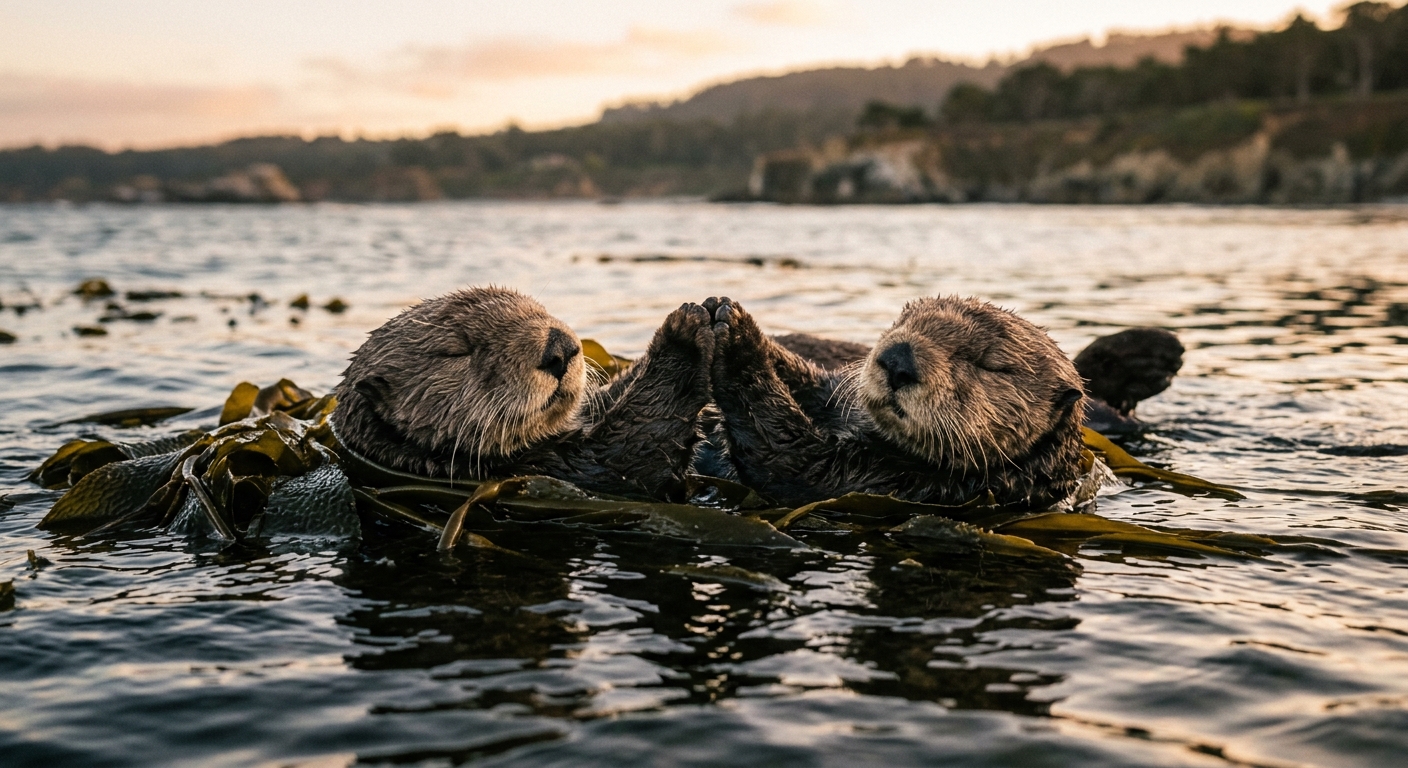
You have probably seen it at least once, maybe in a viral video or a friend’s social media post. Two sea otters, floating on their backs in calm coastal water, their small paws gently intertwined as they drift off to sleep together. For most people, the reaction is immediate and visceral: a soft gasp, a hand pressed to the heart, maybe even a few unexpected tears.
But here is the thing. That image is not just adorable. It is a profound, quietly radical act of survival and trust playing out in real time on the surface of the Pacific Ocean. And once you understand why sea otters actually hold hands, the lesson it carries for human connection becomes almost impossible to ignore.
The Science Behind the Snuggle
Sea otters are marine mammals that spend the vast majority of their lives floating on the ocean’s surface. Unlike most marine mammals, they do not have a thick layer of blubber to keep them warm. Instead, they rely on their extraordinarily dense fur, the thickest of any animal on Earth, and a remarkably high metabolism to stay alive in cold Pacific waters.
When sea otters sleep, they face a very real danger: drifting apart from their group, or being carried away by currents into open water or onto rocky shores. So they developed a behavior called rafting. Groups of otters, sometimes numbering in the hundreds, float together in clusters called rafts, often wrapping themselves in kelp to anchor themselves in place.
And among bonded pairs, whether mothers and pups, mates, or close companions, they hold hands. Or more accurately, they hold paws. This behavior is called clasping, and it serves the very literal purpose of keeping them from drifting away from each other while they sleep.
What Researchers Have Observed
Marine biologists at the Monterey Bay Aquarium, one of the most celebrated sea otter research centers in the world, have documented this behavior extensively. Researchers note that the bond between a mother otter and her pup is especially striking. A mother will hold her sleeping pup on her chest, grooming it constantly to keep its fur buoyant and dry. If she needs to dive for food, she will sometimes wrap her pup in kelp so it does not float away.
The clasping behavior between adult pairs has also been observed in otters that share consistent social bonds over time. It is not random. It is deliberate, repeated, and tied to specific relationships. These otters choose who they hold on to.
7 Things the Sea Otter Teaches Us About Human Connection
- Holding on is a survival strategy. For otters, drifting apart can mean danger or death. For humans, isolation carries its own serious risks. Studies consistently show that loneliness is one of the leading contributors to poor mental and physical health. Connection is not a luxury. It is a necessity.
- Presence matters more than words. Otters do not comfort each other with language. They comfort each other with proximity and touch. Sometimes the most powerful thing you can offer someone is simply being there, physically or emotionally present, without needing to say a single word.
- We all need an anchor. The kelp that otters wrap around themselves serves as a tether to something stable. Every person needs anchors too, whether those are trusted friends, family, routines, or communities that keep us from drifting into dangerous emotional waters.
- Vulnerability is strength. Sleeping is the most vulnerable state any animal can be in. Yet otters choose to sleep in the open ocean, trusting their companions to help keep them safe. Allowing yourself to be vulnerable with the right people is not weakness. It is one of the bravest things you can do.
- Bonds require repetition. Otter pairs do not hold hands once. They do it night after night. Human relationships are also built not in grand gestures but in repeated small acts of showing up, checking in, and choosing the other person again and again.
- Touch is a language all its own. Research in human psychology consistently shows that appropriate physical touch, a hug, a hand on a shoulder, holding someone’s hand, reduces cortisol levels and increases oxytocin. We are wired for contact. The otters figured this out a long time ago.
- You cannot always control the current. Otters cannot stop the tide from moving. They can only hold on to each other. Life will carry us into difficult places. The goal is not to fight every current but to make sure you are not facing it alone.
A Story That Went Around the World
In 2007, footage from the Vancouver Aquarium captured two sea otters named Nyac and Milo holding hands as they floated and slept. The video was uploaded to YouTube and within days had been viewed millions of times. News outlets picked it up. Scientists were interviewed. Late night hosts talked about it. People forwarded the link to friends, to parents, to estranged siblings, sometimes without any message at all, as if the video said everything that needed to be said.
What was it that people were actually responding to? Marine biologist Dr. Terrie Williams, who has studied sea otter behavior extensively, suggested in interviews that the behavior resonates so deeply because it mirrors something we all recognize from our own lives: the instinct to reach for someone we love when we feel uncertain or afraid.
Nyac, one of the otters in that famous video, was a survivor of the 1989 Exxon Valdez oil spill. She had been rescued as a young otter, rehabilitated, and eventually found a home at the Vancouver Aquarium. She lived to be 20 years old, an extraordinary age for a sea otter. Her story of survival, followed by decades of gentle companionship caught on camera, became something of a symbol for resilience and the healing power of connection.
What We Can Actually Do With This
It would be easy to watch the otter video, feel a wave of warmth, and scroll on. But the more interesting question is: what would it look like to actually live more like an otter?
Not literally floating in the ocean clutching your best friend’s hand, though points for commitment if you try. But genuinely asking: who are the people in your life that you are drifting away from? What currents, whether busyness, conflict, distance, or simply time, have been slowly pulling you apart? And what small act of clasping, a text, a phone call, showing up at their door, could serve as your version of reaching out a paw?
Connection does not require dramatic declarations. It requires consistency and intention. It requires choosing, again and again, not to drift.
The Raft Principle
There is also something worth noting about the broader raft, the larger community of otters that sleep together in groups. No otter is meant to float alone. The raft is the community. And community is not just a nice idea. It is a buffer against the coldest currents life can throw at you.
Building your raft means investing in friendships, communities, neighborhoods, and relationships before you need them desperately. It means showing up for people in small ways so that when the current gets strong, you are not alone on the water.
The Smallest Gesture, the Deepest Meaning
There is a reason that image of two otters holding hands has been shared billions of times across decades and platforms. It is not just because it is cute, though it absolutely is. It is because it shows us something true about ourselves, reflected in a creature so different from us, floating in cold Pacific water, making its own quiet case for love.
We are all, in our own way, floating. We are all vulnerable to the current. And every single one of us benefits from someone willing to reach over and hold on.
The otters have known this all along. Maybe it is time we listened.