🎧 Listen to this story
Narrated by Gacrux · 9,129 characters
The Shelter Nobody Talks About
Drive twenty minutes outside of downtown Columbus, Ohio, past the strip malls and the fast food signs and the car washes, and you will find a building that most people in the city have never noticed. It sits between a laundromat and a bail bonds office, marked only by a small laminated sign on the door. Inside, on any given night, between forty and sixty families sleep on donated cots, their belongings zipped into garbage bags tucked beneath them.
This is the Riverside Family Shelter. And until three years ago, most of the children who slept there did so without a blanket to call their own.
That changed because of a seventy-three-year-old retired schoolteacher named Marguerite Ellison, who picked up a pair of knitting needles after her husband passed away, and decided she needed something to do with her hands.
How It Started: Grief, Yarn, and a Tuesday Afternoon
Marguerite will be the first to tell you that the blanket project was not born from some grand vision. It was born from sadness.
“After Harold died, the house got very quiet,” she said, sitting in her living room surrounded by baskets overflowing with colorful yarn. “I watched a lot of television for a while. Too much. I needed to do something that felt like it mattered.”
Her neighbor suggested knitting. Marguerite had tried it once in her thirties and abandoned it after producing what she described as “a very uneven scarf that I gave to no one.” But at seventy, with long winters stretching ahead and grief pressing down on her chest, she was willing to try again.
She started slowly. Dishcloths. Pot holders. A lumpy hat for her granddaughter that was received with diplomatic enthusiasm. But as her hands found their rhythm, her projects grew larger and her speed picked up. By her third month, she was producing full-sized blankets at a rate that surprised even her.
“I would sit down at nine in the morning and look up and it would be two in the afternoon,” she said. “The time just disappeared. And I had a blanket.”
The question became: what to do with them?
Finding the Shelter
Marguerite’s daughter, a social worker named Diane, mentioned offhandedly one evening that the family shelter where she occasionally volunteered was always short on supplies, particularly for the children. Sheets, towels, and basic toiletries were donated regularly. Blankets, somehow, were not.
“The kids would come in and they would have whatever they were wearing,” Diane explained. “Sometimes a jacket, sometimes not even that. And the shelter had maybe thirty blankets for sixty children on a busy night.”
Marguerite asked if she could donate some of hers. Diane brought four to the shelter the following week. The response from the staff, and especially the children, was something neither of them had anticipated.
“One little boy, maybe five years old, grabbed the blanket and just buried his face in it,” Diane recalled. “He carried it around for the rest of the evening like it was the most precious thing he had ever owned. Because honestly, at that moment, it probably was.”
Marguerite heard that story and made a decision: she would knit a blanket for every child in that shelter.
The Scope of the Work
What sounds simple on paper is, in practice, an enormous undertaking. The Riverside Family Shelter serves children ranging in age from newborns to teenagers. The population shifts constantly. New families arrive. Some move on to permanent housing. Some return. To knit for every child meant not just completing a fixed number of blankets, but creating an ongoing supply that could meet a moving target.
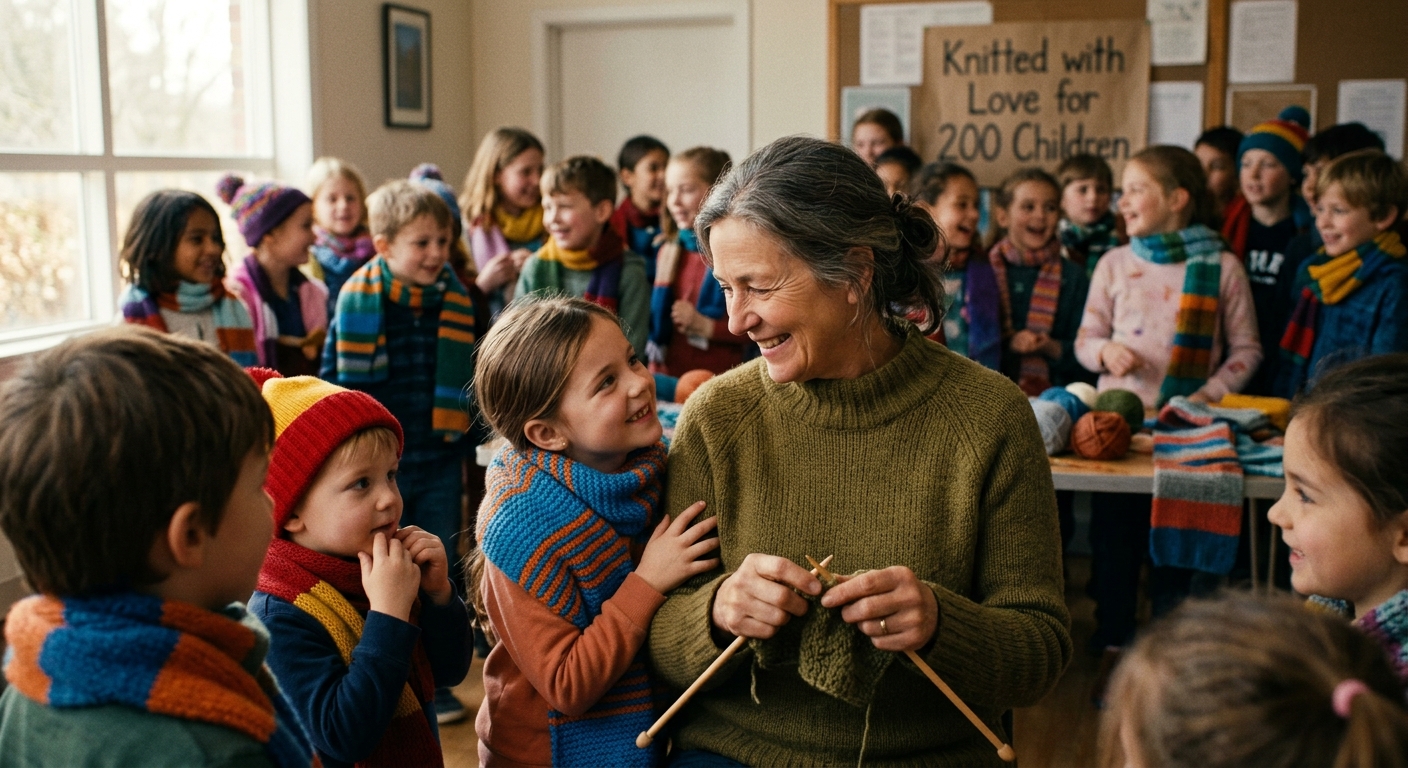
Over the past three years, Marguerite has produced more than 200 blankets for the shelter. She keeps a log in a spiral notebook, recording the date each blanket was completed and the approximate age of the child it was intended for. Newborns receive small, soft blankets in pale colors. Toddlers get bright primaries, often with simple shapes knitted into the border. Older children receive larger blankets in whatever colors they request, when the shelter staff has the chance to ask.
“One twelve-year-old girl asked for purple and black,” Marguerite said with a smile. “I made her exactly that. She deserved to pick something.”
What the Blankets Actually Mean
It would be easy to reduce this story to a feel-good statistic: one woman, 200 blankets, problem solved. But the shelter’s director, a measured and plainspoken man named Robert Caines, is careful to explain what the blankets represent beyond their physical warmth.
“When a family comes into a shelter, they have lost almost everything,” he said. “Privacy, stability, routine, their home. The children especially are often in a state of shock, even if they do not have the words for it. When you hand a child something that was made specifically for them, by someone who took hours and hours to make it, you are telling them something important. You are telling them that someone thought about them. That they were worth thinking about.”
He paused. “That is not a small thing when you have been made to feel like you are invisible.”
The Community Joins In
Word of Marguerite’s project spread, as these things tend to do, first through Diane’s network of social workers, then through a local church bulletin, and eventually through a short segment on a Columbus morning news program. The response surprised everyone.
Within weeks, Marguerite’s living room had transformed into something resembling a small textile operation. Neighbors dropped off yarn. A retired nurse named Carol joined as a regular knitting partner every Wednesday. A local craft supply store began donating surplus yarn on a monthly basis. A group of high school students, fulfilling community service hours, learned basic knitting and contributed their own beginner-level blankets, which Marguerite cheerfully accepted with the same gratitude she showed every contribution.
“Some of those student blankets had more holes than blanket,” she admitted. “But I never said a word about it. Because those kids showed up. That is what matters.”
7 Things Marguerite’s Project Teaches Us
- Grief can become purpose. Marguerite did not set out to build a community project. She set out to survive a difficult year. What she built was a byproduct of choosing action over stillness.
- Small gestures carry enormous weight. A blanket costs roughly twelve dollars in yarn. Its impact on a child who has lost their home is immeasurable.
- You do not need a nonprofit to make a difference. Marguerite has no organization, no 501(c)(3) status, no grant funding. She has yarn, time, and intention.
- Consistency matters more than scale. She did not knit 200 blankets in a month. She knitted one, then another, then another, over three years. Showing up repeatedly is the whole strategy.
- Community forms around genuine action. Marguerite did not recruit volunteers. She simply started, and people were drawn to something real.
- Children remember being seen. The blankets are warm, yes. But what the children at Riverside are actually receiving is evidence that someone, somewhere, spent hours of their own life thinking about them.
- It is never too late to begin. Marguerite started this project at seventy. She plans to continue as long as her hands allow.
A Letter She Keeps in Her Knitting Basket
Among the spools of yarn and the half-finished projects in Marguerite’s living room, there is a small envelope tucked into the side of one basket. Inside is a letter, written in the careful, rounded handwriting of a child who has recently learned to form letters properly. It is from an eight-year-old girl named Sofia, who spent four months at the Riverside shelter with her mother and younger brother before they found stable housing.
The letter reads, in part: “Thank you for my blanket. It is blue and I love it. I sleep with it every night even now that we have a house. My mom says someone made it just for me and I think about that person a lot.”
Marguerite has read it perhaps a hundred times. It is why, on the mornings when her fingers ache from arthritis and the light is gray outside, she still picks up the needles.
How You Can Help
If Marguerite’s story has moved you to act, here are some concrete ways to channel that feeling into something tangible:
- Contact your local homeless shelter and ask specifically what supplies for children are most needed. Blankets are often overlooked in donation drives.
- If you knit or crochet, look into organizations like Warm Up America or search for local “project linus” chapters, which distribute handmade blankets to children in need.
- Donate yarn to crafters who are already doing this work in your community.
- Share this story with someone who needs a reminder that one person, acting consistently, can change the texture of daily life for hundreds of children.
Marguerite Ellison did not save the world. She made it warmer, one stitch at a time, for two hundred children who needed warmth more than they could say. And on any given Tuesday afternoon in Columbus, Ohio, you can find her on her couch, needles clicking, working on number two hundred and one.