
🎧 Listen to this story
Narrated by Orus · 6,834 characters
A Letter in the Mailbox That Changed Everything
Linda Hargrove had been doing the math again. It was a Tuesday morning in late October, the kind of gray, quiet morning that seems designed for worry. Her kitchen table was covered in bills, printed bank statements, and a yellow legal pad where she had been writing down numbers, crossing them out, and writing them again. The mortgage was three months behind. The notice from the bank had arrived the week before. She had two kids in middle school, a part-time job at a dry cleaner, and a husband who had passed away eighteen months earlier after a short battle with pancreatic cancer.
She was not looking for a miracle. She had stopped doing that. She was simply trying to figure out which problem to solve first.
Then the letter arrived.
It was a plain white envelope with no return address. Inside was a single sheet of paper, a cashier’s check, and a handwritten note that read: “You don’t know me, but I know what it means to almost lose everything. Please use this. No strings attached. Pay it forward when you can.”
The cashier’s check was made out for the exact remaining balance of her mortgage.
The Investigation That Led Nowhere (On Purpose)
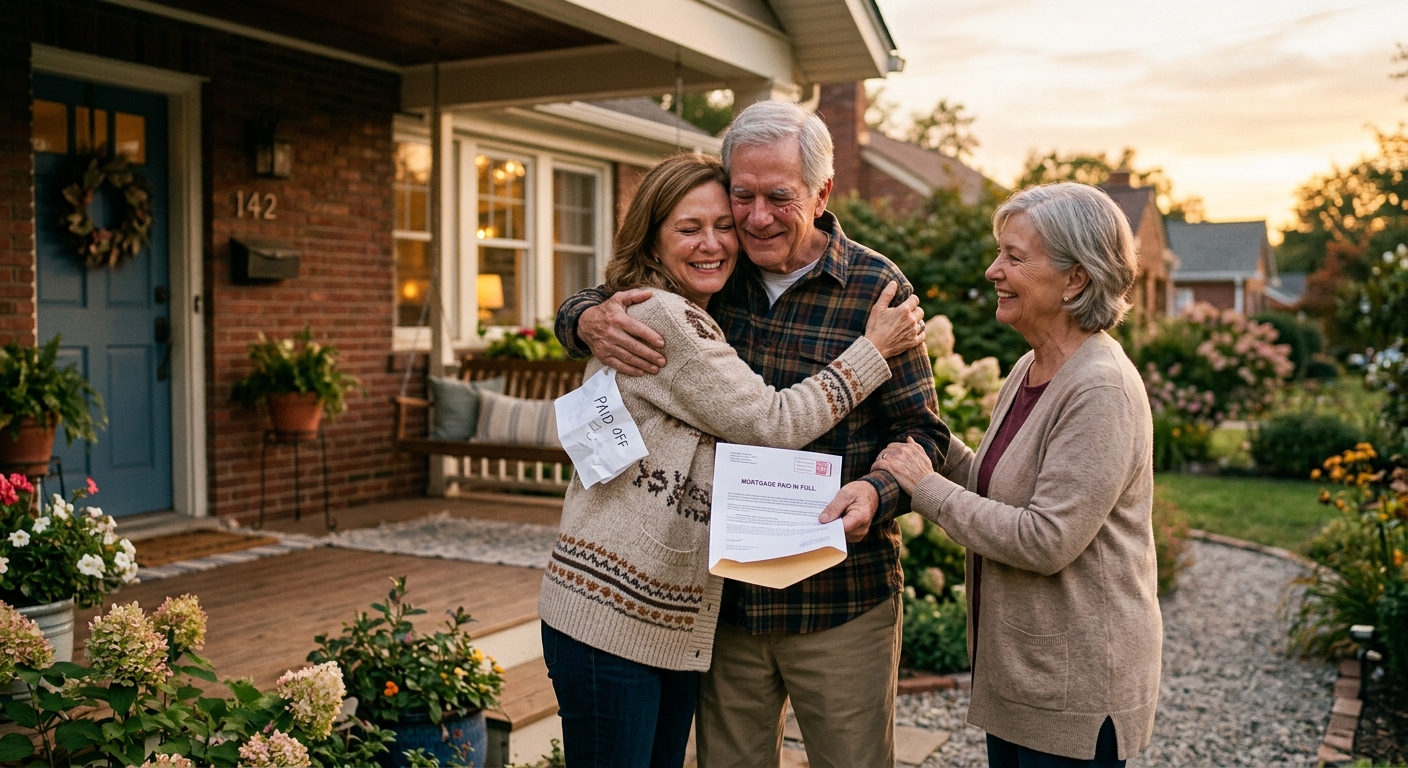
Linda, understandably, thought it was a mistake. Or a scam. She called her bank. She called a lawyer. She spent two weeks trying to verify the check and trace its origin before she allowed herself to believe it was real. It was. The funds cleared without issue. Her mortgage, every remaining dollar of it, was paid in full.
She went to the post office to trace the postmark. She asked neighbors if they had seen anyone unusual near her mailbox. She posted carefully worded questions on local community boards, not revealing the full story, just asking if anyone knew of a local donor who helped families in financial crisis. Nobody came forward.
Whoever had done this had done it deliberately, carefully, and completely anonymously. They had not wanted credit. They had not wanted a thank-you. They had simply wanted Linda’s problem to go away.
“It took me a long time to stop trying to find them,” Linda said. “At some point I realized that maybe the gift included not knowing. Maybe that was part of it.”
Why Anonymous Giving Is One of the Purest Forms of Generosity
Stories like Linda’s are rarer than we’d like but more common than we know. Across the country, anonymous donors quietly pay off layaway accounts at toy stores before Christmas, cover hospital bills for strangers, and yes, occasionally pay off mortgages for people they have never met. These acts rarely make the news because that is precisely how the givers want it.
Researchers who study charitable giving have noted something fascinating about anonymous donations: they tend to create longer ripple effects than public giving. When people receive help with no expectation of recognition or repayment, they are statistically more likely to pay that generosity forward in some form. The act becomes a kind of invisible current that moves through communities.
What Motivates Anonymous Donors?
While we cannot know exactly what moved the person who helped Linda, people who have given anonymously in the past often describe similar motivations:
- Personal history: Many have experienced financial hardship themselves and remember what it felt like to be on the edge.
- A desire for pure giving: Some donors feel that receiving gratitude changes the nature of the gift, and they want the act to remain untangled from social obligation.
- Spiritual or moral conviction: Many faith traditions specifically honor anonymous giving as the highest form of charity.
- A specific trigger: A news story, a conversation overheard, or a community post can move someone to act on a generosity that was already quietly building inside them.
The Ripple That Linda Started
Three years after receiving the letter, Linda Hargrove is still in her home. Her children are in high school now. She works full time at a nonprofit that helps families navigate financial assistance programs. She has also, quietly and carefully, helped two other families in her community with anonymous contributions of her own, nothing as dramatic as a full mortgage payoff, but targeted help at moments when it mattered most.
She keeps the original letter in a frame on her bedroom wall, next to a photo of her late husband.
“I think he would have loved this story,” she said. “He always believed that people are fundamentally good. I used to argue with him about that. I don’t anymore.”
What Stories Like This Teach Us
It would be easy to read this story as a feel-good anomaly, a rare and lucky exception to the difficulty of real life. But there is something more instructive here if we’re willing to look for it.
1. Generosity Does Not Require Wealth
The person who helped Linda was clearly in a position of financial comfort. But the spirit behind the act is available to everyone. Generosity is not a dollar amount. It is a posture toward other people’s needs.
2. Anonymity Can Be a Gift in Itself
By removing themselves from the equation, Linda’s donor gave her something beyond money. They gave her the freedom to receive help without embarrassment, without obligation, without the complicated social weight of owing someone something. That is a thoughtful and underrated form of kindness.
3. You Never Know Who Is Watching Out for You
Linda had no idea anyone was paying attention to her situation. She was, as far as she knew, struggling alone. The reality was different. Someone, somewhere, knew enough to help. That quiet awareness, the idea that community exists even when we cannot see it, is one of the most comforting truths these stories carry.
4. The Instruction to “Pay It Forward” Is Not Cliche
It has become a phrase so common it can feel hollow. But Linda’s story shows what it looks like in practice. The original donor did not set up a foundation. They did not go public. They helped one person and asked that person to help another when they were able. That is a chain of goodness with no beginning and no visible end.
If You Have the Capacity to Help Someone Today
You do not need to pay off a mortgage. You do not need a dramatic gesture. What the anonymous donor in Linda’s story models is simply this: pay attention to the people around you. Notice who is struggling. And when you have something to give, give it without making them feel small for needing it.
Leave no return address. Expect nothing back. And trust that the goodness will continue moving long after you have stepped out of the picture.
Linda still does not know who saved her home. But she carries them with her every day, in the choices she makes, in the families she quietly helps, and in the way she has come to see the world: as a place where strangers sometimes love each other in ways that never make the news.