🎧 Listen to this story
Narrated by Sadachbia · 9,297 characters
A Quiet Experiment With a Loud Lesson
In the late 1980s and early 1990s, a handful of conservation scientists and ecologists made a decision that seemed, at the time, almost counterintuitive: they walked away. They fenced off patches of degraded, scraggly, unremarkable land, put up signs, and told the world to leave it alone. No planting. No managing. No intervention. Just time.
What happened over the next three decades has become one of the most quietly revolutionary stories in modern science. And it has something profound to teach us, not just about forests, but about patience, trust, and the breathtaking intelligence of the natural world.
The Science of Doing Nothing
The concept is called passive rewilding, sometimes referred to as natural regeneration or spontaneous forest recovery. Unlike active reforestation, which involves humans planting seedlings, managing soil, and selecting species, passive rewilding simply removes the pressures that were preventing nature from doing what it already knows how to do.
Studies tracking rewilded zones across Europe, South America, and Southeast Asia have now accumulated enough data to draw some remarkable conclusions. Researchers at institutions including Oxford, Wageningen University, and the Smithsonian Tropical Research Institute have spent years cataloguing what happens when humans simply step back.
The results, published across dozens of peer-reviewed journals, tell a story that is equal parts science and wonder.
7 Things Scientists Discovered When They Let Forests Grow Wild
1. Trees Choose Their Own Communities
One of the first surprises was how quickly pioneer species, fast-growing trees and shrubs, moved in and began creating shade for slower, more complex species to follow. Scientists found that forests did not grow randomly. They grew in a kind of ecological choreography, each species appearing in a sequence that prepared the ground for the next. Wind-carried seeds arrived first, then bird-dispersed seeds, then the seeds carried by larger mammals as the habitat became hospitable enough to attract them.
Within just 10 years, study sites in Costa Rica that had been barren cattle pastures were hosting dozens of native tree species, none of which had been planted by human hands.
2. Biodiversity Exploded Faster Than Anyone Expected
Scientists monitoring rewilded sites in the Białowieża Forest region of Poland and Belarus documented a cascade of returning species that astonished even veteran ecologists. As trees returned, insects arrived. As insects arrived, birds followed. As birds followed, small mammals returned. And as small mammals established themselves, larger predators began to probe the edges of the recovering land.
Some sites saw their recorded species count triple within 15 years. Rare mosses, fungi, and lichens that had not been documented in those areas for half a century were suddenly reappearing, brought back by spores carried on the wind or in the fur of wandering animals.
3. The Soil Came Alive
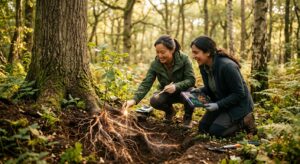
Perhaps the most surprising discovery was happening underground. In degraded land, soil is often compacted, low in organic matter, and biologically dead. But as leaf litter accumulated and root systems expanded, scientists measured dramatic increases in soil microbial activity. Fungi began forming vast underground networks, the so-called wood wide web, connecting trees and allowing them to share nutrients and even chemical warning signals.
One long-term study in the United Kingdom found that carbon stored in the soil of rewilded sites had increased by over 25 percent within 20 years, a finding with enormous implications for climate change conversations.
4. Water Cycles Repaired Themselves
Deforested land is notorious for its relationship with water. Without trees, rainfall runs off quickly, eroding topsoil and flooding low-lying areas, while droughts hit harder because the land has lost its capacity to retain moisture. In rewilded zones, scientists documented a measurable reversal of this pattern.
Tree roots and leaf litter acted like sponges, slowing the movement of rainwater and allowing it to percolate into underground aquifers. Streams that had run dry in summer began flowing again. Wetland areas that had shrunk returned to life. The forest, in short, was re-engineering the local water supply.
5. Native Species No One Was Looking For Came Back
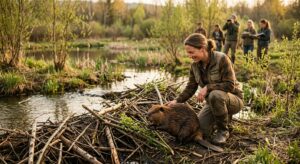
In several rewilding projects across Britain and continental Europe, camera traps and acoustic monitoring devices detected species that researchers had not anticipated. Polecats, pine martens, and even rare species of bat began colonizing rewilded corridors. In Scotland, one long-term rewilding estate reported the first confirmed breeding of white-tailed eagles in that area in over 150 years, without any direct reintroduction effort.
Nature, it turns out, has a memory. Given enough space and enough time, it begins to recall what it once was.
6. Mental Health Benefits Spilled Into Nearby Communities
This was not a finding the scientists were originally looking for, but it emerged from sociological surveys conducted alongside ecological ones. Communities living near rewilded land reported measurable improvements in wellbeing. Access to wilder, less manicured green spaces was associated with lower reported anxiety, higher rates of physical activity, and a stronger sense of connection to the natural world.
Children growing up near rewilded zones showed greater environmental awareness and curiosity compared to peers in similar demographics but without access to wild green space. The forest was not just healing itself. It was healing the people around it.
7. The Forest Became More Resilient to Climate Extremes
In sites that had been rewilding for 25 to 30 years, scientists noted something particularly timely: the recovered forests handled climate stress significantly better than monoculture plantations or managed woodlands nearby. During heat waves and drought periods, rewilded areas maintained cooler internal temperatures due to their denser canopy and higher moisture retention. During storm events, their complex root structures held the soil in place far more effectively.
Biodiversity, it turned out, was not just beautiful. It was structural. The more species present, the more ways the ecosystem had to respond to stress.
What This Means for Us
The lesson that keeps emerging from these 30-year experiments is uncomfortable in the best possible way. It challenges our deep human instinct to fix, to manage, to improve. It asks us to consider that sometimes the most powerful thing we can do is nothing at all.
Conservation scientist Isabella Tree, who co-manages one of Britain’s most celebrated rewilding projects at Knepp Estate in West Sussex, has written and spoken extensively about the cultural shift required to embrace rewilding. We have to learn to let go of our idea of what a landscape should look like, she has noted in interviews. Nature is not tidy. But tidy is not what nature needs.
The 30-year forest experiments are not just a scientific success story. They are a philosophical one. They remind us that resilience is not built by control. It is built by diversity, by interconnection, and by the freedom to respond to circumstances in unexpected ways.
A Lesson Worth Carrying Into Your Own Life
It would be easy to read this as a story only about trees and wildlife. But there is something here that speaks more broadly to how we live. How often do we over-manage the things we love, pruning and shaping and intervening until we have removed the very wildness that made them remarkable? Our children. Our creative projects. Our relationships. Our grief.
Sometimes the most generous, most trusting thing we can offer is space. The same space that allowed a barren hillside in Costa Rica to become a cathedral of trees in a single generation.
The forest did not need us to be smart on its behalf. It just needed us to stop getting in the way.
Where Rewilding Is Happening Right Now
- Knepp Estate, England: Once intensively farmed land, now a thriving mosaic of scrub, woodland, and wetland hosting rare nightingales, purple emperor butterflies, and free-roaming herds.
- Białowieża Forest, Poland and Belarus: One of Europe’s last primeval forests, currently at the center of conservation and rewilding debates.
- Atlantic Forest, Brazil: Passive regeneration projects reclaiming fragments of one of the world’s most biodiverse and most threatened ecosystems.
- Cairngorms Connect, Scotland: A 200-year rewilding vision covering over 60,000 hectares of Highland landscape.
- Guanacaste, Costa Rica: A landmark long-term recovery project that transformed degraded dry tropical forest back into functioning wilderness.
Each of these projects is a living laboratory. Each one is adding chapters to a story that began with a simple, radical act: walking away and trusting what was already there.
Final Thought
Thirty years is both a long time and almost nothing. In a human life, it is careers and children and grey hairs and losses. In the life of a forest, it is barely a breath. And yet in that single breath, given room, a landscape can remember everything it forgot.
There is hope in that. Quiet, rooted, unhurried hope. The kind that does not need our applause to keep growing.