🎧 Listen to this story
Narrated by Callirrhoe · 7,947 characters
What If a Single Tree Was an Entire Universe?
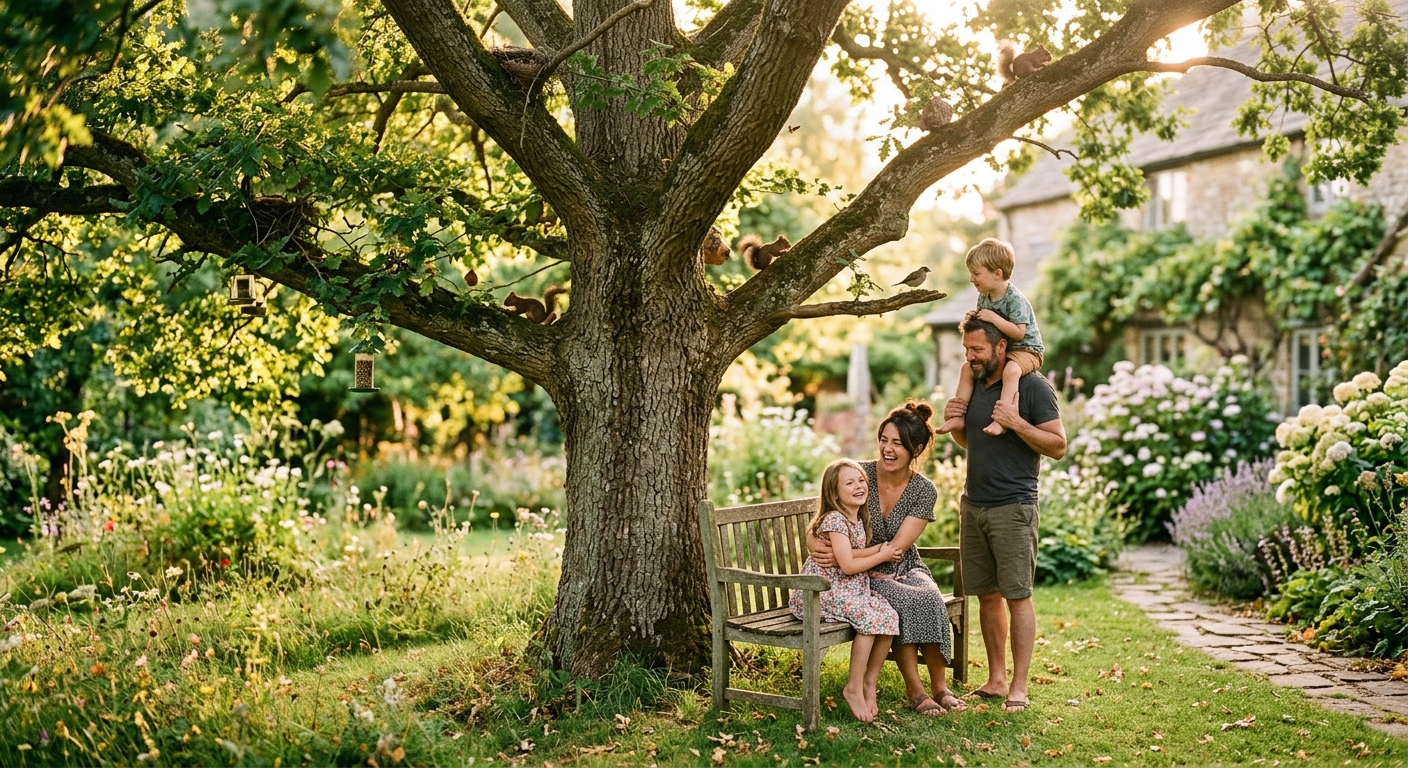
Stand beneath an old oak tree and look up. At first glance, you might see branches, leaves, and maybe a bird or two. But if you could zoom in, layer by layer, from the highest canopy down to the roots threading through dark soil, you would witness something that rivals the complexity of any city on earth. Scientists have confirmed what naturalists long suspected: a single mature tree can support upward of 500 species of wildlife. Not a forest. Not a meadow. One tree.
That number deserves a moment to sink in. Five hundred species. Insects, birds, mammals, fungi, lichens, mosses, and microorganisms, all finding food, shelter, reproduction, and survival within the architecture of one living organism. It is one of the most quietly astonishing facts in all of ecology, and understanding it just might change the way you look at every tree you pass for the rest of your life.
The Science Behind the Number
The research supporting this figure comes largely from the work of British ecologist Dr. Peter Thomas and organizations like the Woodland Trust in the United Kingdom, which have spent decades cataloguing the biodiversity associated with individual tree species. Oak trees, in particular, have been studied extensively. A single mature oak has been documented hosting over 2,300 species in total when all fungi, lichens, mosses, and invertebrates are counted, with more than 500 of those being animals.
In North America, entomologist Doug Tallamy of the University of Delaware has published compelling research showing that native oaks support over 550 species of caterpillars alone. Those caterpillars, in turn, are critical food sources for nesting birds. Tallamy calculated that a pair of chickadees raising one clutch of chicks must deliver between 6,000 and 9,000 caterpillars to the nest before the young birds fledge. Remove the trees that host those caterpillars, and the entire food chain collapses.
A Floor-by-Floor Tour of a Living Tree
Think of a tree as a high-rise apartment building. Every floor, every nook, and every crack serves a different tenant with different needs.
The Canopy: Where the Sky Meets Life
The uppermost branches of a mature tree are prime real estate. Songbirds like warblers, vireos, and tanagers hunt for insects among the leaves. Hawks perch to survey open ground below. Squirrels build dreys, their leafy nests, in the highest forks. The canopy catches rainfall and filters sunlight, creating a microclimate that dozens of species depend on year-round.
The Mid-Branches: A Nursery and a Pantry
Lower in the canopy, woodpeckers excavate cavities that later become homes for owls, small ducks, bats, and flying squirrels. These secondary cavity users could not exist without the woodpecker’s labor. Honeybees and wild native bees seek out old knotholes. Insects lay eggs in the bark. Spiders string webs between branches, hunting the insects drawn to the tree’s flowers and new growth in spring.
The Trunk: A Community in Bark
The bark of a large tree is its own ecosystem. Lichens, which are themselves partnerships between fungi and algae, colonize the outer surface. Mosses hold moisture and provide nesting material for hummingbirds. Bark beetles, though often cast as villains in forestry, are vital decomposers. Beneath the outer bark, communities of microorganisms process nutrients in ways science is still working to fully understand.
The Roots: The Hidden Network
Underground, the roots of a healthy tree connect with mycorrhizal fungi in a partnership that can span acres. These fungal networks, sometimes called the Wood Wide Web, link trees to each other and support soil organisms from nematodes to earthworms to beetle larvae. Voles and shrews tunnel through root systems. Salamanders overwinter in the damp cool spaces between roots. Even fox dens are frequently dug near the base of large old trees whose roots stabilize the surrounding soil.
7 Species Groups That Depend on a Single Tree
- Insects and Invertebrates: By far the most numerous. Hundreds of species of beetles, moths, flies, aphids, and true bugs complete their entire life cycles on or within a single tree species.
- Birds: Over 60 species of North American birds are directly associated with oak trees for feeding, nesting, or shelter. Globally, the numbers are even higher.
- Bats: Many bat species roost under loose bark or in cavities. A single large dead tree can house a maternity colony of hundreds of bats, each consuming thousands of insects per night.
- Mammals: Squirrels, chipmunks, deer, bears, raccoons, opossums, and mice all use trees for food, shelter, or navigation.
- Amphibians and Reptiles: Tree frogs, salamanders, and various lizards and snakes use trees for thermoregulation, egg-laying, and protection from predators.
- Fungi: Both parasitic and mutualistic fungi are inseparable from tree health. Some, like chicken-of-the-woods, are beloved by foragers. Others silently recycle nutrients in the soil.
- Lichens and Mosses: These slow-growing organisms indicate clean air quality and provide nesting material for birds like hummingbirds, which bind their tiny cup nests together with lichen flakes held in place by spider silk.
The Tragedy of What We Lose When a Tree Falls
When a mature tree is cut down or lost to disease, the ripple effect moves through an entire local food web. It is not simply the loss of one organism. It is the displacement or death of the hundreds of organisms that depended on it. And here is a detail that many people do not realize: young replacement trees do not immediately fill that void. It takes a tree decades, sometimes a century, to develop the deep bark furrows, the cavities, the root complexity, and the canopy size that make it genuinely wildlife-rich. A sapling, however well-intentioned its planting, cannot replace a 200-year-old oak overnight.
This is why the loss of ancient and veteran trees in urban and suburban areas is an ecological emergency dressed up in the mundane clothing of development permits and maintenance schedules.
What You Can Do, Starting Today
The good news is that this knowledge is genuinely empowering. You do not need to own a forest to make a difference. Here are practical steps anyone can take:
- Plant native trees. Non-native ornamental trees support far fewer species than native ones. An oak, a willow, a birch, or a native cherry in your yard is a gift to local wildlife that will keep giving for generations.
- Leave dead wood in place. Dead branches and standing dead trees, called snags, are among the most wildlife-rich structures in any landscape. If safety allows, leave them.
- Say no to pesticides. Insecticides applied to trees kill not just pest species but the hundreds of beneficial insects that birds and other animals depend on.
- Advocate for old trees. When development threatens mature trees in your neighborhood, speak up. Attend council meetings. Write letters. One old tree is worth a hundred saplings in ecological terms.
- Teach children to look closely. The child who learns to find a moth egg cluster on a leaf, or to identify a woodpecker hole, is the future advocate who will protect these trees decades from now.
A Different Way of Seeing
There is a concept in ecology called the keystone species, an organism whose presence is so disproportionately important that its removal reshapes an entire ecosystem. In many landscapes, the native tree, particularly the oak, functions as exactly that. It is a keystone of the living world around it.
The next time you walk past a large old tree, try to hold that number in your mind. Five hundred species. Some visible, most invisible. Some permanent residents, some seasonal visitors. All of them woven into a web of dependence so intricate that we are still, after centuries of scientific inquiry, only beginning to map it. That tree is not backdrop. It is not scenery. It is a world. And it deserves to be seen as one.