🎧 Listen to this story
Narrated by Sadachbia · 8,691 characters
The Night I Almost Missed Everything Good About My Life
It started on a Tuesday in February, which is perhaps the least glamorous origin story for a life-changing habit. I was sitting at my kitchen table, halfway through a bowl of cereal I had eaten for dinner because I did not have the energy to cook, scrolling through my phone with that hollow, restless feeling that had become my default setting. I was not depressed, exactly. I was just… numb. Tired. Going through the motions of a life that felt like it was happening to someone slightly more interesting than me.
My friend Delara had mentioned something offhand a few weeks earlier about a “gratitude jar” her grandmother used to keep. The idea was simple: every time something good happened, even something small, you wrote it on a slip of paper and dropped it in the jar. At the end of the year, you emptied it out and read everything back. I had nodded politely and promptly forgotten about it.
But that Tuesday night, staring at a phone full of bad news and a sink full of dishes, I remembered. I found an old mason jar in the back of a cabinet, tore a piece of notebook paper into strips, and wrote my first entry: “The coffee this morning was really good.”
That was it. That was where it started.
What the Jar Actually Looks Like in Practice
If you are imagining a beautifully decorated glass vessel with ribbons and color-coded paper slips, I need to disabuse you of that image immediately. My jar is a plain mason jar. My paper slips are torn from whatever notebook or receipt is nearby. My handwriting, written quickly before I lose the moment, is barely legible. And that is entirely the point.
The rules I set for myself were almost embarrassingly loose:
- Write it down within a few hours of it happening, while the feeling is still fresh.
- It does not need to be significant. It just needs to be real.
- One sentence is enough. A single word is enough.
- No editing. No crossing out. Whatever goes in, stays in.
Some of the entries I have dropped in over the past year include things like: “A stranger held the elevator for me and we had a thirty-second conversation about her dog.” And: “Finished the book. Cried in a good way.” And simply: “Sunshine on my face walking home.”
Nothing earthshaking. Nothing that would make headlines. Just the texture of a life, collected.
The Psychological Reason This Actually Works
Here is something worth understanding: your brain is not wired to remember good things as vividly as bad ones. This is called negativity bias, and it is a feature, not a bug. For most of human history, remembering threats kept you alive. The rustle in the bushes mattered more than the pretty sunset.
But in modern life, this bias works against us. We replay arguments and embarrassments on a loop. We dismiss good moments as ordinary, unremarkable, not worth cataloguing. Meanwhile, we obsessively archive our frustrations.
What the jar does, from a neuroscience standpoint, is interrupt that automatic system. When you physically write something down and place it somewhere tangible, you are forcing your brain to pay attention to the positive experience twice: once when it happens, and once when you process it into language. Researchers studying expressive writing have found that this kind of deliberate reflection helps consolidate positive memories in a way that passive experience simply does not.
You are not tricking yourself into toxic positivity. You are just giving good moments the same archival treatment your brain already gives bad ones.
What Changed in Me, Month by Month
Month One and Two: The Awkward Phase
I will be honest. The first several weeks felt forced. I would stand at the jar with a strip of paper and feel vaguely ridiculous, like I was doing homework for a class I had not signed up for. Some nights I could not think of a single thing to write, and that itself felt like evidence that my life was as grey as I feared.
But then something small shifted. I started noticing good moments as they happened, almost like I had activated a background process in my mind that was scanning for them. Not because I was forcing optimism, but because I knew I would need something to write about later. The jar was waiting. I did not want to disappoint it.
Month Three and Four: The Collection Effect
By spring, the jar had enough slips in it that I could hear them rustle when I walked past. There is something unexpectedly powerful about seeing evidence of your own life accumulate. It stopped feeling like homework and started feeling like documentation of something worth documenting.
I noticed I was less likely to dismiss small pleasures as “not counting.” A warm bath on a cold night? That counts. A text from my mother that made me laugh? That counts. Finding the exact parking spot I needed? Yes, that absolutely counts.
Month Five through Eight: The Shift in Real Time
This is the part that surprised me most. I started to feel the shift not just in how I remembered my days, but in how I experienced them as they were happening. I began to have what I can only describe as a quiet, low-level sense of anticipation. Not excitement exactly. More like… readiness. A posture of openness to whatever small good thing might be coming next.
I became a better listener. I became more patient in lines and traffic because I was not white-knuckling my way through the day. I started noticing other people’s small joys, the way a child examined a puddle, the way two elderly men laughed together outside a coffee shop, and feeling genuinely moved by them.
Month Nine through Twelve: The Inventory
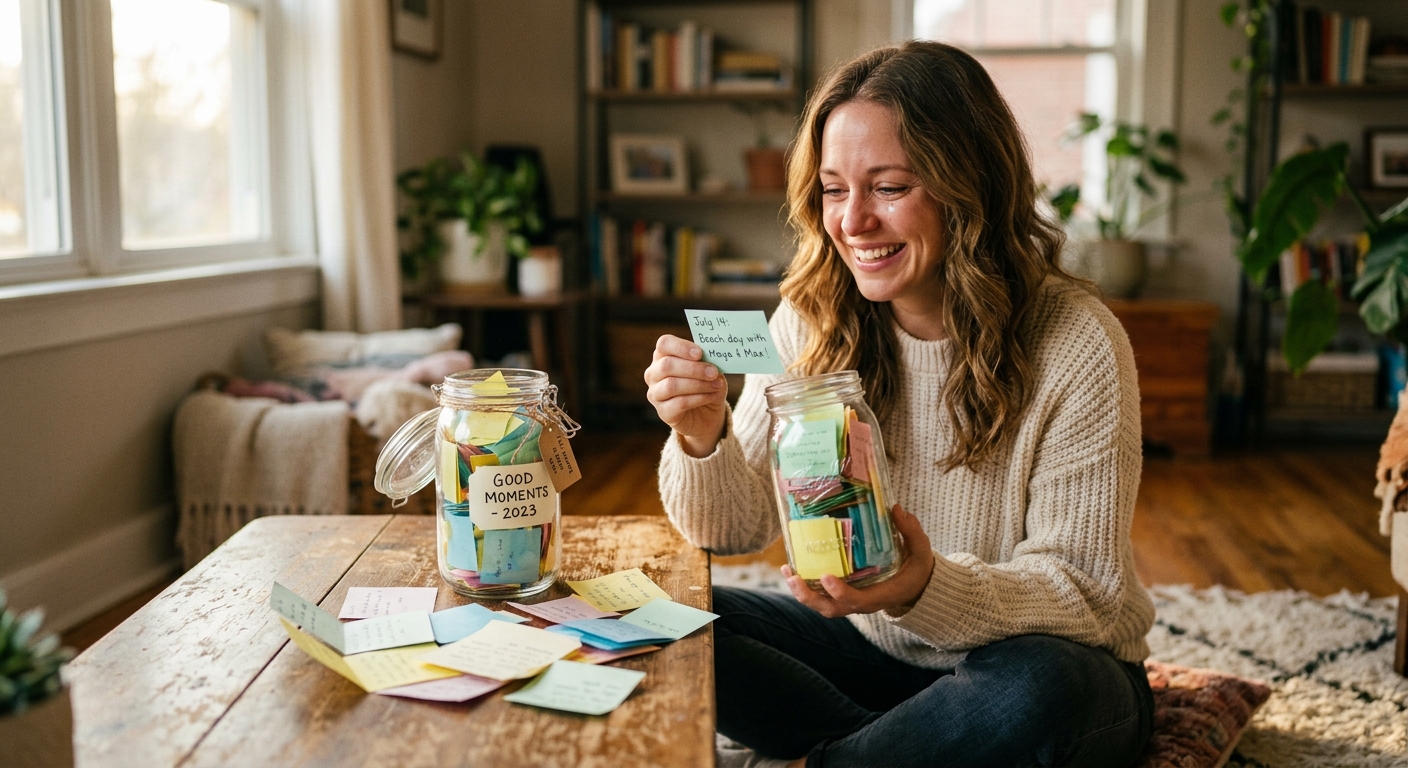
On New Year’s Eve, I sat on my kitchen floor with the jar and emptied it. Three hundred and forty-one slips of paper. I spread them out around me and read every single one.
It took almost two hours. I laughed out loud at entries I had completely forgotten. I cried at a few, not from sadness but from the sudden weight of realizing how much had quietly gone right in a year I had been convinced was difficult. And it had been difficult. There were hard months in that year, losses and disappointments and stretches of grinding exhaustion. But those three hundred and forty-one slips of paper were proof that the hard months had not swallowed the entire year. They had just been louder.
What the Jar Taught Me That I Did Not Expect to Learn
Beyond the mood-lifting effect, keeping the jar taught me several things I have been carrying with me ever since:
- Attention is a form of gratitude. You do not have to feel grateful. You just have to pay attention. Gratitude follows attention almost automatically.
- Small things are not small. The accumulation of small good moments is what a life actually is made of. The big moments are rare. The small ones are the substance.
- Writing changes experiencing. There is something about translating a feeling into words that makes it more yours. More real. More lasting.
- You can choose what to archive. Not in a dishonest way. Not by pretending hard things did not happen. But in the way that a photographer chooses what to point the camera at. You can decide that your life is worth documenting, carefully and lovingly.
How to Start Your Own Jar Tonight
You do not need anything special. A jar, a pen, and some paper. That is the whole supply list. But here are a few things I wish someone had told me at the start:
Start tonight, not Monday. The impulse to wait for a clean starting point will kill this before it begins. Drop one slip in tonight. It can say anything. It just has to be true.
Lower your standards for what counts. Radically lower them. If it made you feel even slightly good, even for a moment, it counts. You are not curating a highlight reel. You are keeping a record of being alive.
Keep the jar somewhere you will see it. Out of sight is out of mind. Put it on the kitchen counter, on your desk, on your nightstand. Let it be a physical reminder that good things are happening and deserve to be noticed.
Do not read the slips mid-year. The power of the end-of-year reading is partly in the surprise. Let the jar hold its secrets until it is time.
The Jar Is Still Going
I am on my second year now. The jar is the same mason jar, slightly sticky from a honey incident I would rather not discuss. The slips of paper are still barely legible. And the habit is still, on some nights, a little effort.
But here is what I know now that I did not know on that February Tuesday: good things are happening in your life right now, today, in this hour. Not instead of the hard things. Alongside them. The jar does not make the hard things smaller. It just makes the good things visible.
And sometimes, that is enough to change everything.