🎧 Listen to this story
Narrated by Rasalgethi · 7,498 characters
Rain, Snow, Holidays, and a Pandemic: Nothing Has Stopped Him
There is a man in a beat-up white cargo van who knows exactly how you take your coffee, what your late wife’s name was, and whether your hip has been bothering you this week. He is not your doctor, your pastor, or your family. He is your cook, your delivery driver, and on most days, the only person who will knock on your door.
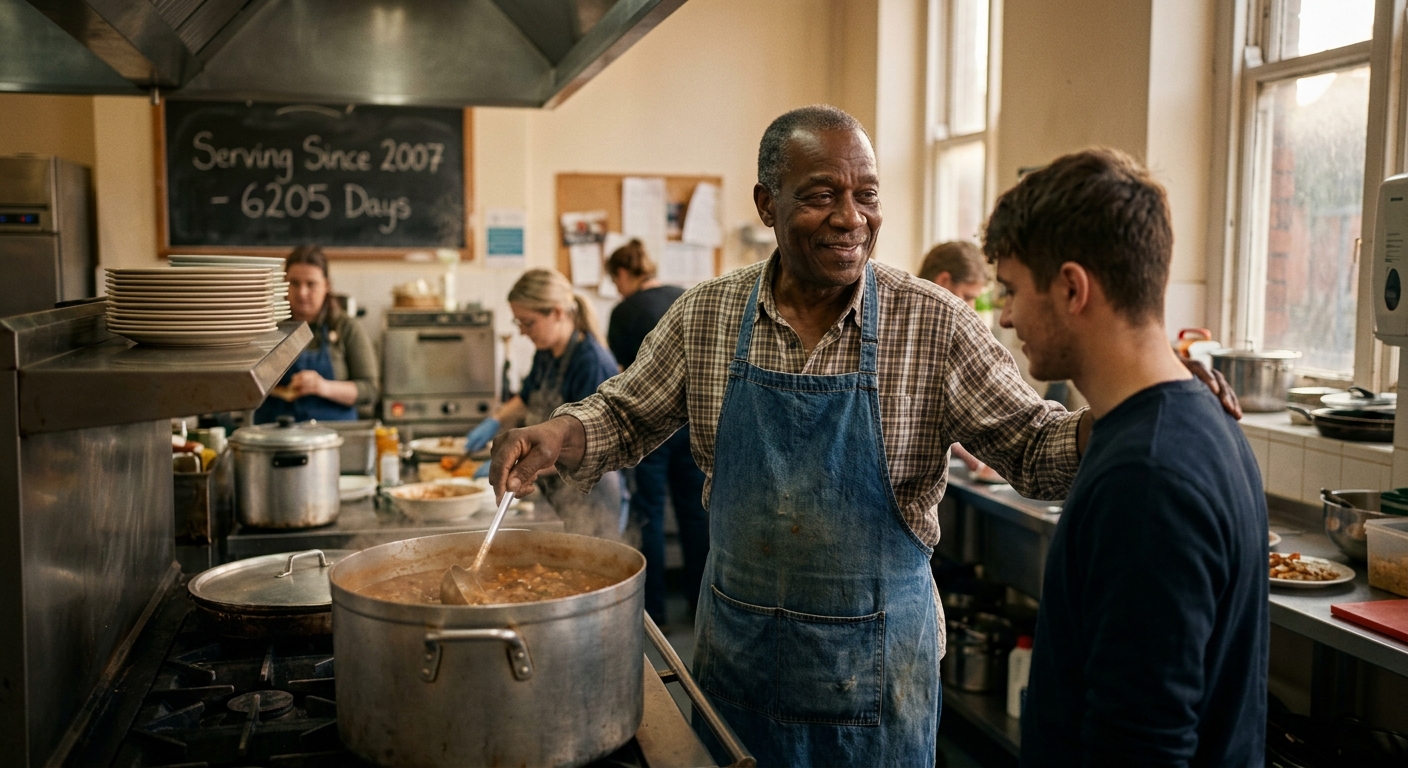
His name is Gerald Moss, and for the past 17 years, he has cooked and personally delivered hot meals to homebound seniors in his community without taking a single day off. Not a vacation day. Not a sick day. Not even on Christmas morning, when most of the world is still in pajamas and the roads are quiet and cold.
“People ask me when I’m going to retire,” Gerald says with a slow smile, wiping down his prep counter at 5:30 a.m. “I tell them I’ll retire when the need retires. And that hasn’t happened yet.”
How It Started: A Lasagna and a Wake-Up Call
Gerald did not set out to become a community institution. In 2007, he was a line cook at a mid-range restaurant, raising two kids, and trying to figure out what to do with his weekends. A neighbor, an 84-year-old woman named Dot, had fallen and broken her wrist. She could not cook for herself. Her children lived out of state. Someone from her church had mentioned it in passing, and Gerald overheard.
“I made her a lasagna,” he recalls. “Big pan of it. Figured it would last her a few days. When I dropped it off, she started crying. Not because of the lasagna. She said she hadn’t had a warm meal in four days.”
That detail lodged itself somewhere deep in Gerald’s chest and refused to leave. He started asking around. He learned that Dot was not an exception. She was a pattern. Across his city, hundreds of seniors were aging in place with limited mobility, no nearby family, and no reliable access to hot, nutritious food. Some were surviving on crackers. Some were skipping meals entirely.
Within three months, Gerald had quit his restaurant job, partnered with a local nonprofit, scraped together a commercial kitchen rental agreement, and started his route with eleven clients. Today, he serves more than sixty.
A Day in Gerald’s World
To understand what Gerald does, you have to understand the hours. His alarm goes off at 4:45 a.m. By 5:15, he is in the kitchen, reviewing the day’s dietary notes, which are color-coded by client. Blue stickers mean low sodium. Yellow means diabetic-friendly portions. Green means soft foods only due to dental issues.
He cooks everything from scratch. No frozen entrees. No reheated institutional food. On a typical Tuesday, the menu might include roasted chicken thighs with herb gravy, mashed sweet potatoes, steamed green beans, and homemade cornbread. There is always a dessert, even if it is just a small cup of fruit.
By 10:30 a.m., the meals are packed into insulated containers, labeled, and loaded into the van. Then Gerald drives. His route winds through apartment complexes, quiet suburban streets, and rural roads that become genuinely treacherous in winter. Some deliveries take two minutes. Others take twenty, because some of his clients just need to talk.
“There’s one gentleman, Walter, he’s 91. Every time I come, he wants to show me something, a photo, a newspaper clipping, something his grandson sent. I never rush him. That visit might be the highlight of his day.”
What the Research Confirms
Gerald’s instincts align closely with what public health researchers have been documenting for years. Social isolation among older adults is not just an emotional problem; it carries serious physical consequences.
- Isolated seniors have a 26 percent higher risk of premature death, according to studies published in peer-reviewed public health journals.
- Chronic loneliness is associated with increased rates of cognitive decline, including dementia.
- Malnutrition affects an estimated one in three homebound older adults, contributing to hospitalizations and reduced immune function.
- Regular, in-person contact from meal delivery programs has been shown to reduce depression scores significantly among elderly recipients.
Gerald is not just delivering calories. He is delivering contact, dignity, and continuity. His clients know he is coming. And that certainty, that someone reliable will knock on the door, matters more than most people realize.
The Hardest Part of the Job
Ask Gerald what the hardest part is, and he does not mention the early mornings or the logistics or the funding shortfalls that have made certain years a white-knuckle financial exercise. He pauses, looks down at the counter, and says one word: “Losing them.”
Over 17 years, Gerald has lost more than forty clients to old age and illness. He has been the one to notice when a door goes unanswered, to call for a wellness check, and in a handful of painful cases, to discover that something was very wrong. He has attended funerals when family invited him. He has sat in parking lots and cried when they did not.
“You can’t do this job and keep a professional distance,” he says. “These are people. Real people with whole lives. You get attached. And when they go, you feel it.”
He always keeps going. The next day, the alarm sounds at 4:45, and the kitchen fills with the smell of something warm.
What His Clients Say
Margaret, 78, has been on Gerald’s route for nine years. She has macular degeneration and uses a walker. When asked about Gerald, she says this: “He remembers that I don’t like cilantro. He remembered after I mentioned it once, three years ago. That tells you everything about the kind of man he is.”
Clarence, 83, puts it differently: “My daughter calls me twice a week. Gerald comes every single day. You do the math.”
Seven Things Gerald’s Story Teaches Us About Showing Up
- Consistency is its own form of love. Being reliably present for someone is a profound act of care, more powerful than grand gestures.
- Small actions compound into enormous impact. One lasagna became sixty daily meals and thousands of lives touched.
- Listening is part of the service. Gerald never separates the food from the human connection that accompanies it.
- Community gaps are visible if you pay attention. He did not conduct research. He listened to a neighbor and looked around.
- Grief does not have to stop purpose. Losing clients has never stopped Gerald from serving the ones who remain.
- Dignity matters as much as nutrition. Scratch cooking and real conversation communicate that someone is worth the effort.
- One person can genuinely change a community. Not with a campaign or a viral moment, but with a van, an alarm clock, and 17 years of showing up.
How You Can Help, or Start Something Similar
Gerald’s program operates on a combination of nonprofit grants, individual donations, and volunteer kitchen assistants who help on the busiest days. He is always in need of funding, and he is always willing to speak with people in other cities who want to model something similar in their own communities.
“The need is everywhere,” he says simply. “Every city has Dots. Every neighborhood has a Walter. You just have to decide to see them.”
If you want to support programs like Gerald’s, consider reaching out to your local Meals on Wheels affiliate, volunteering for senior wellness checks, or even doing what Gerald did at the very beginning: making a lasagna for a neighbor who cannot make one for themselves.
Sometimes the most extraordinary things begin with a casserole dish and the decision to pay attention.