
🎧 Listen to this story
Narrated by Schedar · 8,863 characters
The Day I Walked Into Room 7
I almost didn’t go back after the first day. I had signed up to volunteer at a hospice facility in my city with what I can only describe now as naive optimism. I imagined myself reading books aloud, bringing flowers, maybe holding someone’s hand during a peaceful afternoon. What I didn’t expect was the weight of it. The stillness. The particular kind of quiet that lives in a building where people are finishing their stories.
Room 7 was where I met Margaret. She was 84, sharp as a tack, and completely uninterested in my cheerful small talk. She looked at me the first time I came in, tilted her head, and said, ‘You’ve got that volunteer face on. Drop it.’ I laughed out loud. She smiled. And just like that, something real began.
Over the following months, I sat with dozens of patients. Some were talkative. Some preferred silence. Some were angry, some were radiant, and some were somewhere in between, processing a lifetime in what little time they had left. I went in thinking I was giving something. I had no idea how much I would receive.
Lesson 1: Regret Is Almost Never About What You Did
If I had a dollar for every time a patient expressed regret about something they never did, never said, never tried, I could have funded the entire hospice wing. The pattern was staggering in its consistency. Almost no one lay in those beds wishing they had worked more, worried more, or spent more time on things that didn’t matter to them. The regrets were almost universally about connection, courage, and presence.
A retired engineer named Donald told me he spent forty years being too proud to apologize to his brother after a falling out over something he couldn’t even fully remember anymore. ‘Forty years,’ he said, shaking his head. ‘Over nothing.’ His brother had died six years before him. That particular reconciliation would never come.
What do people wish they had done more of? Based on the conversations I was privileged to be part of, the answers were remarkably consistent:
- Told people they loved them, clearly and often
- Taken the trip, accepted the invitation, said yes more freely
- Spent less energy on the opinions of people who didn’t matter
- Forgiven sooner, both others and themselves
- Paid attention during ordinary moments instead of rushing through them
That last one hit me hardest. Not the grand gestures or the missed adventures, but the ordinary Tuesday afternoons that slipped by unnoticed while everyone was waiting for something more significant to arrive.
Lesson 2: The Body Keeps Score, But So Does the Heart
Hospice care introduced me to the concept of a ‘good death,’ which sounds like a contradiction until you witness one. A good death is not about the absence of pain or difficulty. It’s about the presence of meaning, love, and resolution. The patients who seemed most at peace were not necessarily the ones who had the easiest lives. They were the ones who had reconciled themselves to their choices, made amends where they could, and felt genuinely loved.
I watched a woman named Rita, a former schoolteacher, receive a steady stream of visitors during her final two weeks. Former students, now adults with children of their own, came to tell her what she had meant to them. She couldn’t speak by the end, but her face said everything. That was not luck. That was the harvest of a life spent showing up for others.
Meanwhile, I also sat with patients who had very few visitors. Who stared at ceilings and waited. It would be too simple and too cruel to say this was purely the result of their choices. Life is complicated. Circumstances are real. But in many cases, the isolation was something they themselves could trace back to walls they had built, bridges they had burned, vulnerability they had never allowed themselves.
Lesson 3: Time Is Not a Resource You Can Manage Back Into Existence
We talk about time management as if time is a material we can shape. The hospice stripped that illusion bare. There is no managing your way out of a finite life. There is only the question of what you do with what you have.
One of the volunteers who had been there for years told me something during a break that I have thought about almost every day since: ‘Nobody in there is thinking about their inbox.’
It sounds like a bumper sticker. It lands differently when you’ve just come out of a room where someone is measuring their remaining life in days.
What This Actually Looks Like in Practice
I am not going to pretend that my hospice experience transformed me into some enlightened being who floats serenely through life, untouched by stress or distraction. That would be both dishonest and annoying. What it did do was give me a kind of internal reference point. A question I now ask myself with some regularity: ‘Will this matter at the end?’
Sometimes the answer is yes, and that realization gives me energy. Sometimes the answer is obviously no, and that helps me let things go faster than I used to. And sometimes the answer is genuinely uncertain, and sitting with that uncertainty feels more honest than pretending otherwise.
Lesson 4: Presence Is the Most Radical Thing You Can Offer
In a world of constant distraction, simply being present, really present, with another person has become a quietly countercultural act. In hospice work, presence is everything. You cannot fix what is happening. You cannot offer solutions or silver linings. You can only show up, stay, and bear witness.
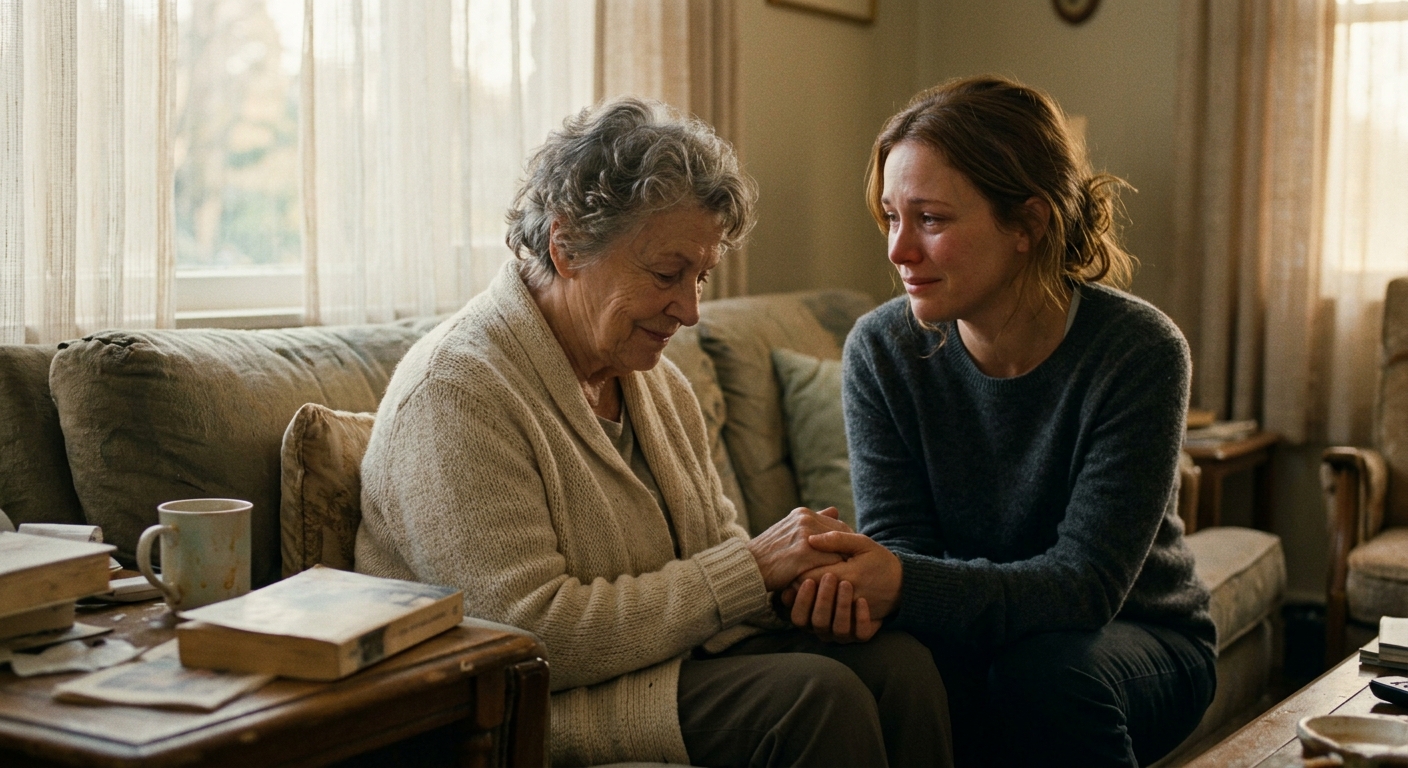
I learned to sit with silence without filling it. I learned that sometimes the most comforting thing you can say is nothing at all. I learned that a hand on a hand, steady and warm, communicates something that language cannot reach.
These are not skills exclusive to end-of-life care. They are the skills of any deep human relationship. They are what our partners, children, friends, and parents are often asking for when they don’t quite have the words for it. Not advice. Not solutions. Just someone who stays.
Lesson 5: How You Treat Small Moments Is How You Treat Your Life
Margaret, the woman from Room 7 who told me to drop my volunteer face, lived for another four months after I first met her. We had dozens of conversations. She talked about her garden, her late husband, a solo trip she took to Portugal in her sixties that she called ‘the most alive I ever felt.’ She talked about her fears and her frustrations and her love for her grandchildren with the same unflinching honesty she’d used to call me out on day one.
The last time I saw her, she was very tired. I sat beside her and we didn’t talk much. At one point she opened her eyes and looked at me with that clear, sharp gaze and said, ‘Pay attention, sweetheart. That’s all. Just pay attention.’
I have turned those five words over in my mind hundreds of times since. They are not complicated. They are not a philosophy or a framework or a productivity hack. They are an instruction so simple that it is almost impossible to follow consistently, and yet so foundational that everything else seems to depend on it.
Why I Think Everyone Should Spend Time in a Hospice
I am not suggesting that volunteering at a hospice is easy, or that it is the right fit for everyone. It requires emotional resilience, boundary-setting, and a certain tolerance for sitting with the unknown. Grief visits you regularly in that work, and you have to know how to care for yourself through it.
But I do believe that proximity to death, when held carefully and with support, is one of the most life-affirming experiences available to us. It clarifies. It strips away the noise. It returns you to what is actually essential in a way that very few other experiences can.
If hospice volunteering doesn’t feel right for you, there are other doorways into this kind of clarity: sitting with a grieving friend without trying to fix anything, writing a letter to someone you love telling them exactly what they mean to you, taking an unhurried hour to do nothing in particular and noticing what surfaces.
The question that the hospice pressed into me, gently but persistently, was this: Are you living the life you will be glad to have lived?
Not the life others expect. Not the life that looks best from the outside. The life that, at the end, will feel like yours.
A Final Note
If you are curious about hospice volunteering, I encourage you to reach out to a local facility. Most hospices have structured volunteer programs with training and ongoing support. The work is sacred. The lessons are irreplaceable. And the people waiting in those rooms have more to teach us than almost anyone else we will ever meet, if we are willing to sit down and listen.
Margaret taught me more in four months than most of my life experiences combined. She did it by being exactly, unapologetically herself, right up until the end. That, too, is a lesson worth carrying.