🎧 Listen to this story
Narrated by Vindemiatrix · 6,411 characters
The Box in the Back of the Closet
It was a Saturday afternoon with no particular agenda. I was doing one of those slow, aimless cleanouts that starts with “I’ll just reorganize this one shelf” and ends three hours later with you sitting cross-legged on the floor, surrounded by forgotten objects, completely lost in time.
That’s when I found the shoebox.
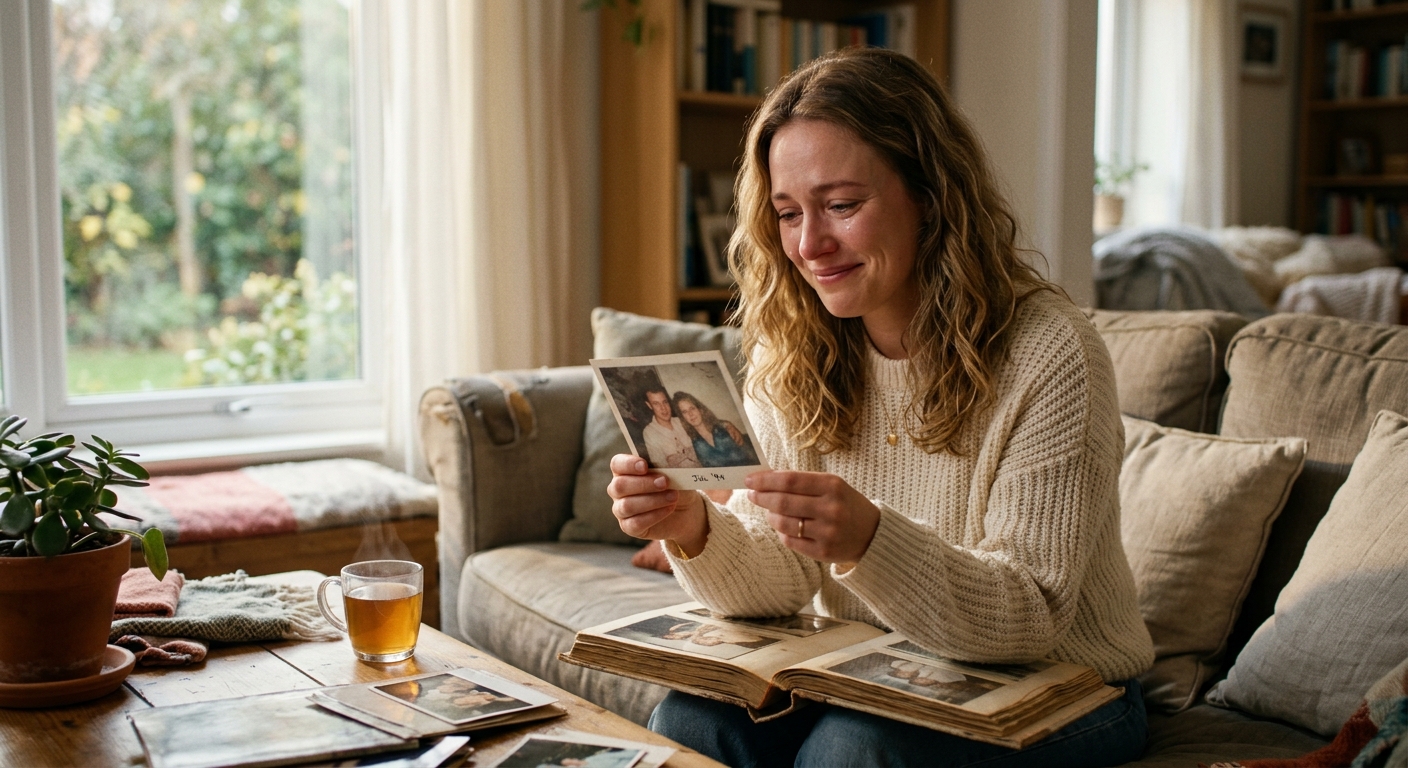
It wasn’t labeled. It wasn’t special looking. It was just a worn, slightly dusty cardboard box that had been quietly sitting in the back of my closet for what I can only estimate was somewhere between ten and fifteen years. Inside were old birthday cards, a couple of ticket stubs, some folded notes written in handwriting I barely recognized as my own, and at the very bottom, a stack of photographs held together by a rubber band that crumbled the moment I touched it.
I picked up the first photo. And something in my chest shifted.
What Was in the Picture
It was a summer barbecue, maybe thirty years ago. The photo was slightly faded, the colors warm and golden in that particular way that only old film photography manages. In it, my grandmother stood at the center of a crowded backyard, laughing at something just off camera. My father, young and sunburned, had his arm around her. My aunt was pouring lemonade. Two of my cousins were frozen mid-run across the lawn. And there, in the far left corner, barely in the frame, was a younger version of me, maybe seven or eight years old, looking up at all of them with an expression I can only describe as complete and total belonging.
I stared at that photo for a long time.
My grandmother has been gone for twelve years. My father lives two states away and we talk maybe once a month if we’re lucky. Those cousins are scattered across the country, caught up in their own full and complicated lives. And me? I’ve spent the last several years grinding through a career, chasing goals, optimizing routines, and quietly convincing myself that I was living intentionally.
That photo told a different story.
The Things We Stop Noticing
There’s a particular kind of grief that doesn’t announce itself. It doesn’t arrive with a dramatic event or a clear breaking point. It just accumulates quietly in the background, like dust on a shelf, until one ordinary Saturday afternoon you reach into a closet and it spills out all over the floor.
Looking at that photograph, I wasn’t grieving the people in it exactly. I was grieving the texture of those days. The unhurried way time moved. The ease of just being in a room with people you loved without needing a reason or an agenda. The way my grandmother’s laugh sounded. The smell of charcoal and cut grass. The absolute, uncomplicated joy of being seven years old in a backyard full of your people.
I had stopped noticing when I stopped having days like that.
And the harder question, the one I sat with for the rest of that afternoon, was this: had I stopped having those days, or had I simply stopped making space for them?
7 Things That Old Photograph Quietly Taught Me
- Presence is the only currency that doesn’t inflate. Nobody in that photo was checking their phone. Nobody was half-elsewhere. They were just there, fully, in that backyard, in that moment. That kind of presence is rarer now, and more precious for it.
- Joy doesn’t need a production budget. There were no elaborate plans in that photo. Just food, people, a lawn, and summer light. The simplest combinations are often the ones that stick.
- The people who anchor you deserve more than your leftover time. I had been giving my best hours to work and my leftover hours to the people I loved most. That photo made the math look embarrassing.
- You will not remember the urgent things. I cannot tell you a single stressful thing that was happening in my life the summer that photo was taken. I guarantee something was. But none of it made it into the picture, literally or figuratively.
- Photographs are a form of accountability. That image showed me, without flinching, what joy looked like on my own face when I wasn’t performing it. It also showed me how long it had been since I’d worn that expression.
- The people who are still here are the point. My father is two states away. He is also a phone call away. Those are both true, but I had been living as if only the first one mattered.
- Some of the most important things in your life will never show up on a resume. That afternoon in that backyard shaped me in ways that no achievement ever has. The warmth, the safety, the laughter, those are the things that become the foundation everything else is built on.
What I Did After I Put the Photo Down
I did something small. I know people expect grand gestures after moments of realization, but the truth is, most real change starts with something almost embarrassingly small.
I called my father.
Not to tell him about the photo or to have some heavy conversation. I just called to talk. We spoke for forty minutes about nothing important: a baseball team he’d been following, a documentary I thought he’d like, an old neighbor we both remembered. At the end of the call, before I hung up, I said, “I want to come visit soon. Like, actually soon.”
He paused for just a second and said, “I’d really like that.”
Forty minutes. One sentence. And something that had been quietly tightening in my chest for years loosened just a little.
The Question the Photo Kept Asking
I put the photograph on my desk where I can see it. Not as a source of sadness, but as a kind of compass. Because the question it keeps asking me is one I think we all need someone, or something, to ask us on a regular basis:
What are you actually doing with the time you have?
Not in a harsh way. Not as an indictment. More like a gentle tap on the shoulder from someone who loves you. A reminder that the goals, the productivity, the optimization, all of it is only meaningful if it’s pointed toward something real. Toward the people. Toward the moments. Toward the backyard barbecues and the laughing grandmothers and the cousins running across the lawn.
The box is still on my floor, actually. I haven’t put it back. I’ve been going through it slowly, one photograph at a time, letting each one ask me its question.
I’d recommend it, the slow kind of Saturday, the dusty shoebox, the honest reckoning. Not because it’s comfortable. But because sometimes the clearest directions home come from the places you almost forgot to look.