🎧 Listen to this story
Narrated by Sulafat · 8,750 characters
The Morning He Put Down the Sprayer
It was a Tuesday in late April when Gideon Hartwell walked out to his equipment shed, looked at the pesticide sprayer he had used for nearly two decades, and made a decision that would quietly reshape an entire agricultural region in the years that followed.
He did not have a grand plan. He was not an environmental activist. He was a third-generation corn and soybean farmer in the rolling hills of central Ohio, and he was, by his own admission, simply exhausted by the cost, the complexity, and a nagging feeling he could not quite articulate.
‘I kept watching the bees disappear,’ he told a local agricultural extension journalist several years later. ‘And I kept thinking, what am I actually doing to this land that my grandfather gave everything for?’
What followed was not an overnight transformation. It was messy, expensive at first, sometimes discouraging, and full of lessons he had to learn the hard way. But ten years after that April morning, the story of Gideon Hartwell and the Muskingum Valley has become one of the most quietly remarkable examples of grassroots environmental and agricultural change in recent memory.
Year One: The Hardest Season
Gideon did not go fully organic overnight. His first step was simply to eliminate synthetic pesticides from his fields while keeping other practices in place. He introduced companion planting in small test sections, planting marigolds and clover alongside his crops to deter insects naturally. He brought in a specialist from Ohio State’s agricultural extension program who looked at his soil samples and told him something that stuck with him for years: ‘Your soil is starving. It has inputs, but it has no life.’
That first summer was difficult. He lost a portion of one crop to a pest outbreak that he might have controlled with a single spray application. His neighbors noticed. Some were sympathetic. Others were skeptical in the blunt, practical way that farmers tend to be.
‘My neighbor Dale told me I was going to lose the farm by harvest,’ Gideon recalled with a laugh. ‘And honestly, for about six weeks in July, I thought he might be right.’
But he did not lose the farm. The harvest that autumn was lower than average, but not catastrophically so. And something else happened that he had not expected: his soil started to change. Earthworm counts in his test sections were up noticeably by fall. A few bee species he had not seen on the property in years began appearing near the clover borders.
The Ripple Effect Begins
By his third year, Gideon had expanded his pesticide-free zones to cover his entire 340-acre property. He had adopted cover cropping, rotational grazing with a small herd of cattle, and had begun using biological pest controls including beneficial insects and targeted natural sprays derived from plant oils.
His yields had stabilized and in some sections had actually improved, partly because his soil biology had recovered enough to support better nutrient cycling. Word started to get around in the way that it does in farming communities, quietly, over fences and at the grain elevator.
A neighboring farmer named Rosa Chen, who ran a 200-acre mixed vegetable and grain operation, came by to see what he was doing. She was not looking to replicate everything, just to understand it. She left four hours later with a notebook full of observations and a commitment to try cover cropping on one of her fields.
That small visit turned out to matter more than either of them knew at the time.
What Changed in the Valley
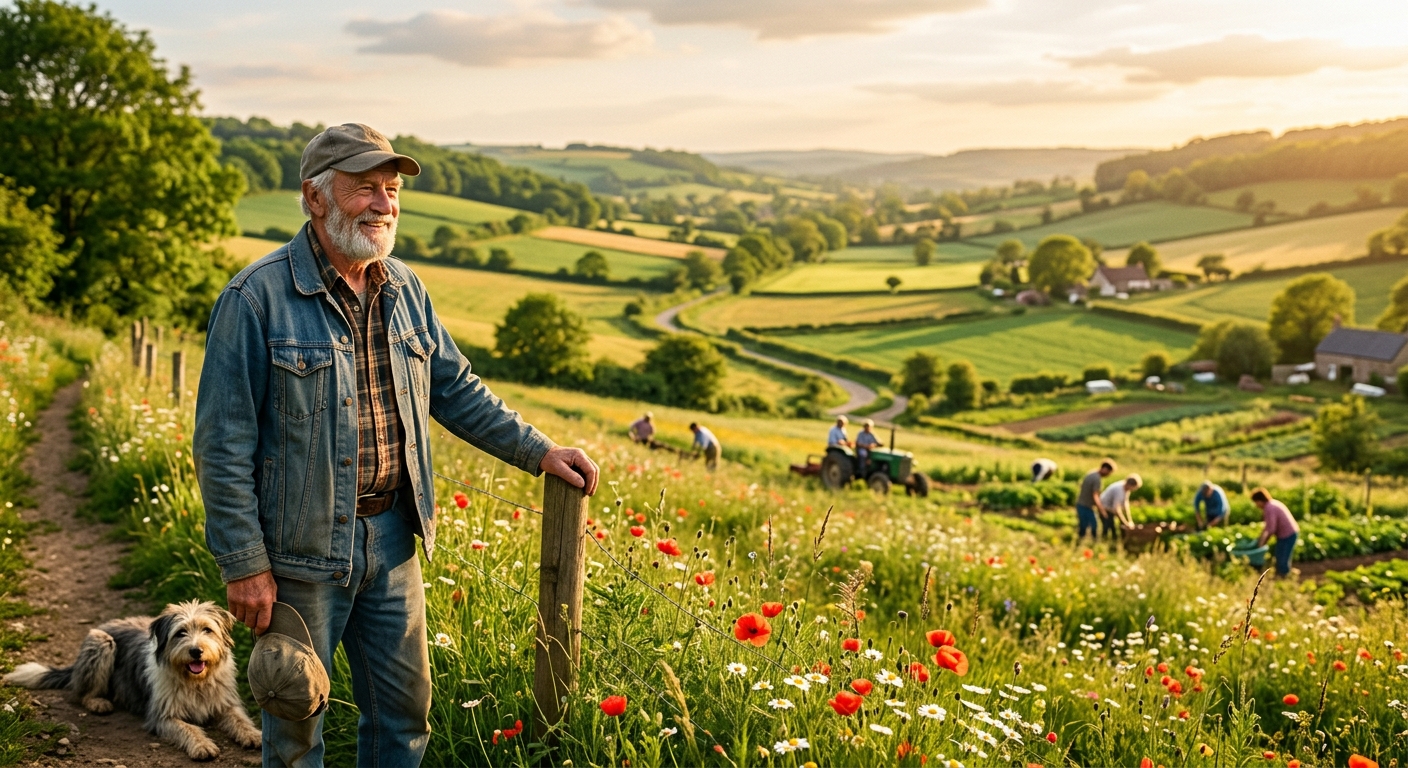
Over the following seven years, the transformation of the Muskingum Valley farming community unfolded not through top-down policy or government mandates, but through the oldest agricultural tradition there is: farmers watching what works on the land next to theirs.
Here is a breakdown of what researchers and local extension agents documented during that period:
- Pesticide use across the valley dropped by 67 percent among farms within a 12-mile radius of Gideon’s property, based on purchasing data compiled by regional agricultural co-ops.
- Pollinator populations rebounded significantly. A university study tracking bee species diversity in the region recorded a 40 percent increase in native bee variety over five years in the areas surrounding farms that had adopted reduced-chemical practices.
- Soil health metrics improved across participating farms. Organic matter content, a key indicator of soil vitality, rose by an average of 1.8 percentage points across 14 farms that adopted cover cropping and eliminated synthetic pesticides.
- A regional cooperative formed. In year six, 22 farmers in the valley joined together to form the Muskingum Clean Farm Cooperative, pooling resources for biological pest control supplies, sharing equipment, and collectively marketing their products as low-chemical or chemical-free to regional grocery buyers.
- Waterway health showed measurable improvement. A county environmental monitoring program noted reduced pesticide runoff in two local streams, with one waterway showing the first signs of returning aquatic insect life in over a decade.
The Science Behind the Shift
What Gideon stumbled into through intuition and frustration is increasingly supported by decades of agricultural science. Synthetic pesticides, while effective at eliminating target pests, also disrupt the complex web of organisms that keep soil and ecosystems functional. Beneficial insects, soil microbiota, and natural predators that keep pest populations in check are all affected.
When a single farm reduces chemical inputs, it creates what ecologists call a refuge, a space where beneficial species can survive, reproduce, and eventually spread into surrounding areas. In a dense agricultural landscape, even one such refuge can have an outsized positive impact on the surrounding ecosystem.
Dr. Amara Osei, an agricultural ecologist at Ohio State University who has studied the Muskingum Valley case, describes it this way: ‘What we see here is a cascade effect. One farm makes a change, the local ecology begins to respond, and neighboring farmers start to notice tangible benefits on their own land, more pollinators, fewer pest outbreaks, healthier soil. That makes the decision to change much easier for the next person.’
What Other Farmers Say Now
Dale, the skeptical neighbor who once predicted Gideon would lose the farm, is now a member of the Muskingum Clean Farm Cooperative. He began reducing pesticide use on his property in year five. He does not make a big deal of it.
‘I watched his yields for a few years,’ Dale said simply. ‘The numbers worked. And I’ll be honest, the creek at the back of my property has more life in it than I’ve seen since I was a boy. That means something to me.’
Rosa Chen, whose notebook visit in year three was one of the first ripples in the pond, now runs one of the most recognized chemical-free vegetable operations in the region. She supplies three regional grocery chains and a network of community-supported agriculture subscribers.
‘Gideon didn’t tell anyone what to do,’ Rosa said. ‘He just did it. And doing it honestly, including the hard years, was more convincing than any argument could have been.’
The Lessons This Story Carries
The story of Gideon Hartwell and the Muskingum Valley is not really about farming. Or rather, it is about farming in the same way that any good story about human behavior is about something much larger than its surface details.
It is about what happens when one person acts on a conviction, not perfectly, not with a master plan, but genuinely and persistently. It is about how communities actually change, not through grand proclamations but through visible results and quiet conversations. And it is about the relationship between individual choices and collective outcomes, a relationship that is easy to underestimate when you are standing alone in a field, wondering if any of it matters.
It matters. It almost always matters more than the person acting can see from where they are standing.
A Final Word from Gideon
When asked what advice he would give to a farmer thinking about making a similar change today, Gideon paused for a long moment before answering.
‘Start small,’ he said. ‘Pick one field. Give it three years before you judge it. And pay attention to what comes back, the insects, the birds, the way the soil smells after rain. Once you start noticing those things, the decision kind of makes itself.’
He paused again, then added something quieter: ‘My grandfather used to say the land remembers how to be healthy. It just needs you to stop getting in the way.’
Ten years after that Tuesday morning in April, the land in the Muskingum Valley seems to be proving him right.