
🎧 Listen to this story
Narrated by Rasalgethi · 8,425 characters
The Mystery That Has Baffled Scientists, Skeptics, and Dog Lovers for Decades
It happens in households all over the world, every single day. A dog that has been lounging on the couch, napping by the window, or quietly chewing a toy suddenly perks up. It walks to the front door. It sits. It waits. And roughly twenty to forty-five minutes later, a key turns in the lock and the owner walks through the door.
Nobody called ahead. Nobody sent a text. The owner’s schedule that day was completely irregular. So how did the dog know?
This phenomenon has fascinated pet owners, animal behaviorists, and parapsychologists for generations. And while the full picture is still being painted, what science and careful observation have uncovered is nothing short of extraordinary.
The Woman Who Started Taking It Seriously
In the 1990s, British biologist Rupert Sheldrake began documenting what many dog owners had been reporting anecdotally for years. He set up controlled video experiments, filming dogs at home while simultaneously tracking their owners’ movements and intentions miles away.
One of his most famous subjects was a dog named Jaytee, a mixed terrier whose owner, Pam Smart, would return home at unpredictable times. In hundreds of filmed sessions, Jaytee consistently moved to the porch or window within minutes of the moment Pam decided to head home, regardless of the time of day, regardless of whether she came by car, taxi, or on foot.
Skeptics attempted to replicate and debunk the study. Some argued there were methodological flaws. But Sheldrake’s core documentation remained compelling enough to inspire a generation of researchers to dig deeper. The question was no longer simply whether dogs could anticipate their owners, but how.
What Science Actually Tells Us
Researchers have proposed several overlapping explanations, and it is likely that the truth involves more than one of them working together.
1. A Nose That Puts Crime Labs to Shame
A dog’s sense of smell is estimated to be anywhere from 10,000 to 100,000 times more acute than a human’s. Their noses contain up to 300 million olfactory receptors, compared to about 6 million in humans. The part of their brain dedicated to analyzing smell is, proportionally, about 40 times larger than ours.
When you leave your home each morning, your scent lingers. It settles into furniture, floors, and air currents. Over the course of the day, that scent fades at a predictable rate. Researchers believe that dogs may literally be able to smell the time, tracking the gradual dissipation of their owner’s scent signature and learning to associate a certain threshold of fading with the owner’s return.
In other words, your dog’s nose might be functioning as a biological clock calibrated entirely around you.
2. Routine Recognition at a Microscopic Level
Dogs are masters of pattern recognition. Even in households with irregular schedules, dogs pick up on micro-cues that humans never consciously notice: the sound of a particular car engine two blocks away, the rhythm of a specific set of footsteps, the faint vibration of a garage door motor. Over months and years, these patterns get catalogued deep in a dog’s behavioral memory.
What looks like psychic ability to a stunned owner may be the result of a dog’s brain connecting hundreds of near-invisible sensory dots into a coherent prediction.
3. The Emotional Frequency Theory
This is where things get genuinely fascinating and a little harder to pin down. Sheldrake and others have proposed that the bond between dogs and their owners may involve some form of emotional or energetic connection that science has not yet fully mapped.
In Sheldrake’s experiments, some dogs began their anticipatory behavior at the precise moment their owner formed the intention to come home, before any physical travel had begun, before any car engine turned over, before any footsteps hit pavement. The owner might be sitting in a restaurant or an office, simply deciding it was time to leave, and the dog at home would immediately move to the door.
No scent. No sound. No visible cue. Just a shift in intention.
Whether this represents a form of quantum entanglement, a sensitivity to electromagnetic fields, or something else entirely remains one of the genuinely open questions in animal cognition research.
What Dog Owners Have Been Saying All Along
Long before any laboratory ever pointed a camera at a front porch, dog owners were sharing these stories. Here is a small collection of experiences that reflect what millions of people have witnessed firsthand:
- A nurse in Portland, Oregon described her German Shepherd sitting at the front window precisely when her hospital shift ended, even on nights she worked overtime and arrived home hours later than usual.
- A truck driver in rural Texas noted that his Border Collie would stop eating mid-meal and move to the driveway on the specific days the driver decided to take an alternate route home, despite arriving at the same time.
- A college student in the UK set up a pet camera to check on her anxious rescue dog and discovered the dog would stop pacing and calm down the moment she left the library to head back to her flat, sometimes a full half hour before she arrived.
These are not isolated incidents. They are reported across cultures, continents, and dog breeds, from working dogs on farms to pampered apartment pets in city high-rises.
The Role of the Bond Itself
One detail that consistently appears in both scientific observation and personal accounts is that the anticipatory behavior tends to be strongest in dogs with the deepest attachment to their owners. Dogs who have experienced trauma, abandonment, or frequent rehoming show less of this behavior. Dogs with secure, long-term bonds show it more reliably.
This suggests that whatever mechanism is at work, it may be amplified by emotional closeness. The stronger the relationship, the more finely tuned the connection.
Alexandra Horowitz, a dog cognition researcher at Barnard College and author of Inside of a Dog, has written extensively about how dogs experience the world through a sensory lens so different from ours that we have barely begun to understand its full dimensions. She notes that attributing dog behavior purely to training or routine misses the deeper reality: dogs are exquisitely calibrated to the specific humans they love.
Three Things This Tells Us About Our Dogs
They Are Paying Attention in Ways We Cannot See
Every moment you spend with your dog, information is being collected and stored. The way you smell after a long day. The particular cadence of your footsteps when you’re tired versus energized. The micro-expressions that cross your face when you’re about to reach for your keys. Your dog is building a detailed, multi-sensory portrait of you that runs deeper than any database.
The Bond Is Genuinely Reciprocal
It is easy to assume that love between humans and dogs is somewhat one-sided, that we project emotion onto animals who operate purely on instinct. But the evidence increasingly suggests otherwise. A dog who waits at the door for you is not running a program. Something in them recognizes something in you across distance and time. That is not instinct alone. That is connection.
We Still Have So Much to Learn
For all of modern science’s tools and measurements, the full story of how dogs know when we’re coming home has not been completely told. And that is a genuinely wonderful thing. It means that the relationship between humans and dogs contains mysteries still worth exploring, wonders that have survived centuries of domestication and still refuse to be fully explained away.
The Simple Truth at the Heart of It All
Your dog waits for you. Not because it was trained to, not entirely because of scent or sound, and not simply because of routine. It waits because you matter to it in a way that reshapes its entire sensory experience of the world.
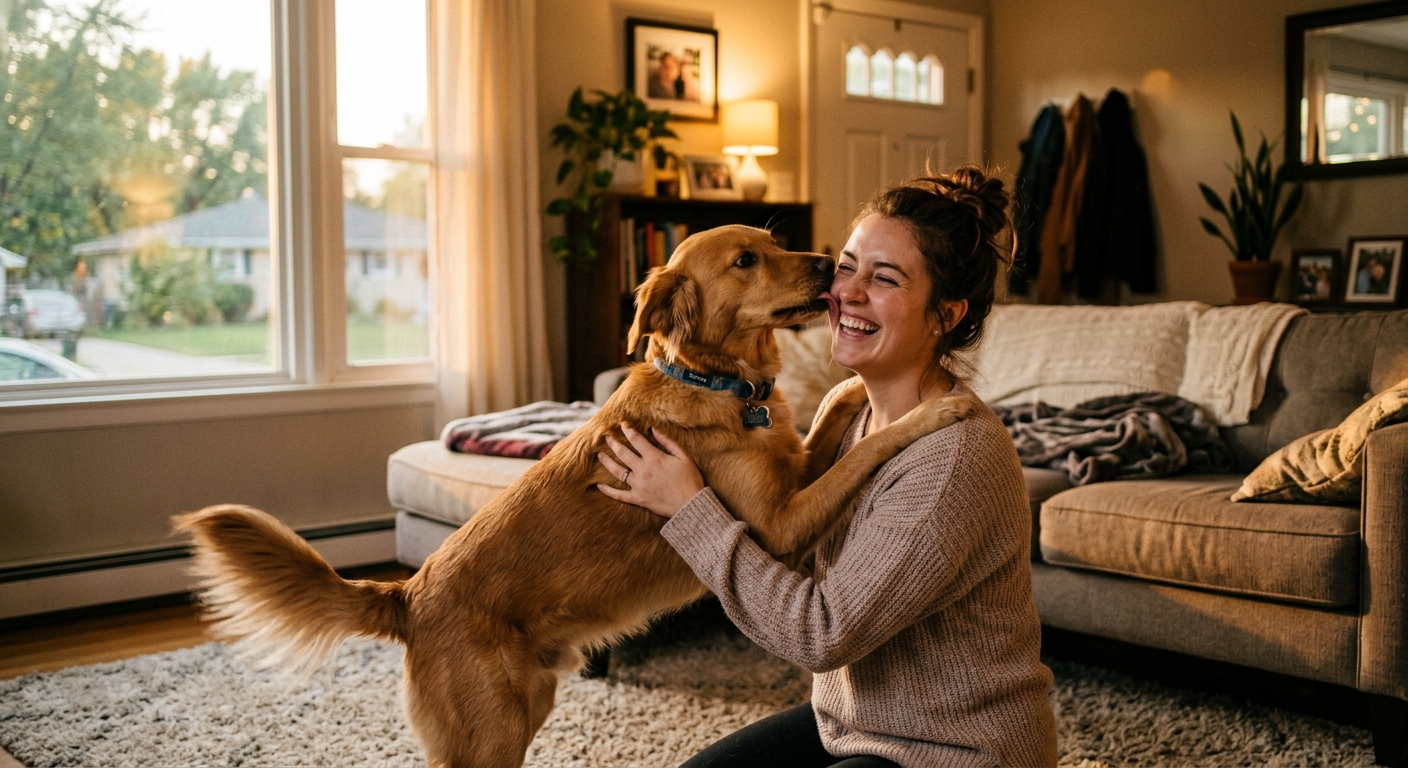
The next time you come home to find your dog already at the door, tail going, eyes bright, body vibrating with the kind of joy that humans mostly forget how to feel, take a moment. Not just to appreciate the greeting, but to appreciate what it represents.
Somewhere between biology and mystery, between science and love, your dog has been counting down the minutes to your return. And that, perhaps more than any study or theory or controlled experiment, is the part worth holding onto.