🎧 Listen to this story
Narrated by Sulafat · 7,479 characters
Every Morning, the Same Ritual
It started the way most extraordinary things do: quietly, without any fanfare, and over something as ordinary as breakfast.
Gabi Mann was eight years old when she began sharing her food with the crows that gathered near her Seattle home. It was not a scientific experiment. It was not a project for school. It was simply the instinct of a generous child who noticed hungry birds and decided to do something about it. She scattered peanuts and bits of food in the yard each morning before school, and the crows always came.
What she did not expect was for them to start giving something back.
The First Gift
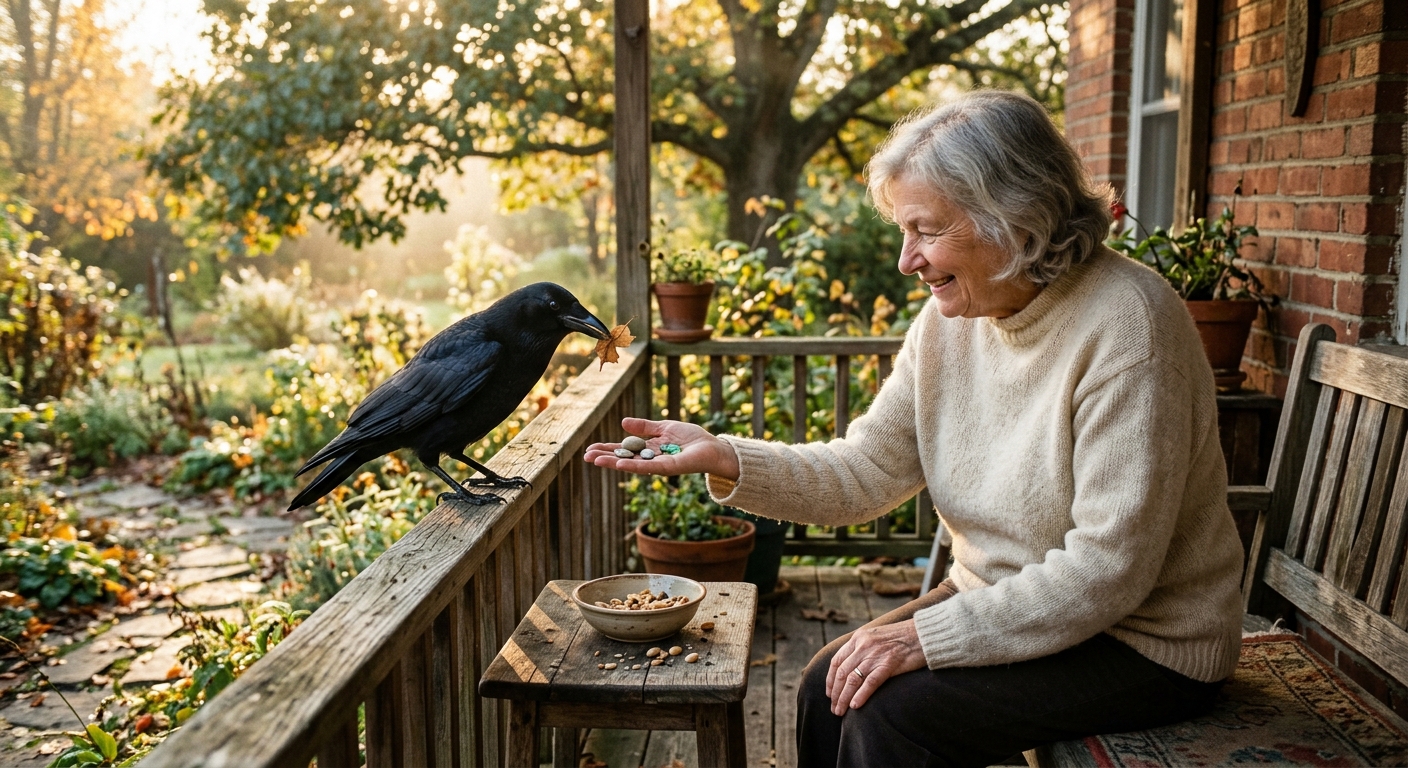
One morning, Gabi noticed something small and shiny sitting in the birdbath near where she usually left food. It was a tiny pearl-colored button. The next day, a piece of black foam. Then a rusted screw. Then a small blue bead that caught the light like a jewel.
The crows were leaving her things.
Her mother Lisa began documenting the objects in a meticulous labeled collection stored in plastic bags and bead boxes. Over time, the gifts accumulated into something remarkable: a broken piece of light bulb, a black button, a blue paper clip, a small green piece of sea glass, a white pebble, a brass fastener, and dozens more. Each item was cataloged with the date it was found. Some items were trash by most standards. Others, the Manns felt, were treasures.
When a local news story brought their experience to wide attention, it captivated the internet and drew the curiosity of wildlife researchers who said this behavior, while unusual, was not entirely without scientific basis.
What Science Says About Crow Intelligence
Crows belong to the corvid family, which also includes ravens, magpies, jays, and jackdaws. For decades, researchers have studied corvids and found that their cognitive abilities rival those of great apes in several key areas. They use tools, recognize human faces, remember specific people who have treated them well or badly, and communicate information across generations of birds.
Corvids Remember Faces
A landmark study from the University of Washington found that crows could recognize and remember the faces of humans who had captured and banded them for research. Even years later, those same crows would scold and dive-bomb the researchers. Conversely, they appeared to develop positive associations with people who fed and treated them well.
They Understand Reciprocity
The gift-giving behavior observed by the Mann family aligns with what researchers describe as reciprocal exchange behaviors in corvids. While scientists are careful about attributing human motivations to animals, the evidence suggests crows are capable of associating specific people with positive experiences and adjusting their behavior accordingly.
John Marzluff, a wildlife biologist at the University of Washington who has spent years studying urban crows, has spoken at length about how crows integrate themselves into human environments and form long-term relationships with individual people. His research suggests the gifts Gabi received were likely a natural extension of a relationship the crows had come to value.
A Friendship Built in Small Moments
What makes the story of Gabi and her crows so quietly moving is not the scientific explanation but the human element underneath it. A child chose generosity as her default setting. She did not feed the crows because she expected a reward. She did not start a project or seek recognition. She simply saw creatures that were hungry, and she shared what she had.
That consistency, that showing up every single morning regardless of weather or mood or circumstance, is what built the trust. The crows came to know her schedule. They learned her face. They watched her walk to the bus stop and began escorting her there. When she dropped food, they waited. When she called to them, they answered.
It is the kind of relationship that takes time and reliability to grow. And Gabi, even at eight years old, gave both.
What the Gifts Actually Mean
There is something deeply poetic about receiving gifts from a wild creature. The objects left by Gabi’s crows were not valuable in any conventional sense, but they carried weight. They were proof of attention, of memory, of a relationship forming across the boundary between human and wild.
Her mother Lisa described one moment in particular: Gabi had lost a lens cap from a camera near the yard. A few days later, one of the crows left it in the birdbath. Whether this was coincidence or something more deliberate has never been confirmed. But the Mann family chose to believe it was a small act of care.
Perhaps what matters most is not whether the crow understood what it was doing in human terms. What matters is the effect: a little girl who learned that kindness creates connection, and that the world responds to generosity in ways you cannot always predict or plan for.
7 Things We Can Learn From Gabi and Her Crows
- Consistency builds trust. Gabi showed up every morning. In relationships of any kind, showing up reliably matters more than grand gestures.
- Generosity without expectation opens unexpected doors. She never fed the crows hoping they would give her things. The gifts came precisely because they were not the goal.
- Intelligence shows up in unexpected places. The crows reminded the world that brilliance and emotional depth are not exclusively human qualities.
- Children often see clearly what adults overcomplicate. Gabi did not need a study or a theory to understand that feeding a hungry animal was simply the right thing to do.
- Small rituals carry enormous meaning. A handful of peanuts each morning became the foundation of a cross-species friendship that lasted years.
- Documentation preserves wonder. Lisa Mann’s careful labeling of each gift turned a fleeting experience into a lasting story. Record the things that move you.
- Nature rewards attention. The more closely Gabi paid attention to the crows, the more they paid attention to her. Presence is its own kind of gift.
A Lesson That Goes Beyond Birds
It would be easy to read this story as a charming curiosity, a fun fact to share at dinner parties. But there is something deeper here if you are willing to sit with it.
We live in a world that often measures kindness by its return on investment. We are encouraged to give strategically, to network with purpose, to be generous in ways that advance our goals. Gabi had none of that calculus. She was eight. She saw birds. She shared her food.
And the universe, in its quiet and feathered way, said thank you with blue beads and lost lens caps and a glossy-winged escort to the school bus.
The crows did not read a book about reciprocity. They simply responded to being treated as though they mattered. Which is, when you think about it, all any of us ever really want.
The Collection Lives On
As of the last reports from the Mann family, Gabi’s collection of crow gifts continued to grow even as she moved into her teenage years. The birds that first came when she was a small child had, in the way of crows, likely passed their knowledge of her down to younger birds in the flock. The relationship, in a sense, had outlasted its original moment.
Some mornings, she still goes outside. The crows still come. And somewhere in a carefully labeled box, a small pearl button sits beside a blue bead and a rusted screw, proof that kindness, even when it asks for nothing, tends to find its way back to you.