🎧 Listen to this story
Narrated by Kore · 6,934 characters
A Rainy Tuesday That Nobody Will Forget
It was the kind of afternoon that makes you want to stay indoors. Dark clouds had rolled in fast over the small town of Clarksville, Tennessee, and the rain was coming down in heavy, relentless sheets. Most people were rushing to their cars, pulling up hoods, and cursing the weather app they had ignored that morning.
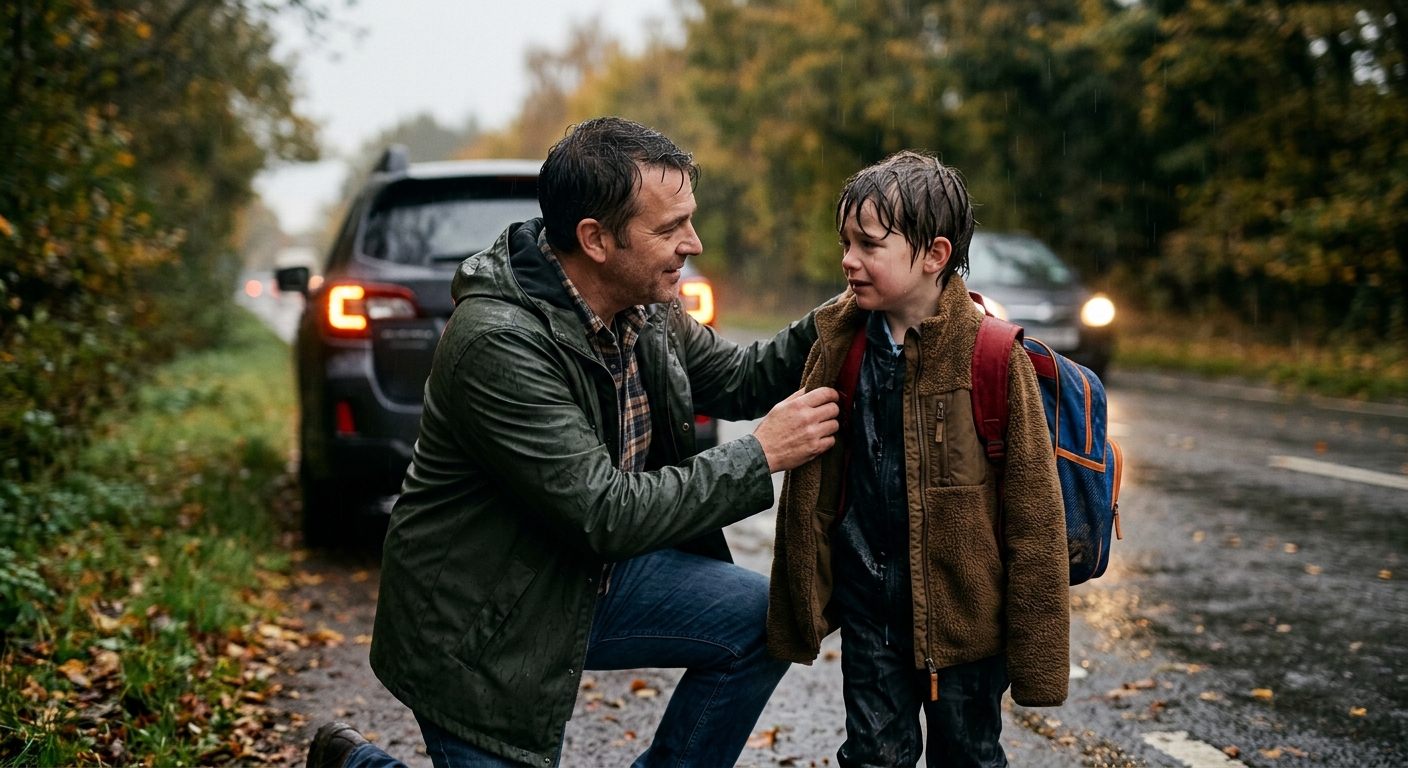
Marcus Webb, a 34-year-old electrician, was driving home after a long shift when his headlights caught something unusual at the edge of the road. A small boy, no older than seven or eight, was walking alone along the sidewalk. No umbrella. No raincoat. Just a backpack and sneakers that were clearly soaked through.
Marcus slowed down. Then he stopped.
“I almost kept going,” he admitted later. “You hear stories, you know. You don’t want to scare a kid or make things worse. But I just couldn’t drive past him. Something in me said, ‘That’s somebody’s child.'”
The Moment He Made the Call
Marcus pulled his truck over to the curb and rolled down the passenger window. The boy, whose name turned out to be Eli, stopped walking and looked at the truck with cautious eyes. Marcus stayed inside and called out gently, asking if Eli was okay and whether he knew where he was going.
Eli said he did. He was walking home from school. He lived about two miles away. He had missed the bus.
Two miles. In the rain. Alone. At eight years old.
Marcus asked Eli if he could call his mom or dad so that a parent could come pick him up. Eli’s face crumpled slightly. His mom was at work, and she didn’t always answer her phone during shifts. His dad was out of the picture.
“He wasn’t crying,” Marcus recalled. “He was just… resigned. Like this was something that happened sometimes and he just had to get through it. That hit me harder than anything.”
Building Trust, One Careful Step at a Time
What Marcus did next is something child safety experts would actually praise. He did not immediately offer Eli a ride. Instead, he parked the truck, got out, and stood at a respectful distance. He introduced himself clearly. He showed Eli his driver’s license so the boy could see his name and face. He called his own wife on speaker phone and had her speak directly to Eli, giving the child a point of contact he could trust.
Then he said: “I’m not going to make you get in my truck. But I’d like to help you get home safely. What would make you feel okay about that?”
Eli thought about it for a moment. Then he asked if Marcus could call his teacher. Marcus said absolutely. Eli recited the school’s phone number from memory, and Marcus dialed it right there on the sidewalk, standing in the rain himself now, getting soaked alongside this small, serious boy.
The teacher confirmed who Marcus was speaking to and vouched that getting in the truck was safe. The school also reached Eli’s mother, who tearfully gave her permission and her address.
The Ride Home
The drive took less than ten minutes. Marcus had an old kids’ playlist on his phone from road trips with his own daughter, and he put it on low. Eli sat in the back seat, wrapped in a dry hoodie Marcus dug out from behind the seat, and by the time they turned onto Eli’s street, the boy was quietly singing along to a song he recognized.
Eli’s aunt, who had been called ahead, was waiting on the porch. She ran down the steps the moment she saw the truck and pulled Eli into a hug so fierce it bent her at the waist. She looked up at Marcus with wet eyes and said simply, “Thank you for stopping.”
Marcus waved it off. But he sat in his truck for a moment before driving away, and he later told his wife he cried the whole ride home.
What This Story Teaches Us About Community
When Marcus shared the story on a local Facebook group a few days later, the response was immediate and overwhelming. Thousands of shares. Hundreds of comments from parents who said they had experienced the fear of their child being unreachable. Teachers who shared how often kids miss buses with no backup plan. And neighbors who said the post inspired them to actually introduce themselves to the families on their street.
But beyond the feel-good reaction, this story raises some genuinely important questions worth sitting with:
How Do We Build the Kind of Community Where This Goes Well?
- Neighbors who know each other by name are more likely to notice when something is off and more likely to be trusted when they try to help.
- Kids who have practiced stranger safety, not just “never talk to strangers” but nuanced conversations about trusted adults and safe situations, are better equipped to make good decisions in moments like these.
- Parents who have backup contacts listed at school ensure that a missed bus doesn’t become a crisis. One extra name on a form can change everything.
- Adults who slow down instead of assuming someone else will handle it are the thread that holds a community together.
Marcus Didn’t See Himself as a Hero
In the days after the story went viral locally, Marcus was asked to appear on a morning radio show. He declined. He didn’t want the attention. What he said in a follow-up comment on the Facebook post was quietly profound:
“I just did what I hope someone would do if they ever saw my daughter walking alone in the rain. That’s all this was. Everybody has the ability to be that person for somebody else’s kid. You just have to decide not to keep driving.”
That last sentence has been shared as a standalone quote hundreds of times since. Printed out and stuck on refrigerators. Used as a caption on Instagram posts. Read aloud at a school assembly in a neighboring district.
It resonates because it’s not a call to heroism. It’s a call to basic human attention.
Eli’s Mom Reached Out
About a week after the incident, Eli’s mother, a nurse named Dana, reached out to Marcus directly. She had been struggling with guilt, as working parents often do when circumstances beyond their control create gaps in their children’s care. Marcus told her she had raised a remarkably composed and smart kid, and that Eli’s instinct to ask for a trusted adult voucher before getting in the truck showed real maturity.
Dana laughed through tears at that. “He got that from a book we read together,” she said. “I didn’t even know he remembered it.”
The two families have since met for dinner once. Their kids played in the backyard while the adults talked. Nothing dramatic. Just neighbors becoming friends, the way it used to happen more often.
The Quiet Ripple Effect of One Good Decision
Stories like this one don’t change the world in a headline. They change it in the small, slow way that actually lasts. A driver who stops. A boy who gets home safely. A mother who doesn’t carry guilt for years. A community that remembers it has the power to look out for its own.
You don’t need a platform, a charity, or a grand gesture. Sometimes all it takes is looking out the window during a rainstorm and choosing not to look away.