
🎧 Listen to this story
Narrated by Gacrux · 7,655 characters
A Flight That Almost Didn’t Wait
On a busy Tuesday evening at Denver International Airport, Flight 2461 was minutes away from pushing back from the gate. Passengers were buckled in, overhead bins were shut, and the flight attendants had begun their safety demonstration. By every measure of airline protocol, the plane was ready to go.
But somewhere in that terminal, a man named Daniel Holt was sprinting through the concourse, phone pressed to his ear, voice cracking with every stride. His father had just suffered a catastrophic stroke in a hospital in Memphis, and the doctors had told him, gently but plainly, that he needed to come now. Not tomorrow. Not on the next available flight. Now.
Daniel had made it to Denver from a work conference in Boulder, caught an Uber at record speed, and cleared security just barely. But the gate had already shown “Departed” on the board. He ran anyway, because sometimes you run even when you know it’s too late.
The Decision That Changed Everything
Captain Mark Gennaro had been a commercial pilot for over 22 years. He had flown through turbulence over the Atlantic, navigated fog delays at O’Hare, and once guided a plane to an emergency landing with a failed hydraulic system. He knew the rulebook inside and out, and he respected it. Airlines have schedules for a reason. Delays cost money, frustrate passengers, and can create cascading problems across an entire network of flights.
But on that Tuesday night, his gate agent knocked on the cockpit door and told him something simple: there was a man outside the jetway, barely able to breathe from running, who needed to get to his dying father.
Captain Gennaro did not hesitate for long. According to passengers on board, the intercom crackled and his voice came through calm and unhurried:
“Folks, I know we’re ready to push back, and I appreciate your patience. We’re going to hold for just a few more minutes. There’s a passenger who needs to be with his family tonight, and we’re going to make sure he gets there. Thank you for understanding.”
The cabin was quiet for a moment. Then, a few rows back, someone started clapping. And then the whole plane followed.
What the Other Passengers Did Next
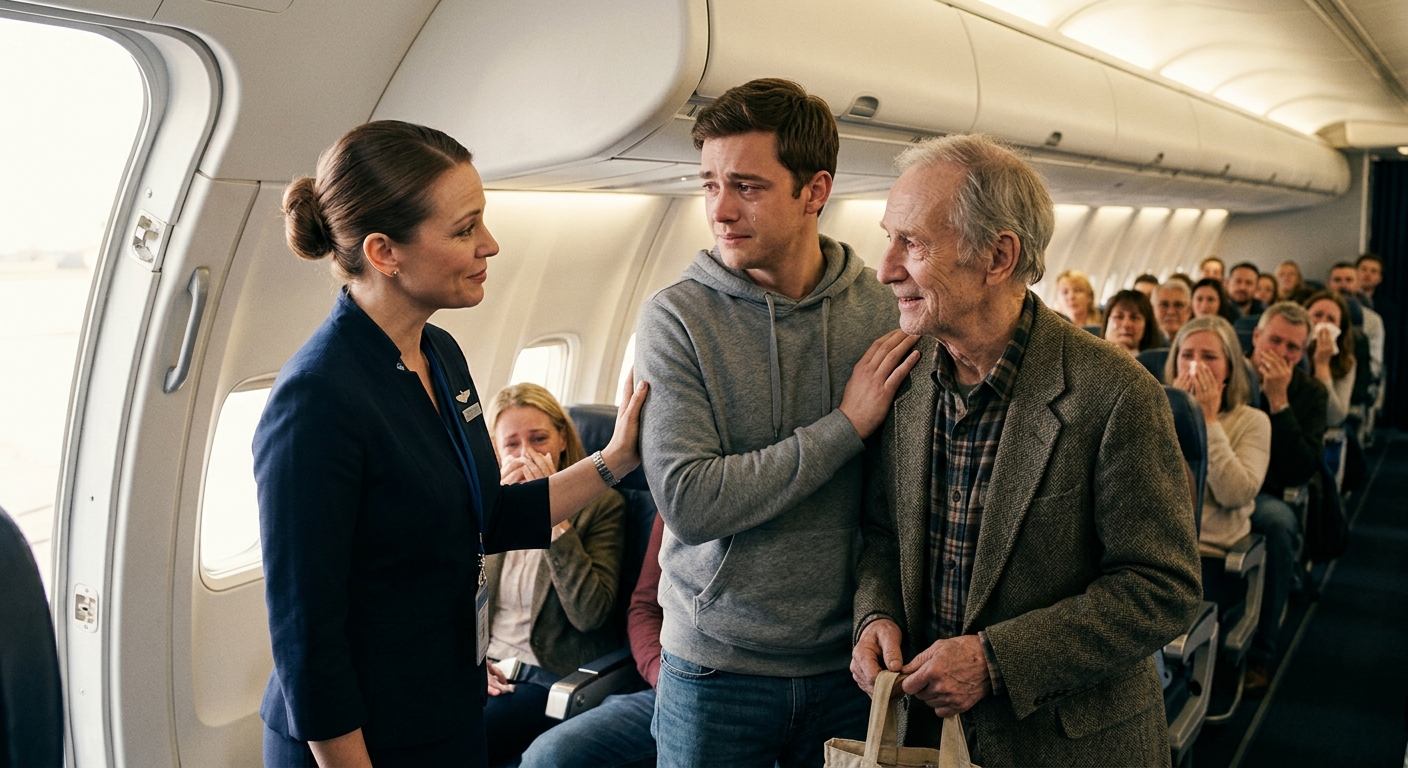
When Daniel finally boarded, red-faced and trembling, he expected at best a few cold stares. He was the reason everyone had been delayed. He was the inconvenience. Instead, a flight attendant took his bag from him without a word, a woman in 14C handed him a pack of tissues, and a retired nurse in the exit row leaned across the aisle and said, “We’re all rooting for you, honey.”
A fellow passenger, Sarah Okafor, later shared the story on social media, and her post was shared over 400,000 times in 48 hours. She wrote:
“I’ve never felt more proud to be stuck on a delayed flight. That captain reminded all of us what it means to see another human being. I’m not crying, you’re crying.”
Sarah noted that during the flight, several passengers quietly asked the flight attendants if there was anything that could be done to help Daniel get off the plane faster once they landed. The crew arranged for him to deplane first, and a gate agent in Memphis had a car service waiting to take him directly to the hospital.
He Made It in Time
Daniel arrived at the hospital at 11:47 p.m. His father, Raymond Holt, a retired schoolteacher and Navy veteran, passed away at 12:22 a.m. with his son holding his hand.
In a short statement Daniel later shared publicly, he wrote:
“I got to tell my dad I loved him. I got to hold his hand when he left. I got to say goodbye. That is everything. That pilot, those passengers, that crew, they gave me the only thing that mattered. I will never forget it as long as I live.”
What This Story Teaches Us About Humanity
It would be easy to call this a feel-good story and move on. But there are layers here worth sitting with.
1. Rules Exist to Serve People, Not the Other Way Around
Captain Gennaro did not throw the rulebook out the window. He made a judgment call within his authority as the pilot in command of that aircraft. There is a difference between breaking rules recklessly and exercising human discretion wisely. He chose the latter, and it cost the other passengers fewer than 12 minutes.
2. Inconvenience Looks Different When You Know the Story
Every delayed flight has a grumbling passenger or two. That is understandable. But Sarah Okafor’s post struck such a nerve because it reminded people that inconvenience is relative. Twelve minutes versus a lifetime without a final goodbye. When we know the context, our tolerance for disruption expands dramatically.
3. Kindness Is Contagious in the Best Possible Way
The captain’s decision did not just help Daniel. It transformed the atmosphere of the entire cabin. Strangers handed tissues to a man they had never met. A nurse offered words of comfort. Passengers coordinated to let him off first. One act of grace unlocked a chain of them.
4. The People Around You Are Carrying Things You Cannot See
The man rushing through the terminal, the woman crying quietly in the window seat, the teenager staring at his phone with hollow eyes. We are surrounded by people mid-crisis, mid-grief, mid-breakthrough, and mid-miracle at all times. The capacity to pause and ask “what does this person need right now?” is rarer than it should be, and more powerful than we often realize.
5. Heroes Are Not Always Wearing Capes
Captain Gennaro did not scale a building or run into a burning structure. He held a plane for 12 minutes. He used his position to show one terrified, grief-stricken son that he mattered. That is the kind of heroism most of us can practice every single day in our own small ways, if we choose to.
Captain Gennaro’s Response to the Attention
When journalists tracked down Captain Gennaro for comment, he was characteristically understated. He said:
“I’m a father. I have a father. It wasn’t a hard decision. I just hope more people get the chance to make it.”
He declined further interviews, citing a preference for keeping the focus on Daniel and his family. A spokesperson for the airline confirmed the delay was logged as “operational,” and that Captain Gennaro received no disciplinary action, only commendations.
The Ripple Effect of One Good Decision
In the weeks following Sarah’s viral post, hundreds of people shared their own stories in the comments. Stories of strangers who had once pulled over to help them change a tire in the rain. Teachers who stayed late to help them understand something they were ashamed to not know. Neighbors who quietly shoveled their driveways after a surgery without ever mentioning it.
The story of Daniel and Captain Gennaro did what the best stories do: it held up a mirror. It reminded people of both the kindness they had received and the kindness they still had the capacity to give.
Raymond Holt was a Navy veteran and a schoolteacher. The people who knew him described a man who showed up for others without fanfare, who believed in doing the right thing even when it cost you something. In a beautiful, unplanned way, the story of his final night became a tribute to everything he stood for.
A Final Thought
We spend a great deal of time building systems designed for efficiency. Schedules, protocols, timelines, and metrics. These things matter and they serve a real purpose. But every now and then, a moment arrives that asks us to look past the system and see the person standing in front of it.
Captain Gennaro saw that person. And because he did, a son got to say goodbye to his father.
The next time you are in a position to hold the plane, even metaphorically, even just for a moment: hold it.