
🎧 Listen to this story
Narrated by Vindemiatrix · 7,344 characters
The Bird You’ve Been Underestimating Your Entire Life
Most people see a crow and think: scavenger. Nuisance. The ominous black bird perched on a fence, picking at something unpleasant on the side of the road. We shoo them away, we write them into horror movies, we give them names like ‘murder’ when they gather in groups. But what if everything you thought you knew about crows was wrong?
Science has spent the last few decades quietly uncovering one of the most startling truths in the animal kingdom: crows are among the most intelligent creatures on Earth. Not just ‘smart for a bird.’ Genuinely, measurably, disturbingly intelligent in ways that force us to rethink what we believe about animal minds, problem-solving, and even emotion.
Here are some of the most remarkable things researchers have discovered about these misunderstood birds, and why paying attention to them might just change the way you see the world.
1. They Recognize Individual Human Faces
This is not a metaphor. Crows can look at a crowd of people and identify specific individuals, remembering whether that person has been kind or threatening to them. A landmark study at the University of Washington confirmed this in a remarkable way: researchers wore caveman masks while trapping and banding crows on campus. When those same masked researchers returned months later, without doing anything threatening, the crows immediately scolded them, dive-bombed them, and alerted other crows nearby.
The information was also passed on. Crows that had never even encountered the masked researchers joined in the scolding, having apparently learned from other members of the group that this particular face meant danger. That is not instinct. That is social learning, cultural transmission of information, the very building block of civilization.
If a crow has decided it does not like you, it will not forget. And it will tell its friends.
2. They Use and Make Tools
For a long time, tool use was considered one of the defining characteristics of human intelligence. Then we discovered chimpanzees used sticks to fish termites from mounds. And then we discovered crows doing something arguably more sophisticated.
New Caledonian crows, a species found in the Pacific, have been observed crafting hooks from sticks and leaves in order to retrieve food from narrow crevices. They select materials with deliberate care, shape them with their beaks, and even carry their tools from one feeding site to another, treating them as possessions worth keeping. In laboratory settings, crows have solved multi-step puzzles that require using one tool to unlock access to another tool, which is then used to retrieve food. This is called ‘meta-tool use,’ and it was once thought to be exclusive to great apes.
Betty, a New Caledonian crow studied at Oxford University, spontaneously bent a straight wire into a hook to lift a bucket of food from a vertical tube. She had never seen wire before. She figured it out on her own, in the moment, through what researchers cautiously described as insight.
3. They Plan for the Future
Most animals operate in the present tense. They eat when they are hungry, they sleep when they are tired, they react to what is directly in front of them. Crows do something different: they think ahead.
Studies have shown that crows cache food strategically, not just hiding it randomly but considering who might be watching. If a crow suspects it has been observed while hiding food, it will wait until the observer is gone and then move the cache to a new location. This requires the crow to understand that another creature has a perspective different from its own, a cognitive milestone called ‘theory of mind’ that human children typically don’t develop until around age four.
Crows also plan for tomorrow. Research published in Science showed that corvids (the family that includes crows, ravens, and jays) will pass up an immediate food reward in order to save a tool they will need the following morning to access a better meal. That is delayed gratification paired with future planning, a combination that most animals, and frankly many humans, struggle with.
4. They Mourn Their Dead
Perhaps the most quietly devastating discovery is this: crows hold funerals.
When a crow dies, other crows will gather around the body in large numbers, often going silent, sometimes touching the deceased bird. Researchers initially thought this might be a warning behavior, a way of assessing danger in the environment. But further study revealed something more layered. Crows appear to be gathering information, yes, but they also exhibit behaviors consistent with mourning as seen in elephants and great apes: lingering, vocalizing in specific ways, and showing signs of stress in the days following the death of a flock member.
Whether crows grieve in the emotional sense that humans do, we cannot say with certainty. But the behavior is undeniable. These birds mark death as significant. They do not simply move on.
5. They Are Playful and Creative
Intelligence and playfulness are deeply connected, and crows are extraordinarily playful creatures. They have been filmed sledding down snowy rooftops on pieces of plastic, apparently for no reason other than the joy of it, returning to the top and doing it again. They play keep-away with dogs and other animals. They have been known to steal shiny objects, not for any survival benefit, but seemingly out of curiosity and delight.
Young crows engage in elaborate social play, and adult crows have been documented teasing other animals, including pulling the tails of dogs, otters, and even eagles, then flying away before retaliation. There is a mischievousness to them that is almost impossible not to recognize as something close to a personality.
6. They Have Been Known to Bring Gifts
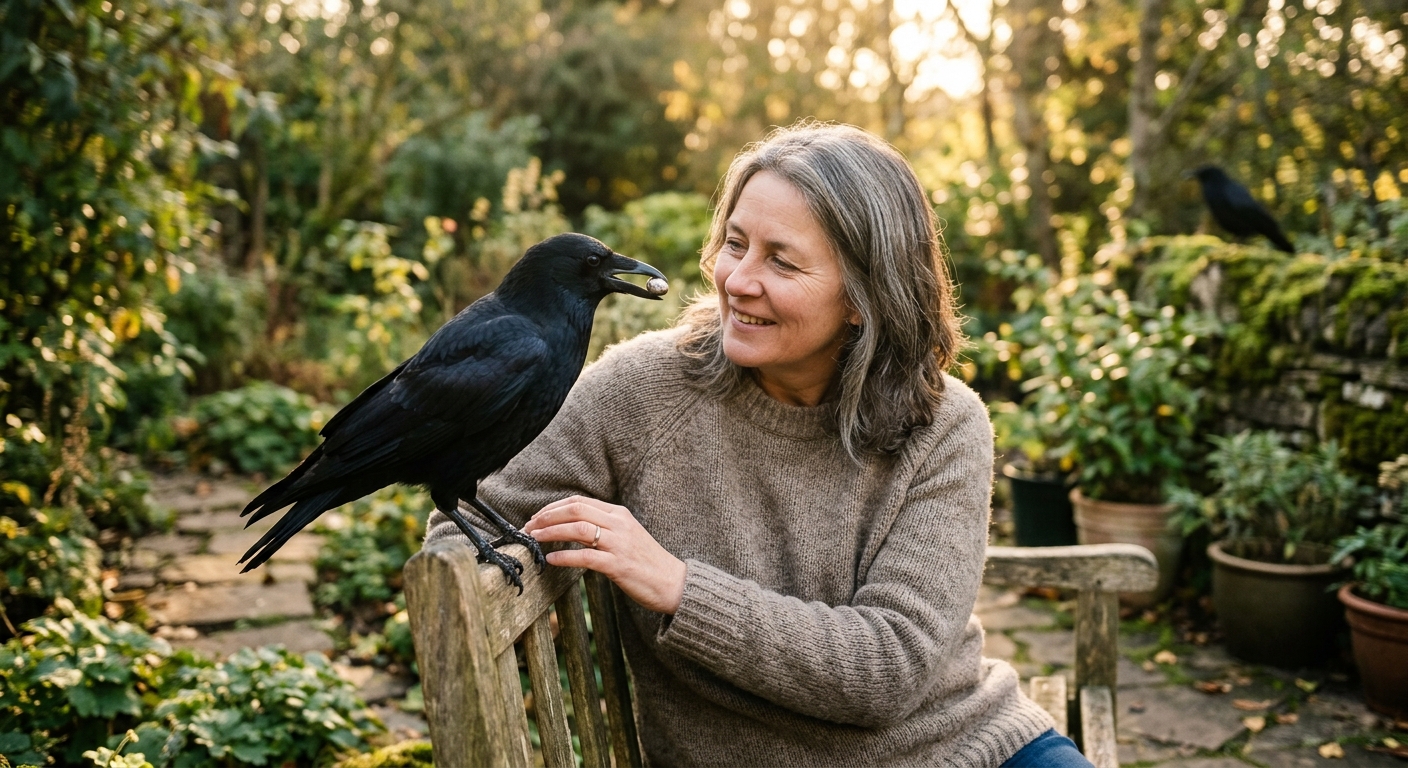
In Seattle, a young girl named Gabi Mann began leaving food out for the crows in her neighborhood. Over time, the crows began leaving things in return: a piece of blue glass, a small hinge, a button, a pearl-colored heart. Each time Gabi left food, she would find a new offering at the tray. Her collection grew. Scientists believe this behavior, documented in multiple cases around the world, represents reciprocal exchange, a concept foundational to human social bonding.
These were not coincidences. The crows were, in their own way, saying thank you.
What This Teaches Us
The intelligence of crows challenges something fundamental in the way humans have long understood themselves in relation to the natural world. We have drawn sharp lines between ‘us’ and ‘them,’ between the beings who think and feel and the beings who simply react. Crows blur that line considerably.
They remind us that intelligence is not a single trait but a collection of capacities: memory, planning, empathy, creativity, social learning, and emotional response. And those capacities are not the exclusive property of humans or even of mammals. They evolved, in a completely different branch of the animal tree, in a creature with a brain the size of a walnut.
The next time you see a crow watching you from a telephone wire, consider the possibility that it is not just an ominous backdrop to your morning commute. It may be assessing you, remembering you, and deciding whether you are worth knowing.
You might want to be on its good side.