🎧 Listen to this story
Narrated by Sadachbia · 7,933 characters
A Neighborhood Held Its Breath
It started with a Facebook post. On a Thursday evening in late September, a mother named Carrie Mullins typed out a simple, heartfelt message to a local community group in Murfreesboro, Tennessee. She explained that her seven-year-old daughter, Lily, had been diagnosed with spastic cerebral palsy at eighteen months old. Lily used a wheelchair, had limited mobility in her arms, and had never been able to use the playground equipment at the neighborhood park. What Carrie wanted, more than anything, was to watch her daughter play outside in their own backyard, on equipment built just for her.
She wasn’t asking for money. She wasn’t asking for donations. She was asking if anyone knew a contractor who might be willing to offer advice.
By Friday morning, the post had been shared over four hundred times. By Friday afternoon, a construction crew of eleven volunteers had already started drawing up plans.
The Crew That Showed Up
Marcus Webb had been in residential construction for nineteen years. He ran a small but respected contracting company called Webb Build Co., and when his wife showed him Carrie’s post over morning coffee, he didn’t deliberate for long.
‘I’ve got a crew, I’ve got materials, and I’ve got a free weekend,’ he told her. ‘What else do I need?’
He made a few calls. Within hours, he had commitments from ten other tradespeople including carpenters, a welder, two landscapers, and a woman named Dana Reyes who specialized in accessible design and had worked on ADA-compliant public spaces for years. Dana immediately volunteered to serve as the project’s lead designer, ensuring everything built would be genuinely usable for Lily, not just visually appealing.
The group met Friday evening at Carrie’s home. They measured the backyard. They talked to Lily. They asked her what colors she liked (purple and yellow), what she dreamed of doing outside (swinging, mostly, and going down a slide), and whether she had any friends who might come over to play. Lily answered every question with enormous seriousness, as though she understood the weight of the conversation. She probably did.
What Accessibility Actually Looks Like
This is where the story gets instructive, because building a playground for a child with physical disabilities is not simply a matter of goodwill. It requires real knowledge, careful engineering, and the willingness to ask the right questions.
Dana walked the crew through several key principles before a single board was cut:
- Ground surface matters enormously. Standard wood chips or gravel are nearly impossible to navigate in a wheelchair. The crew installed a rubberized poured surface across the entire play area, creating a smooth, firm path from the back door to every piece of equipment.
- Entry points must be wide and ramped. Every platform was designed with a gradual ramp entry rather than ladder-only access, allowing Lily to use her wheelchair or be transferred more easily.
- Swing selection is critical. A standard belt swing is unusable for many children with cerebral palsy. The team sourced a full-support bucket swing with a harness system that cradles the body properly and keeps the child safe without requiring them to grip.
- Height and reach angles affect independence. Activity panels, sensory boards, and play elements were mounted at heights Lily could reach from her chair, giving her the ability to engage independently rather than always requiring adult assistance.
- Shade and rest areas are part of the design. Children with certain conditions are more sensitive to heat and fatigue. The crew built a small covered seating nook adjacent to the equipment so Lily could take breaks comfortably.
Forty-Eight Hours of Work
They began at seven in the morning on Saturday. Neighbors brought coffee and breakfast sandwiches. By noon, the rubberized surface had been poured and was curing. By late afternoon, the main platform structure was framed and standing. Carrie kept Lily inside for most of the day, preserving the reveal, though more than once the little girl pressed her face to the glass back door and watched with wide eyes.
Sunday was a blur of finishing work: painting the railings purple and yellow per Lily’s specifications, installing the sensory wall panels, bolting down the swing set, and landscaping the surrounding area with raised garden beds that Lily could reach from her chair. Marcus later said it was the most focused his crew had ever been on a single project, and also the most fun.
‘Nobody complained. Nobody checked their phone every five minutes,’ he said. ‘Everyone just worked.’
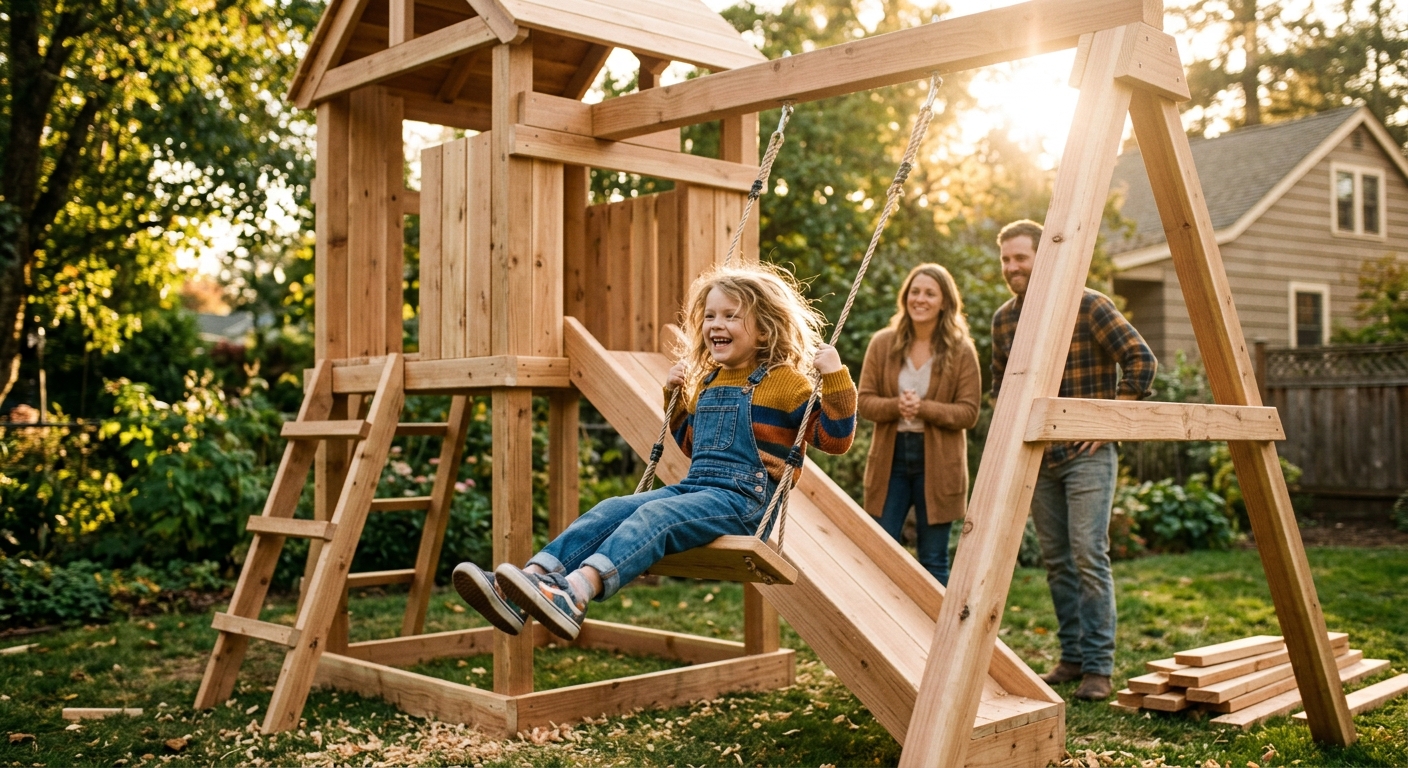
By four o’clock Sunday afternoon, the playground was complete. It had a ramp-accessed platform with a low slide, a full-support swing, a sensory activity wall, two raised garden beds, a small musical panel with chimes and drums, and a poured rubber surface connecting everything from the back porch in a gentle, navigable loop.
The Moment That Stopped Everyone
Carrie brought Lily out just before five. The crew stood off to one side, tired and paint-splattered and grinning. Lily was in her chair. She looked at the playground for a long moment without saying anything.
Then she asked her mother if she could go on the swing.
It took about three minutes to get her situated in the harness. When the swing began to move and Lily felt that familiar pull of momentum, the lift and fall that every child knows and most take completely for granted, she laughed. Not a polite laugh, not a surprised laugh, but the kind of full-body, uncontrollable laugh that belongs only to children experiencing pure joy.
Several members of the crew cried. Marcus Webb, who describes himself as not a crier, had to walk to the far side of the yard and collect himself before he trusted his voice again.
What This Teaches Us About Community
It would be easy to frame this story as simply a tale of generosity, and it is that. But it is also something more specific and more useful: it is a demonstration of what becomes possible when skilled people decide to apply their skills toward something that matters.
Marcus Webb had nineteen years of construction experience. Dana Reyes had a decade of accessible design expertise. The other volunteers had their own trades and knowledge. None of what they built over that weekend was magic. It was competence, deliberately directed.
There is a version of this story where Carrie’s Facebook post gets thirty sympathetic comments and nothing else. There is a version where someone shows up with good intentions but no real knowledge, builds something unsafe, and the project does more harm than good. What made this story end the way it did was not just kindness. It was kindness combined with capability, coordination, and the humility to ask a seven-year-old girl what colors she wanted.
How to Support Accessible Play in Your Own Community
If this story has moved you to action, here are practical ways to help children with disabilities gain access to inclusive play spaces:
- Contact your local parks department and ask about their accessible playground audit. Many municipalities have outdated equipment that does not meet modern accessibility standards.
- Volunteer with organizations like Boundless Playgrounds or Shane’s Inspiration, nonprofits that design and build inclusive play spaces specifically for children of all abilities.
- Donate to local adaptive equipment funds, many of which help individual families purchase specialized swings, sensory tools, and mobility aids for home use.
- If you have a trade skill, consider reaching out to your local disability services organization and offering your time on a project basis. Skilled volunteers are often more valuable than financial donations.
As for Lily Mullins, she has reportedly requested that her birthday party this year be held in the backyard. Her mother said yes before she even finished asking.
Some things don’t need deliberating.