🎧 Listen to this story
Narrated by Schedar · 7,458 characters
A Dog, a Highway, and a Split-Second Decision
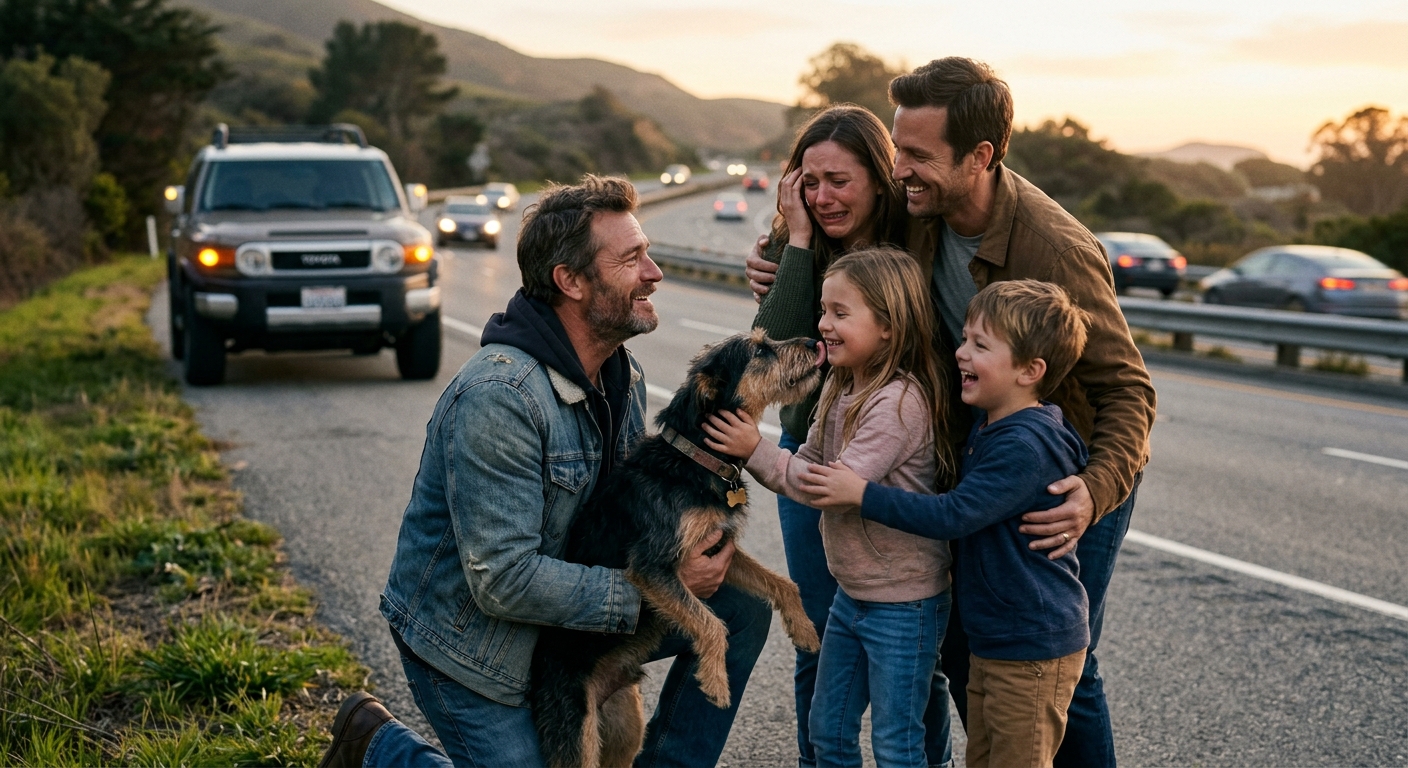
It was a Tuesday morning in late October when Marcus Webb, a 34-year-old electrician from rural Tennessee, spotted something small and brown darting along the shoulder of Interstate 40. He almost kept driving. He was already running late for a job site, had two thermoses of coffee going cold in the cupholder, and a full schedule that left no room for detours.
But something made him pull over.
“I don’t know what it was,” Marcus later told a local reporter. “I just saw those little legs scrambling and I thought, if that were my dog, I’d want someone to stop.”
So he stopped. And what happened over the next 72 hours became a story that spread quietly through a small Tennessee community, a reminder that ordinary people are still capable of extraordinary things.
The Dog Nobody Claimed (At First)
The dog was a Beagle mix, maybe three years old, visibly underweight, and limping on her back left leg. Marcus scooped her up with his work jacket, secured her in his truck cab, and drove to the nearest animal clinic. The vet on duty, Dr. Lena Parris, noted dehydration, a minor fracture in the hind leg likely from a collision or fall, and early signs of a skin infection from prolonged exposure.
The estimate for treatment came to just under $800.
Marcus had no idea whose dog this was. He had no obligation. He could have surrendered her to the county shelter and gone about his day. Instead, he handed over his credit card.
“I figured I’d find the owner,” he said. “And if I didn’t, well, I’d have a dog.”
The Search Begins
While the Beagle, whom Marcus nicknamed “Exit” for obvious reasons, recovered at the clinic, he got to work. He posted photos on three local Facebook groups, checked the county lost pet registry, and called two animal shelters within a 40-mile radius. He even printed flyers during his lunch break and drove them to a gas station and a dollar store near where he’d found her.
The response was slow at first. A few shares, some comments wishing him luck, a couple of false leads that went nowhere. By Wednesday evening, Marcus was quietly making peace with the idea that Exit might become a permanent member of his household.
Then, Thursday morning, his phone rang.
“That’s Our Molly”
The voice on the other end belonged to a woman named Diane Coulter, 58, who had been searching for her Beagle, Molly, for six days. Molly had slipped out of the backyard during a thunderstorm and disappeared into the dark. Diane and her teenage granddaughter, Ayla, had driven every road within ten miles, posted hundreds of flyers, and barely slept.
“When I saw the photo Marcus posted, I started shaking,” Diane said. “That little white patch above her left eye. That’s our Molly. I knew it right away.”
Within two hours, Diane and Ayla were at the clinic. The reunion, by all accounts, was the kind of scene that makes veterinary staff remember why they chose their profession. Molly, still bandaged and groggy, lifted her head, sniffed once, and launched into a full-body wiggle that the vet said was impressive given her current condition.
Ayla reportedly cried for ten minutes straight.
The Part Nobody Expected
Here is where the story takes the turn that made people stop scrolling and actually read.
When Diane learned about the vet bill, she immediately opened her purse. Marcus stopped her.
“He literally put his hand over mine and said, ‘Please don’t,'” Diane recalled. “He said it was already done and he was just glad Molly was going home.”
Diane pushed back. She insisted. Marcus held firm. He told her that he had two dogs of his own at home, that he understood what it felt like to love an animal, and that the best thing she could do was take Molly home and give her a good life.
“He shook my hand, patted Molly on the head, and walked out,” Diane said. “I stood there for a full minute just trying to process what had just happened.”
Why Stories Like This Matter More Than Ever
It would be easy to write this off as a feel-good fluke, a lucky alignment of circumstances and character. But people who study prosocial behavior say that stories like Marcus’s are more common than we think. We simply don’t hear about them as often because the people involved rarely seek attention.
Dr. Sara Kimble, a social psychologist who studies altruism and community behavior, explains it this way: “Most genuine acts of kindness never get reported. The person who pays for a stranger’s groceries, the neighbor who shovels an elderly person’s driveway, the driver who stops for a scared animal. These things happen every single day. We just don’t build systems to notice them.”
What makes Marcus’s act notable isn’t just the money. It’s the series of choices stacked on top of each other:
- The choice to pull over when no one was watching.
- The choice to pay for care for an animal that wasn’t his.
- The choice to spend his own time searching for the owner.
- The choice to refuse repayment when offered.
Each of those decisions was made quietly, without applause, without an audience. That’s not luck. That’s character.
What Diane Did Next
Diane Coulter is not the kind of person who lets a debt go unacknowledged, even when the other party insists otherwise. Unable to repay Marcus directly, she did something else. She made a $800 donation to a local animal rescue organization in his name and mailed him a handwritten card explaining what she had done.
Marcus received the card on a Monday, read it twice in his driveway before going inside, and then texted Diane a single line: “Now we’re both even with the universe.”
Diane framed the text message. It hangs in her kitchen.
Lessons We Can Actually Use
This story is not just a warm moment to scroll past and forget. There are real, practical things we can take from what Marcus did, things that cost very little but mean everything.
1. Hesitation is human. Acting anyway is heroic.
Marcus almost didn’t stop. He was late, busy, tired. The impulse to keep going is normal. What separates people like Marcus isn’t the absence of that impulse, it’s the decision to override it.
2. Kindness is often just a series of small choices.
He didn’t plan to spend $800 or three days searching for an owner. He just made the next right decision, and then the next one, and then the next. That’s how most meaningful acts of kindness actually work.
3. Refusing repayment can be its own kind of gift.
By not accepting Diane’s money, Marcus gave her something more valuable than a balanced transaction. He gave her proof that the world still contains people who help without keeping score.
4. Generosity tends to move forward, not backward.
Diane couldn’t repay Marcus. So she paid it forward through a donation that will help other animals and other families. Kindness, it turns out, is not a closed loop. It radiates.
Molly Is Doing Just Fine
As a postscript, and because this is the detail everyone wants to know: Molly the Beagle made a full recovery. Her fractured leg healed cleanly, the skin infection cleared up, and according to Diane, she has not shown any interest in escaping the backyard since her ordeal. Ayla, her granddaughter, started volunteering at the local animal shelter three weeks after Molly came home.
And Marcus? He got a Christmas card from Diane and Ayla. Inside was a photo of Molly, healthy and bright-eyed, wearing a little plaid bandana. He taped it to the dashboard of his truck.
Right next to his two cold thermoses of coffee.