🎧 Listen to this story
Narrated by Iapetus · 7,312 characters
A Winter Route With an Unexpected Twist
Most people expect a delivery driver to pull up, drop a package at the door, and move on. That is the unspoken contract of modern convenience. You order something online, a stranger brings it to your porch, and both of you go about your day without ever really connecting.
But Marcus Tillman, a 34-year-old delivery driver based in Columbus, Ohio, decided that contract was not quite enough. Last February, during one of the coldest and snowiest winters the region had seen in over a decade, Marcus started doing something that nobody asked him to do, nobody paid him to do, and nobody even noticed at first. He started shoveling.
Not just his own driveway. Not just a neighbor’s sidewalk. He began shoveling the walkways of every elderly customer on his delivery route, one house at a time, box in hand, in temperatures that rarely climbed above 15 degrees Fahrenheit.
How It Started: One Icy Step and a Gut Feeling
Marcus says it began almost by accident. He was delivering a set of vitamin supplements to a woman named Dorothy, 81 years old, who lived alone in a small ranch-style home on the east side of Columbus. As he walked up her path, he nearly slipped on a sheet of black ice hidden under a thin layer of fresh snow.
“I caught myself on the railing,” Marcus recalled in a conversation shared on a local neighborhood Facebook group that quickly went viral. “And I thought, what if Dorothy had stepped out here to grab her mail? She doesn’t have a railing to grab. She lives alone. One fall at her age could be it.”
He knocked on the door, handed her the package, and noticed the small shovel propped against the side of her house, clearly unused. He asked if she had anyone helping her with the snow removal. She smiled and shook her head. “My son lives in Arizona,” she told him. “He worries, but there’s not much he can do from there.”
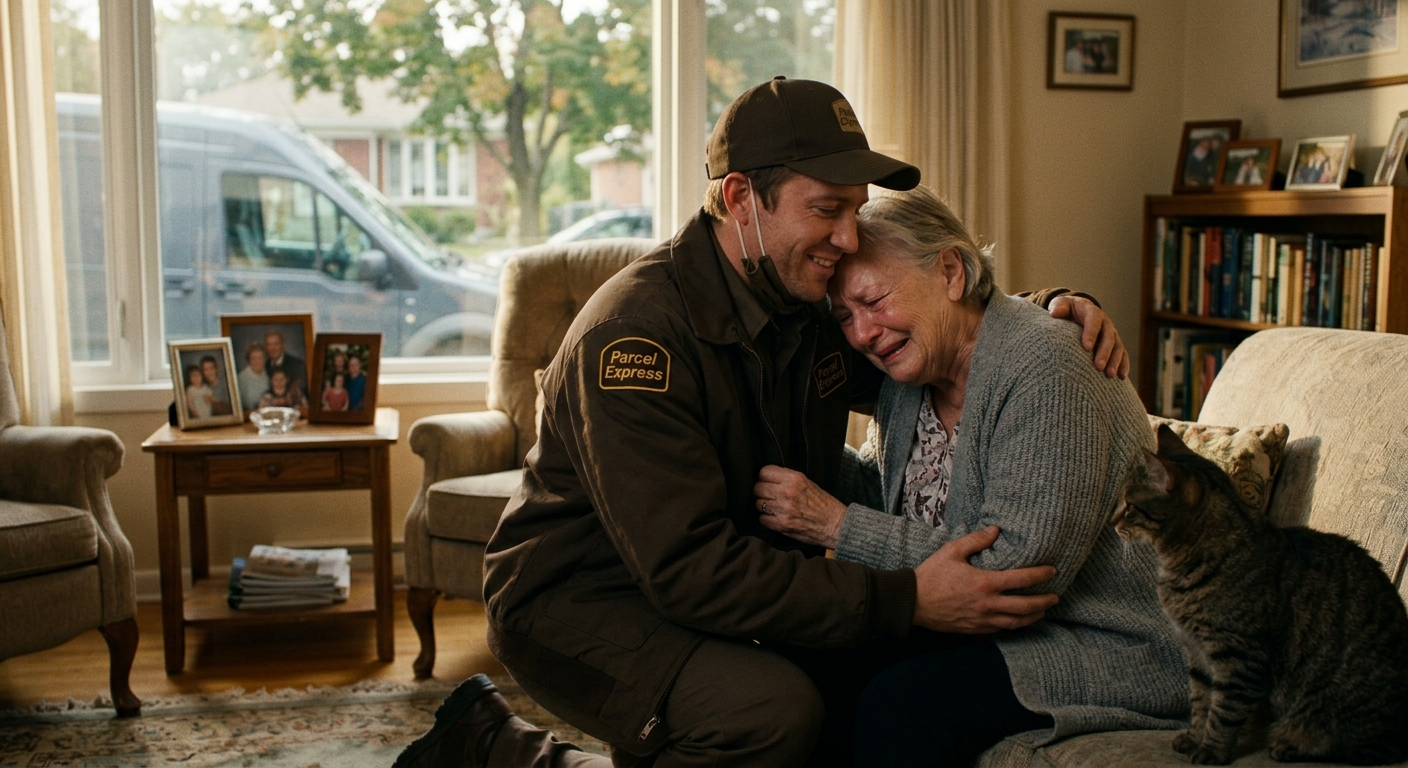
Marcus went back to his truck, finished his route, and then drove back to Dorothy’s house with a bag of ice melt he had bought at a gas station. He cleared her entire walkway and salted the path to her mailbox. It took him twenty minutes. Dorothy watched from the window, and by the time he was done, she was standing at the door with tears on her cheeks and a five-dollar bill in her hand.
He refused the money. He told her to stay warm. And he drove away wondering how many other Dorothys were on his list.
The List Grew Longer Than He Expected
Over the following two weeks, Marcus quietly identified every customer on his route who appeared to be elderly and living alone. He cross-referenced delivery names with what he observed: single-portion grocery orders, medical supply shipments, mobility aid deliveries, and the general stillness of homes where no one came and went very often.
He built a mental map of about 22 households. He started carrying a lightweight collapsible snow shovel in his truck alongside his standard equipment. On heavy snow days, he woke up an hour earlier than required and began his route with the goal of hitting each of those homes before the afternoon freeze made everything worse.
He did not announce what he was doing. He did not post about it. He just showed up, cleared the snow, left the package, and moved on.
What His Customers Said
When the story eventually broke, several of Marcus’s customers shared their experiences. Here is what a few of them had to say:
- Harold, 77: “I have bad knees. I’ve fallen twice in the last three years trying to shovel. This winter I didn’t have to worry once. I didn’t even know it was the same delivery guy until my daughter pointed it out.”
- Gloria, 84: “He never rang the bell or asked for anything. I would just look outside and the path would be clear. I thought I was imagining it the first time.”
- Robert, 79: “I tried to give him a Christmas card with some cash in it. He handed the card back and kept the card. Said the card was enough. I still think about that.”
- Dorothy, 81: “He saved my life. Maybe not in a dramatic way. But when you are my age and you live alone and it snows, a clear path is the difference between safe and not safe. He understood that without being told.”
The Ripple Effect Nobody Planned For
Once the neighborhood Facebook post gained traction, something remarkable happened. Other delivery drivers in the area began doing the same thing on their own routes. A local hardware store donated 15 snow shovels and 200 pounds of ice melt to drivers who wanted to participate. A church in the neighborhood created a volunteer list to help elderly residents throughout the remainder of the winter.
Marcus was not trying to start a movement. He was just trying to make sure nobody fell. But that is often how the most genuine acts of kindness work: they spread not because they are performative, but because they are honest.
What We Can Learn From Marcus Tillman
There are a few things about this story that are worth sitting with:
1. Empathy Is a Choice You Make in Motion
Marcus did not pause to wonder whether it was his responsibility. He felt something, recognized a need, and acted. That moment of connection between a near-slip on icy pavement and the mental image of an 81-year-old woman taking that same step is empathy in its most functional form. It does not require a grand declaration. It requires a willingness to let someone else’s vulnerability matter to you.
2. Small Observations Have Big Consequences
He noticed a shovel propped against the house, unused. He noticed the quiet of certain homes. He paid attention. In a world where we are constantly distracted, the simple act of noticing the people around us, really noticing them, can change the entire direction of someone’s day, or their winter, or their life.
3. You Do Not Need Permission to Be Kind
Nobody assigned Marcus this task. No app flagged Dorothy’s walkway as dangerous. No manager told him to add twenty minutes to his route. He made a decision with zero external validation and zero guarantee of recognition. That is the kind of kindness that actually costs something, and that is exactly what makes it so rare and so powerful.
4. Refusing the Reward Is Part of the Gift
Every time Marcus turned down money or waved off gratitude, he was communicating something important: this is not a transaction. You do not owe me anything. That message, delivered silently through a wave and a walk back to the truck, was often more meaningful to his customers than the cleared path itself.
A Final Word From Marcus
When a local news station eventually tracked him down for a brief interview, Marcus was visibly uncomfortable with the attention. He said something simple that has stayed with the people who heard it:
“I’ve got a grandmother. She’s 83 and she lives alone and I worry about her every time it snows. I just figured someone out there is probably doing the same thing for her, or I hope they are. So I try to be that person for somebody else’s grandmother.”
He cleared 22 walkways that winter. He never missed a single one after a snowfall. And when spring finally arrived in Columbus, he quietly put the collapsible shovel back in his closet, already wondering what he might be able to do differently next year.
Some people wait for the world to become a kinder place. Marcus Tillman just showed up early, with a shovel, and got to work.