🎧 Listen to this story
Narrated by Sadachbia · 8,893 characters
When the Levees Break, So Do the Walls Between Us
It was 3:47 in the morning when the sirens began. In the small river town of Millhaven, population 4,200, most residents were asleep when the first emergency alert lit up their phones. The Crestline River, swollen by three days of relentless rain, had breached its eastern bank. Within six hours, nearly a third of the town would be underwater.
What happened next was not remarkable in the way news stories usually are. There were no single heroic acts caught on camera. No viral moments. No celebrity fundraisers swooping in with oversized checks. What happened in Millhaven was quieter than that, and in many ways, far more profound. A community that had spent years fraying at the seams, divided by politics, economic tension, and long-simmering neighborhood rivalries, suddenly forgot every single reason it had ever had to distrust itself.
This is not a story about a flood. This is a story about what a flood revealed.
A Town Already Underwater, Long Before the Rain
To understand what the storm changed, you first have to understand what it interrupted. Millhaven had been quietly fracturing for nearly a decade. The closure of the Hargrove Textile Mill in 2016 had gutted the eastern side of town, leaving hundreds of families without income and a neighborhood that felt increasingly invisible to the rest of the community. Property values on the west side had risen sharply, drawing in newer residents who brought money but also tension. Local elections had grown bitter. A proposed community center had stalled for three years due to disputes over whose neighborhood it should serve. Neighbors who had once borrowed sugar from each other now scrolled past each other’s angry Facebook posts without making eye contact at the grocery store.
Dr. Renata Fusilier, a sociologist at the nearby state university who had been studying Millhaven’s social dynamics for two years, described the town before the flood as “a place experiencing what I call proximity without community. People were physically close but emotionally and socially miles apart.”
Then the river rose.
Hour by Hour: How Crisis Collapsed the Distance
By 6 a.m., the Millhaven Community Church on Archer Street had become an unofficial evacuation hub. Pastor Glenn Oduya had unlocked the doors without calling a committee meeting or consulting the deacon board. He simply opened them. By 8 a.m., the parking lot was full of pickup trucks from the west side, loaded with supplies and driven by people who, just weeks earlier, had been loudly arguing about zoning laws at town hall.
Across town, in the flooded eastern neighborhoods, something equally unexpected was unfolding. Marcus Thibodeau, a 34-year-old mechanic who had been one of the most vocal critics of west-side development, was waist-deep in floodwater, helping an elderly woman he had never spoken to in his life carry her belongings to higher ground. Her name was Eleanor Voss. She had lived on Millhaven’s west side for 40 years. She had voted in every election that Marcus felt had ignored his neighborhood.
“I didn’t think about any of that,” Marcus said later. “I just saw a woman who needed help. That’s it. That’s the whole story.”
But of course, it was not the whole story. It was the beginning of one.
What the Research Tells Us About Disaster and Social Bonding
Social scientists have long observed what is known as the “disaster utopia” effect, a term popularized by author Rebecca Solnit in her landmark book about the aftermath of major catastrophes. The theory holds that in the immediate aftermath of a disaster, human beings often revert to their most cooperative, generous, and community-minded instincts. Class distinctions blur. Political affiliations become irrelevant. The shared experience of vulnerability creates what researchers call “sudden solidarity.”
But critics of this theory are quick to note that the effect is often short-lived. Communities bond during the crisis and then, as the adrenaline fades and the cleanup begins, old tensions resurface. In many documented cases, the aftermath of a disaster actually deepens inequality and resentment, particularly when resources are distributed unevenly.
What made Millhaven different, according to Dr. Fusilier, was what the community chose to do with the window of solidarity before it closed.
The Mud Brigade and the Meals That Changed Everything
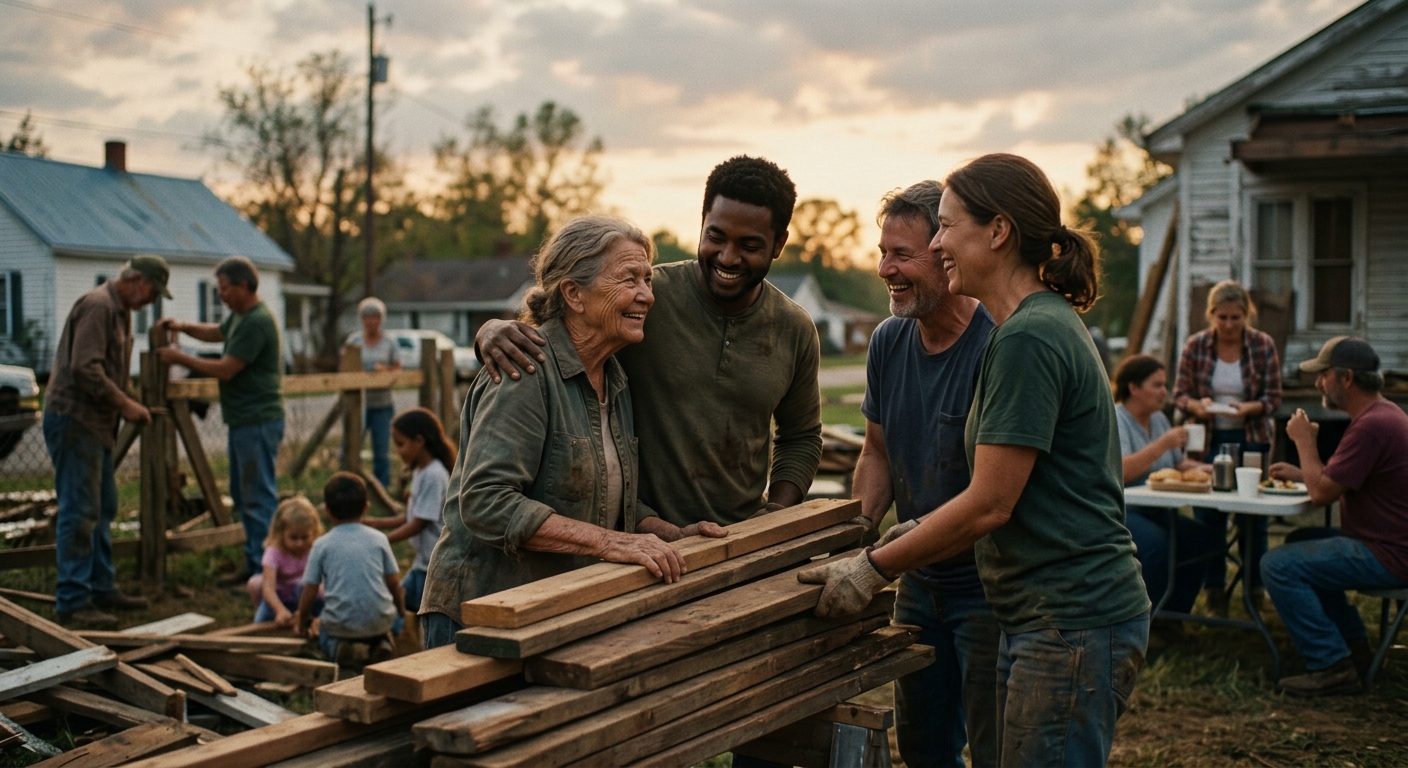
Three days after the flood, a group of about 20 volunteers calling themselves the Mud Brigade began organizing systematic cleanup efforts across the town. What was remarkable was not the labor itself but the composition of the group. It included Tanya Reeves, the west-side real estate developer who had been the face of the contentious rezoning project. It included Jerome Castillo, a retired mill worker from the east side who had once publicly called for Tanya’s proposal to be rejected. They worked side by side, shoveling mud out of strangers’ living rooms, and somewhere between the second and third house, they started talking.
“She told me about her dad losing his job in the ’80s,” Jerome recalled in an interview with a local paper. “I didn’t know that about her. I just knew what I’d read on a flyer. And I thought, ‘How many people do I think I know because of a flyer?'”
Meanwhile, a rotating kitchen was established at the community church, where meals were cooked and distributed freely to anyone who needed them, displaced or not. The kitchen drew volunteers from every corner of Millhaven. It drew people who had not spoken to each other in years. It drew teenagers and retirees. It drew arguments about whose chili recipe was better, which is, arguably, a much healthier kind of argument than the ones Millhaven had been having.
7 Things the Flood Taught Millhaven About Itself
- Shared vulnerability is a great equalizer. When everyone is in danger, nobody has the luxury of maintaining carefully constructed social distance.
- Physical labor alongside someone changes how you see them. It is nearly impossible to dehumanize someone you have spent six hours shoveling mud with.
- Crisis reveals capacity. Millhaven discovered it had far more community infrastructure, generosity, and resourcefulness than it had believed.
- Children are often the first to adapt. Within days, kids from opposite sides of town were playing together in the makeshift shelter at the school gymnasium, completely indifferent to whatever their parents had been arguing about.
- Old stories can be rewritten. Many residents who had carried narratives about “those people on the other side of town” found those narratives simply did not survive contact with reality.
- Need cuts through noise. Political slogans and social media arguments evaporated the moment real, immediate, human need was placed in front of people.
- The window of solidarity can be extended on purpose. If communities make intentional choices during the aftermath of a crisis, the bonds formed can outlast the emergency.
The Long Rebuild: Choosing to Keep the Door Open
Six months after the flood, the long-stalled community center proposal came back to the table. This time, the conversation was different. Tanya Reeves, the developer, publicly advocated for the center to be built on the east side, where it was most needed. Jerome Castillo showed up to support the proposal. Pastor Oduya agreed to host planning meetings at his church. The vote passed, 11 to 1.
It would be dishonest to say that Millhaven was magically healed. Tensions still exist. Economic disparities have not vanished. There are still difficult conversations ahead about resources, representation, and fairness. Dr. Fusilier is careful to note that disaster-forged solidarity is not a substitute for structural change.
“The flood didn’t fix Millhaven’s problems,” she said. “But it reminded Millhaven that it was a community. And that is not a small thing. That is, in fact, the prerequisite for fixing anything.”
What We Can Take With Us
The story of Millhaven is not really about a flood. It is about the extraordinary human capacity for connection that hides just beneath the surface of even the most divided communities. It is about how quickly the stories we tell about each other can dissolve when we are placed in the same room, facing the same sky, dealing with the same water rising around our ankles.
You do not have to wait for a disaster to find that capacity in your own community. The Mud Brigades, the rotating kitchens, the open church doors, these can be chosen. The vulnerability does not have to be imposed by a river. It can be offered freely, in a conversation across a fence, in a decision to show up for a neighbor you do not know, in the simple and radical act of deciding that the people around you are worth knowing before the sirens start.
Millhaven learned that lesson the hard way. But maybe the learning is what matters most.