
🎧 Listen to this story
Narrated by Aoede · 6,921 characters
A Diagnosis That Felt Like a Death Sentence
At twenty-three years old, Maria Delgado sat in a cold, sterile office and listened as her doctor delivered news that would reshape the entire landscape of her future. She had been diagnosed with premature ovarian insufficiency, a condition in which the ovaries stop functioning normally before the age of forty. The clinical language was careful, measured, and devastating. The doctor told her, gently but plainly, that the likelihood of her conceiving naturally was less than five percent. For all practical purposes, she was told, biological motherhood was not in the cards for her.
Maria drove home in silence. She did not cry until she reached her apartment, and when the tears finally came, they lasted for hours. She was not yet married. She had not even begun to think seriously about children. But the moment that possibility was taken from her, it became the only thing she wanted in the world.
What happened over the next fifteen years is not a story of medical miracles, though it contains moments that feel miraculous. It is a story about refusing to accept a single narrative about your own life, about the power of relentless hope, and about what it means to become a mother in every sense of the word.
The Years of Grief No One Talks About
Before the hope, there was grief. Maria is quick to point out that her journey was not a straight line from diagnosis to triumph. There were years in between that she describes as a kind of quiet mourning, a loss that had no funeral and no name.
“People don’t understand that infertility is grief,” she says. “You are mourning someone who never existed. You are mourning a version of your life that you had already pictured in your mind. And there’s no socially accepted way to do that.”
She watched friends get pregnant, attended baby showers with a smile that cost her more than anyone knew, and nodded politely when relatives asked when she was planning to start a family. She carried the diagnosis privately for years, telling almost no one. It felt like a secret shame, even though she knew, intellectually, that it was nothing of the sort.
During this period, she also began to research. Obsessively, relentlessly, and with the focus of someone who had decided that information was the only weapon she had. She read medical journals, joined online forums, consulted with specialists, and sought second, third, and fourth opinions.
What the Doctors Did Not Account For
Premature ovarian insufficiency does not always mean zero egg function. In some cases, the ovaries produce sporadic, unpredictable bursts of activity. Hormonal support, lifestyle changes, and specialized fertility treatments can, in rare cases, create windows of opportunity that most physicians are hesitant to promise.
Maria found a reproductive endocrinologist who was willing to work with her rather than simply manage her expectations downward. Together, they developed a protocol combining hormone therapy, targeted monitoring, and timed interventions. It was expensive, emotionally exhausting, and offered no guarantees.
After two years of treatment and two heartbreaking early losses, Maria became pregnant with her daughter, Sofia, now twelve years old.
“When the doctor confirmed it, I didn’t believe him at first,” she recalls. “I asked him to check again. And then I sat in my car for forty-five minutes before I could drive.”
Four Children, Four Stories
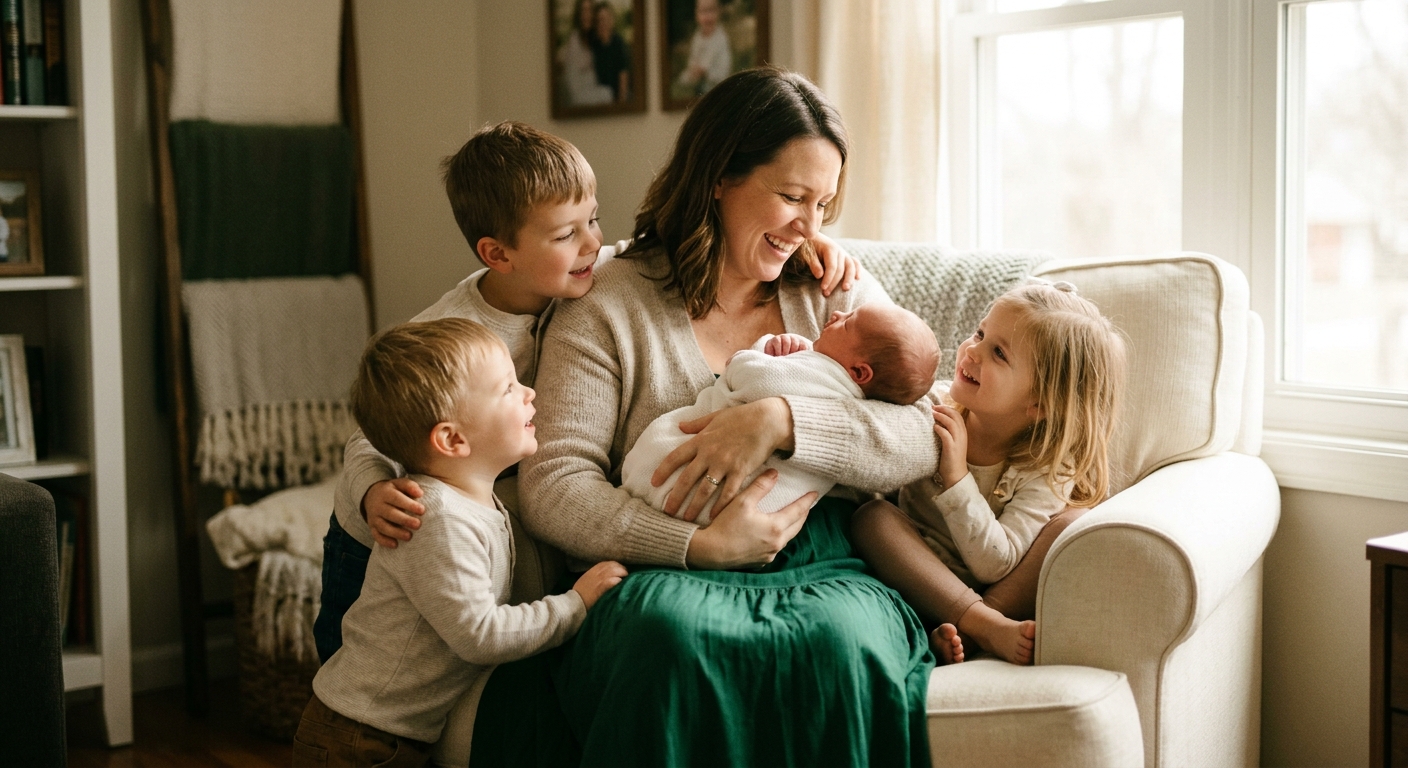
Sofia was followed by her brother Daniel, now nine. Then came twins, Lucia and Marco, who turned six last spring. Each pregnancy was carefully monitored, each child considered something close to a miracle by the medical team that helped bring them into the world.
But Maria is careful not to let her story be reduced to a simple “never give up” motto. She acknowledges that her outcome is genuinely rare. She has sat with friends who tried everything she tried and did not get the same result. She does not want her story weaponized against women who are still waiting, still hurting, or who ultimately chose different paths to parenthood.
“My story is not a prescription,” she says firmly. “It is just my story. And I want every woman going through this to know that whatever path they take, including adoption, fostering, choosing to live child-free, all of it is valid. All of it is brave.”
What She Learned About Hope (And What She Learned About Herself)
Maria now volunteers with a fertility support nonprofit, where she speaks to newly diagnosed women navigating the same disorienting grief she once felt. Here are some of the core lessons she shares in those conversations:
- A diagnosis is not a destiny. Statistics describe populations, not individuals. They are useful data, not personal verdicts.
- Find a doctor who listens. The right medical partner makes an enormous difference, not just in outcomes, but in how you experience the process.
- Grief and hope are not opposites. You can hold both at the same time. Allowing yourself to grieve does not mean giving up.
- Community is medicine. Connecting with others who understand the specific pain of infertility can reduce isolation and provide practical knowledge that no clinic brochure will give you.
- Your worth is not tied to your fertility. This one, Maria says, took her the longest to truly believe. “I had to learn that I was a whole person regardless of whether I ever became a mother. That foundation actually made me a better mother when the time came.”
The Morning She Thinks About Most
When asked what moment she returns to most often, Maria does not mention a birth or a diagnosis or a pivotal phone call from a doctor’s office. She describes an ordinary Tuesday morning, not long after Sofia started kindergarten.
“She was eating cereal at the kitchen table and she looked up at me and said, ‘Mom, do you know that you’re my favorite person in the whole world?’ Just like that. No reason. Just because she felt it.”
Maria pauses before finishing the story.
“And I thought about that doctor’s office. I thought about the drive home. I thought about all those years. And I just thought: look where we are now.”
A Note to Anyone Still Waiting
If you are reading this in the middle of your own uncertain journey, Maria’s story is not meant to promise you a specific outcome. Medicine is complicated. Life is unpredictable. Some things do not resolve the way we desperately want them to.
But there is something worth holding onto in Maria’s experience, and it is this: the people who told her what was impossible were not being cruel. They were being statistically accurate. And statistics, as it turns out, are not the whole story. They never are.
Whatever your path looks like, whether it leads to a kitchen table covered in cereal bowls or somewhere else entirely, it can still be a life filled with love, meaning, and the specific joy that comes from refusing to let someone else write the ending of your story.