
🎧 Listen to this story
Narrated by Gacrux · 7,853 characters
The Alarm That Never Stopped Going Off
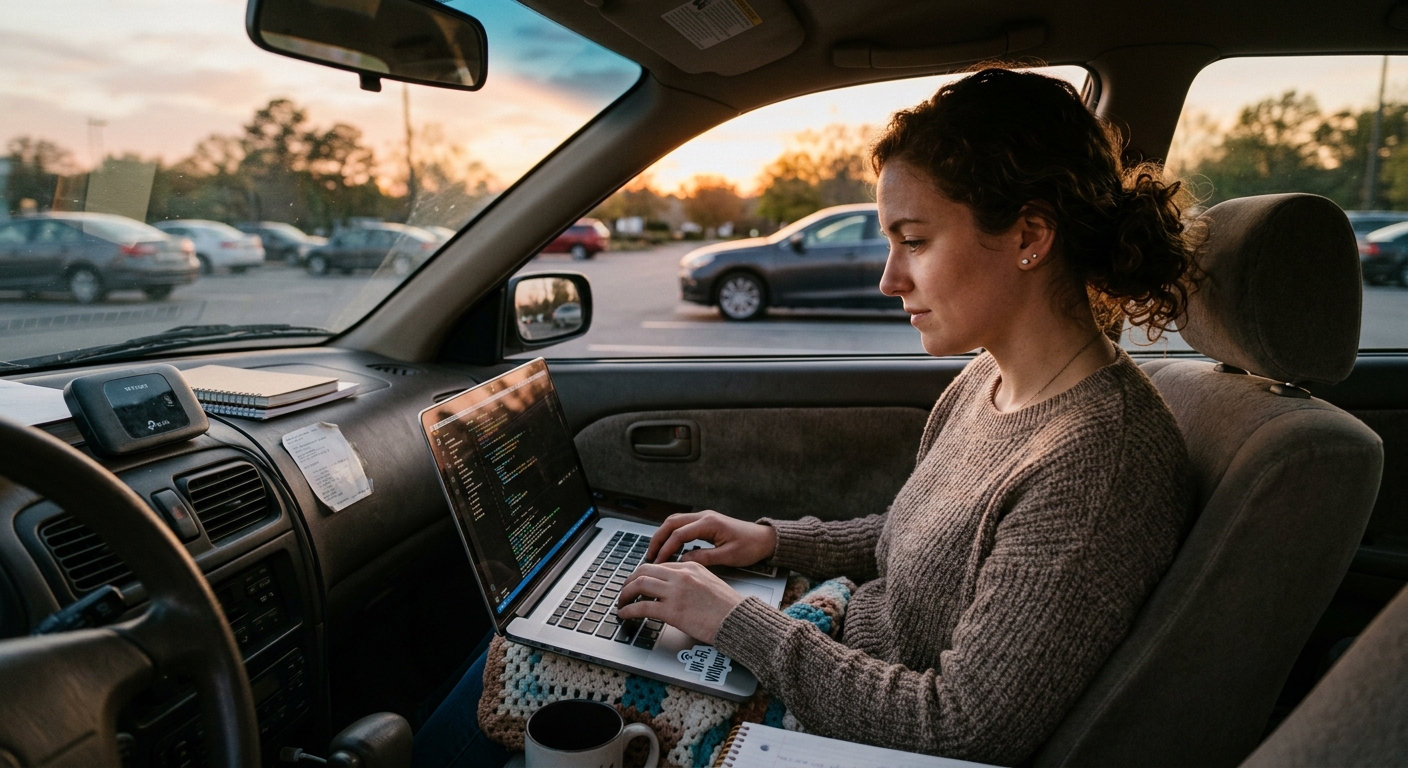
At 6:47 every morning, Marisol Vega’s phone alarm buzzed against the passenger seat of her 2003 Honda Accord. She would sit up slowly, her back stiff from the reclined driver’s seat, and check the parking lot around her. A grocery store on one side. A laundromat on the other. She had learned which lots felt safe and which ones did not. She had learned a lot of things that year that she never expected to need to know.
Marisol was 34 years old, a former restaurant manager in Phoenix, Arizona, who had lost her job and her apartment within the same brutal 60-day stretch in 2019. A combination of a lease dispute and a sudden closure of the small chain she worked for left her without income or housing almost simultaneously. She had a storage unit, a duffel bag, and a car that still ran. That, she would later say, was enough to start.
What happened next is not a story about luck. It is a story about a public library, a stubborn woman, and the quiet revolution of learning something completely new from scratch.
Finding the Library Like Finding Oxygen
Within her first week living in her car, Marisol discovered the Burton Barr Central Library in downtown Phoenix. It opened at 9 a.m. She was always there by 9:01.
“The library became my office, my living room, and honestly my therapy,” she said in a community spotlight interview published by a local nonprofit in 2022. “I could use the bathrooms to get cleaned up, charge my phone, and just sit somewhere that felt normal.”
She had no specific plan at first. She browsed job listings, updated her resume, and applied to management positions she was qualified for. The rejections trickled in. Weeks passed. The restaurant industry in her area was shifting, and mid-level management roles were scarce. She needed a different angle.
One afternoon, she noticed a flyer on the community board near the library entrance. A free introductory coding workshop was being hosted in the library’s computer lab. Six sessions. No experience required. She signed up mostly because it was free and because it was something to do.
She walked out of that first session completely overwhelmed and completely hooked.
What Learning to Code Actually Looks Like With No Safety Net
There is a popular image of the self-taught coder. It usually involves a hoodie, a high-end laptop, a cozy apartment, and a strong wifi connection. Marisol had none of those things. What she had was a library computer with a 2-hour daily usage limit, a spiral notebook, and whatever she could memorize before her session ended.
She started with HTML and CSS, the foundational building blocks of web pages. She found free resources: freeCodeCamp, The Odin Project, W3Schools. She would spend her two hours coding, then spend the rest of the day reviewing her handwritten notes in the car, mentally walking through what she had practiced.
“I couldn’t just leave a browser tab open and come back to it,” she explained. “Every day I had to rebuild where I left off in my head. Which sounds hard, but honestly, it made things stick. I had to actually understand it, not just follow along.”
She began waking up earlier to arrive at the library right when it opened. She made friends with the librarians, who quietly extended her computer time on slower days. She started a notebook system where she color-coded different concepts: blue for structure, green for styling, red for errors she had made and needed to remember.
The Setbacks That Almost Won
Progress was not linear. It never is.
In month three, the Honda needed a repair she could not afford. She spent two weeks doing odd jobs through a task-based app, fixing the car, and losing momentum on her coding. When she came back to it, she felt like she had forgotten everything. She sat at the library computer and stared at a blank screen for forty minutes before typing a single character.
“That was probably my lowest point,” she said. “Not even the car. Just that feeling of, what if I’m not smart enough for this? What if I’ve been wasting my time?”
She did not quit. She went back to the very beginning of her notes. She rebuilt the basics. And then something clicked that had not clicked before, because this time she was rebuilding with context, with experience, with the knowledge of what came next. The setback had accidentally deepened her understanding.
This is a pattern that educators and psychologists have a name for: desirable difficulty. The idea that learning under slightly harder conditions, with more retrieval and less passive review, creates stronger long-term retention. Marisol had accidentally engineered it for herself out of necessity.
The Project That Changed Everything
By month five, Marisol had moved from HTML and CSS into basic JavaScript. She decided to build something real. A small website for a friend who ran a mobile dog grooming business and had no online presence. It took her three weeks of library sessions. The friend offered to pay her $200.
It was the first money Marisol had earned from coding. She sat in the parking lot that night and stared at the deposit notification on her phone for a long time.
“It sounds small,” she said. “But it was proof. Proof that this was real, that I could actually do this.”
She started taking on small freelance projects through platforms like Fiverr and Upwork, carefully choosing beginner-friendly gigs. She was honest about her experience level and priced accordingly. Within two months, she was earning enough to rent a room in a shared house. The car stayed in the driveway. She slept in a bed for the first time in seven months.
7 Things Marisol’s Story Teaches Us About Learning and Resilience
- Constraints can be teachers: Limited computer time forced Marisol to truly internalize what she learned, rather than passively consuming it.
- Community resources are underused: Public libraries offer computers, internet, workshops, and community boards that most people walk past without a second glance.
- Starting is not the same as being ready: Marisol had no background in tech. She signed up for a flyer on a wall. That was enough to begin.
- Analog tools still work: Her color-coded notebooks were as important as any screen. Writing by hand reinforced what her eyes had seen.
- The first paid project is a turning point: There is something irreplaceable about the moment a skill earns real money. It transforms practice into profession in your own mind.
- Setbacks can accidentally accelerate growth: Having to restart from scratch after her car trouble forced a deeper review that ultimately strengthened her foundation.
- Dignity is portable: Marisol described maintaining a daily routine, clean clothes, and a sense of purpose as essential to her mental health during this period. Structure kept her going when circumstances could not.
Where She Is Now
By 2021, Marisol had completed several freelance web development projects and enrolled in a part-time bootcamp using income she had saved. In 2022, she was hired as a junior front-end developer at a mid-sized marketing agency in Scottsdale. She has since been promoted once and is currently studying UX design in her evenings.
She volunteers twice a month at the Burton Barr library, helping run a beginner coding workshop for adults. The same kind of workshop she once signed up for because a flyer caught her eye.
“I always tell people in the workshop: you don’t need the perfect setup,” she says. “You need the next two hours. That’s it. Just figure out the next two hours.”
Somewhere in Phoenix, there is probably someone sitting in a library right now, staring at a screen full of code they don’t fully understand yet, scribbling notes in a spiral notebook, and trying to figure out how to make something from nothing. If Marisol’s story says anything at all, it says this: that person is going to be okay.