
🎧 Listen to this story
Narrated by Orus · 8,481 characters
When a Speech Therapist Brought Her Work Home
Christina Hunger had spent years helping toddlers find their words. As a speech-language pathologist, she knew the science of communication inside and out. She understood how humans develop language, how the brain maps sounds to meaning, and how a child learns to connect a button press to a want, a need, a feeling. What she did not expect was that one evening in her San Diego apartment, watching her new puppy Stella paw at the back door, she would ask herself a question that would change everything: What if Stella could do that too?
That question launched one of the most fascinating and quietly revolutionary experiments in modern human-animal communication. And the answer Stella eventually gave her, in the form of pressed buttons and chosen words, made headlines around the world and forced a lot of people to rethink what they thought they knew about the minds of dogs.
The Science Behind the Buttons
The concept Christina used is rooted in Augmentative and Alternative Communication (AAC), a field that uses devices and tools to help people who cannot speak verbally to express themselves. AAC boards, for instance, are used with non-speaking autistic individuals, children with cerebral palsy, and stroke survivors. The user presses a button or a symbol and a pre-recorded word plays out loud.
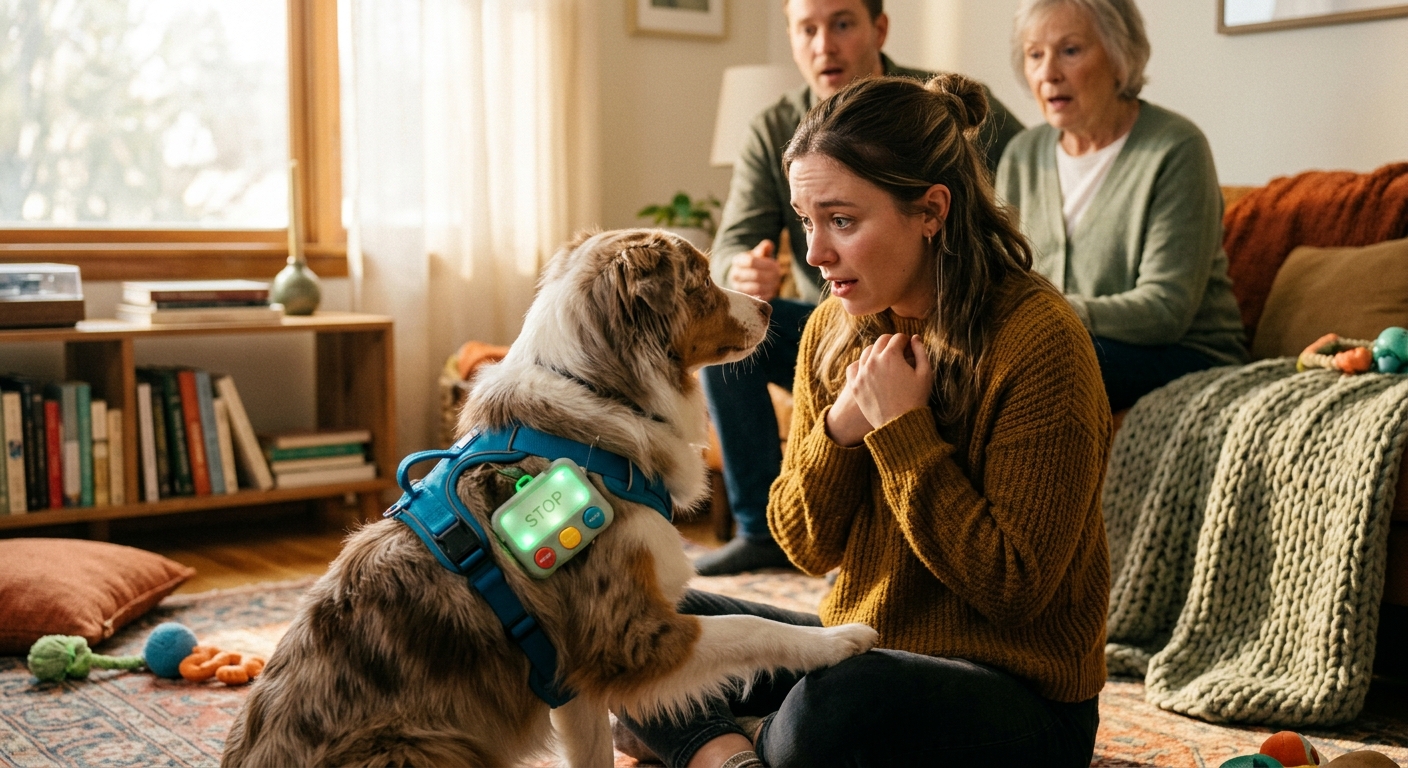
Christina reasoned that if dogs could understand words, and anyone who has ever called a dog’s name or said the word “walk” in a dog’s presence knows they absolutely can, then perhaps dogs could also learn to produce words, not just respond to them. She began small, placing a single button near the back door. The button said “outside.” Every time Stella seemed to want to go out, Christina pressed it. Every time they went outside, she pressed it again.
Within weeks, Stella was pressing it herself.
Building a Vocabulary, One Button at a Time
From that first button, Christina slowly expanded Stella’s board. New words were introduced gradually and always with consistent reinforcement. Christina treated the process exactly as she would with a human toddler learning to communicate. She modeled the behavior, narrated her own actions, and gave Stella time to process and respond.
The words Stella learned included:
- Outside (one of the first and most used)
- Play
- Walk
- Eat
- Water
- Happy
- No
- Come
- Help
- All done
Over time, Stella’s board grew to include dozens of buttons. And something remarkable began to happen. Stella was not just pressing single words. She began pressing combinations. Sequences. Phrases that looked, unmistakably, like sentences.
What Stella Actually Said
One of the earliest and most discussed moments came when Christina’s partner Jake came home from a work trip. Stella trotted to her board and pressed: “Jake” + “come” + “love you.”
Another time, when her usual walk was skipped, Stella pressed: “Upset” + “no” + “walk.”
When Stella was unwell one day, she pressed: “Ouch” + “help.”
And in a moment that sent chills through anyone who read it, on a day when a family friend who Stella adored passed away, Stella wandered to her board and pressed: “Good” + “bye.”
Christina documented all of this meticulously on social media, sharing video after video of Stella at her board. The account amassed millions of followers. Scientists, linguists, animal behaviorists, and everyday dog lovers tuned in with fascination and, sometimes, fierce debate.
The Skeptics Have a Point and a Limit
It would be dishonest not to address the skepticism, because it exists, and some of it is well-founded. Critics, including some respected animal cognition researchers, point out several important concerns:
- Dogs are extraordinarily attuned to human cues and may be pressing buttons in response to subtle, unconscious signals from their owners rather than expressing independent thoughts.
- Confirmation bias may lead owners to interpret random button presses as meaningful sentences.
- The lack of controlled, peer-reviewed studies on AAC in dogs means the science is not settled.
These are fair points. Christina herself has acknowledged them and has called for more rigorous research. In fact, her work sparked a formal scientific study led by researchers at the University of California San Diego, examining whether dogs trained on AAC devices demonstrate genuine communicative intent or something else entirely.
But here is where the skeptics hit a wall: even the most cautious researchers admit that the video evidence is, at minimum, deeply interesting. Dogs like Stella are not randomly mashing buttons. They show preference, timing, context-sensitivity, and what looks very much like emotional motivation. Whether that constitutes “language” in the human sense remains open. But something is clearly happening.
What the Buttons Revealed About How Dogs Think
Even setting aside the debate over language, the button experiment has yielded something genuinely valuable: a window into the inner life of dogs that we rarely get to see so clearly.
When Stella pressed “beach” on a day she had not been to the beach in weeks, and then paced until Christina took her, it revealed that Stella held onto memories of places she loved. When she pressed “stranger” before the doorbell even rang, it revealed an anticipatory awareness we had underestimated. When she pressed “ouch” and then lay down, refusing to engage with her toys, it told her owner something was wrong long before any visible symptoms appeared.
In this way, the buttons are not just a communication tool. They are a diagnostic tool, an emotional gauge, a relationship deepener. They are, perhaps most importantly, a reminder that the animals sharing our homes have inner worlds that are richer and more layered than we have historically given them credit for.
The Ripple Effect: Other Dogs, Other Animals
Stella was not the last. Inspired by Christina’s work and her book How Stella Learned to Talk, thousands of pet owners around the world began introducing AAC buttons to their own dogs and cats. Videos flooded social media of dogs pressing “outside” then “ball” then “you” in a sequence that looked suspiciously like an invitation to play. Cats, famously independent, began pressing “food” and “attention” with what their owners described as a tone of mild impatience.
Researchers began studying parrots, pigs, and even horses using similar communication models. The field of animal-assisted communication exploded almost overnight, and what had started as one speech therapist’s late-night curiosity had become a genuine movement.
7 Things Stella Taught Us That Have Nothing to Do With Buttons
- Pay attention. Stella’s owners had to slow down and really watch her to understand her communications. That quality of attention transformed their relationship with her.
- Consistency matters more than intensity. It was not grand gestures but small, repeated moments of modeling that taught Stella her words.
- Curiosity is an act of respect. Asking “what is she trying to say?” treated Stella as a being worth understanding.
- Communication is a two-way street. The real shift was not in Stella’s behavior but in Christina’s willingness to listen.
- We underestimate the animals around us. Almost constantly and almost certainly.
- Science and wonder can coexist. The skepticism and the awe are both appropriate responses, and holding both is healthier than choosing one.
- Love finds a language. Whether or not Stella truly “understands” love in the human sense, she pressed “love you” to Jake when he came home. And he felt it. That matters.
A Final Word, from Stella
Stella passed away in 2024, and Christina shared the news with a world that had followed their journey together for years. The grief was real and wide. Thousands of people who had never met Stella but had watched her press her buttons felt the loss in a personal way.
Christina wrote that in Stella’s final days, her dog had pressed a combination that she had not pressed in that order before. The words were: “Happy” + “love” + “you.”
Whether that was language or learned association, whether it was a sentence or a coincidence, is almost beside the point. What Stella gave the world was something more durable than a scientific conclusion. She gave us permission to believe that the animals we love might be trying, in their own way, to tell us something. And she reminded us, quietly and with a paw on a small plastic button, that the most important thing we can do is make space for them to be heard.