🎧 Listen to this story
Narrated by Kore · 7,582 characters
A Gorilla, a Scientist, and a Conversation That Changed Everything
In 1972, a young psychologist named Francine “Penny” Patterson began what she thought would be a short-term research project at the San Francisco Zoo. Her subject was a one-year-old western lowland gorilla named Hanabi-Ko, which means “fireworks child” in Japanese. The world would come to know her simply as Koko.
What followed over the next four decades was one of the most remarkable and quietly moving relationships between a human and an animal ever documented. Penny did not just study Koko. She raised her, communicated with her, and eventually listened as Koko used American Sign Language to express something that stunned the entire research team: she wanted a cat.
Not a toy cat. Not a picture of a cat. A real, living, breathing feline companion.
Learning the Language of Another Species
The Gorilla Foundation’s language research project was ambitious from the start. Patterson’s goal was to teach Koko a modified version of American Sign Language, known as Gorilla Sign Language, adapted to suit the physical structure of a gorilla’s hands. Skeptics were plenty. Many in the scientific community doubted that any great ape could truly grasp language as a communicative tool rather than simply as a trained behavior for rewards.
Koko silenced most of those doubts.
By the time she was a teenager in gorilla years, Koko had mastered over 1,000 signs and demonstrated an understanding of approximately 2,000 spoken English words. She could string signs together to form original thoughts, express emotions, make jokes, and even lie, which researchers found particularly significant as a marker of higher cognitive function.
She called a broken toy a “squash” because she had no sign for it and used what she knew to approximate meaning. She referred to herself in the third person. She commented on her own sadness. She asked questions.
And one day, she asked for a cat.
The Request That Made Headlines Around the World
It began around Koko’s birthday in 1983. The research team wanted to give her a special gift, so they brought her a collection of stuffed animals to choose from. Koko looked through them carefully and selected a small, realistic-looking stuffed cat. She carried it everywhere, cradled it gently, and treated it with what could only be described as maternal affection.
But something was different about how she interacted with this toy compared to others. Koko kept signing to her caregivers. She signed “cat” repeatedly. She signed “real.” She signed “cat” again.
The team was moved, but cautious. Could she really be distinguishing between a stuffed animal and a living creature? They watched her continue to carry the toy while consistently signing for something real, something alive. The message became impossible to ignore.
For her birthday in 1984, Koko was introduced to a litter of abandoned kittens and allowed to choose one. She selected a tiny, tailless gray male kitten and named him, using her signs, “All Ball.” The name delighted her caregivers. It was pure Koko: playful, observant, and oddly poetic.
Koko and All Ball: A Friendship Without Words
What happened next was documented, photographed, and studied as one of the most tender interspecies friendships ever recorded. Koko treated All Ball with extraordinary gentleness. She would cradle him in her massive arms with care that researchers described as maternal. She groomed him. She let him curl up on her body. She signed his name to visitors, visibly proud.
The photographs from this period, many of which were published in National Geographic in 1985, circulated around the world and became iconic. A 300-pound gorilla, delicately holding a tiny kitten. It challenged assumptions about animal emotion, animal intelligence, and the boundaries of what we define as love.
Penny Patterson described Koko’s behavior with All Ball not as instinctive or conditioned, but as genuinely affectionate. “She mothered that cat,” Patterson said in interviews. “She was tender with him in a way that showed she understood he was fragile.”
The Day Koko Learned About Loss
In December 1984, All Ball slipped out of Koko’s living area and was struck by a car. He died. The researchers faced the painful task of telling Koko what had happened.
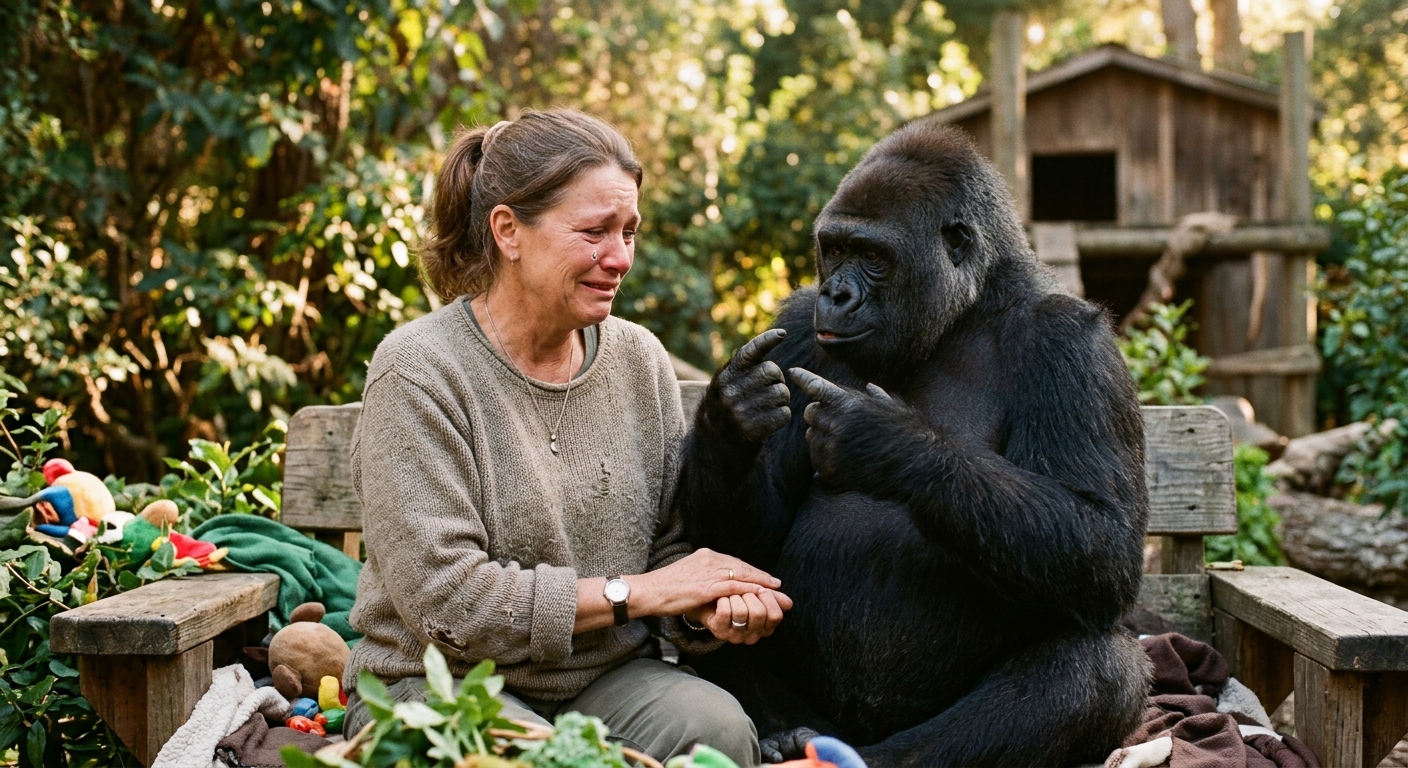
When Patterson told her, Koko was quiet for a moment. Then she began to sign. She signed “cry.” She signed “sad.” She signed “frown.” Later, she moved away from her caregivers and made a series of high-pitched vocalizations that the team had rarely heard from her before. Researchers believed these were sounds of grief.
The moment was documented carefully. It became one of the most cited examples in animal cognition research of a non-human primate demonstrating what appears to be genuine mourning. Koko was not performing sadness. She was expressing it.
She later signed about All Ball in a way that researchers interpreted as meaning he had gone to a place where he was comfortable and warm. Whether that was her way of making sense of death or something more, nobody could say for certain. But it was undeniably something.
What Koko’s Story Teaches Us
Over the years, Koko went on to have other cat companions. She was given two more kittens, whom she named “Lips” and “Smoky,” and she cared for each with the same attentiveness she had shown All Ball. Each time a new kitten arrived, Koko signed with what her caregivers described as excitement and happiness.
Her story raises questions that researchers, philosophers, and everyday people are still grappling with today:
- What does it mean to communicate? Koko did not just respond to prompts. She initiated conversations, expressed unprompted desires, and conveyed complex emotional states.
- What does it mean to grieve? Her response to All Ball’s death mirrored the stages of grief in a way that is difficult to dismiss as coincidence or conditioning.
- What does it mean to love? The care Koko showed her cats, small and vulnerable creatures she could have easily harmed, pointed to something that functions very much like love, regardless of what we choose to call it.
- What does it mean to be lonely? Her persistent requests for a real cat, her dissatisfaction with a stuffed substitute, suggest an awareness of companionship and a longing for connection that goes far beyond simple instinct.
Koko passed away on June 19, 2018, at the age of 46, at The Gorilla Foundation’s preserve in Woodside, California. She died peacefully in her sleep. Penny Patterson, who had spent nearly five decades alongside her, described the loss as profound.
A Legacy That Still Speaks
Koko never wrote a book. She never gave a speech. She communicated in a language she was taught by humans, in a world she never chose to enter, under circumstances she had no control over. And yet, in asking for a cat, in naming him All Ball, in grieving when he was gone, she communicated something universal and deeply human.
She told us, without any ambiguity, that she did not want to be alone. That she was capable of tenderness. That she understood loss. That she could love something small and fragile and mourn it when it was gone.
That is not a story about a gorilla. That is a story about connection. And it is one of the most quietly extraordinary stories of the twentieth century.
In a world that often draws hard lines between species, between intelligence and instinct, between love and mere behavior, Koko sat at the edge of all those boundaries and, with a simple sign, asked for a friend.
She got one. And for a while, they were happy together.