🎧 Listen to this story
Narrated by Kore · 6,706 characters
At 8:45 every evening, something shifts on the second floor of Maplewood Care Center. The television in the common room gets turned down. The clatter of dinner trays fades. And one by one, residents who have been drifting in and out of the day’s long, slow hours begin to sit up a little straighter in their beds.
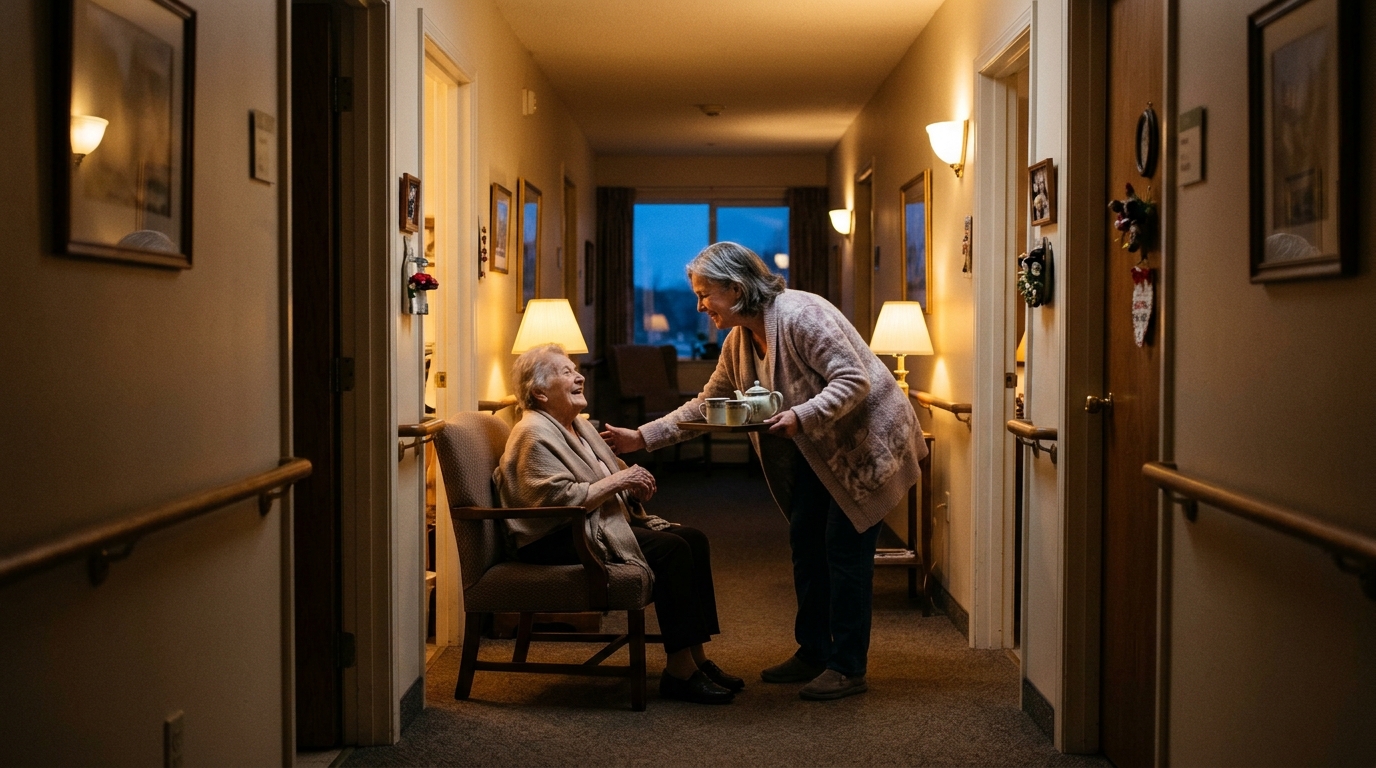
They are listening for the squeak of a cart wheel and the soft shuffle of rubber-soled shoes. They are listening for Dolores.
Dolores Whitfield has worked as a certified nursing assistant for twenty-six years, the last eleven of them on the evening shift at Maplewood. Her official duties on nightly rounds include checking vitals, repositioning residents, refilling water pitchers, and making sure everyone is safe and settled before the overnight staff takes over. But ask any resident what happens during those rounds, and they will tell you something different.
“She tucks us in,” said Harold, ninety-one, a retired machinist who has lived at Maplewood for three years. “Nobody has tucked me in since my mother. And Dolores does it like she means it.”
More Than a Checklist
The rounds themselves are routine. What makes them extraordinary is the attention Dolores brings to each room. She does not rush through the list to reach the end. She treats every door as the beginning of a small, separate conversation.
When her colleagues were asked to describe what she does differently, a pattern emerged. It was not one grand gesture. It was a collection of small, deliberate habits repeated night after night.
The Habits That Define Her Rounds
- She remembers the little things. She knows that Margaret in Room 14 likes her blanket folded down at the corner, not the top, and that Walter in Room 9 sleeps better when the hallway light is left slightly cracked under the door.
- She asks one real question. Not “How are you?” but something specific: “Did your granddaughter call about the recital?” or “Did the sun come through your window this afternoon the way you hoped?”
- She sits down. Even for thirty seconds. Standing over a bed communicates a task. Sitting on the edge of it communicates presence.
- She says goodnight by name. Every single time, to every single person, including those who may not always remember hers.
What the Evening Holds for Those Who Live Here
Anyone who has spent time around people in long-term care knows that evenings can be the hardest part of the day. The daytime has structure: meals, activities, visitors, therapy, the comforting noise of other people. But when the sun goes down, the building quiets, and the quiet can feel enormous.
For residents with memory loss, dusk can bring confusion and fear, a phenomenon caregivers sometimes call sundowning. For those who are lonely, the end of the day is when the empty chair beside the bed feels most noticeable. For those who have lost a spouse, it is the hour when the absence is loudest.
Dolores understands this without being told. “The days are for doing,” she said. “The nights are for feeling. And a lot of folks don’t have anybody to feel with. So that’s where I come in.”
She does not frame it as sacrifice or heroism. She frames it as simple arithmetic. “If I can make the last ten minutes of someone’s day feel safe, they carry that into sleep. And sleep is when the body heals. So really, I’m just doing my job.”
The Story of Room 14
Margaret, eighty-eight, arrived at Maplewood following a stroke that left her with limited mobility and a deep reluctance to talk. For her first several weeks, she turned her face to the wall whenever staff entered. She ate little and spoke less.
Dolores did not push. On her first night with Margaret, she simply said goodnight and left the room. The second night, she said goodnight and mentioned she liked the quilt on the bed. The third night, she stayed a minute longer and noted the quilt had a pattern of blue stars.
On the fourth night, Margaret spoke. “My sister made that,” she said, in a voice rough from disuse. “She died in the spring.”
Dolores sat down. She did not offer a platitude or change the subject. She asked, “What was her name?”
They talked for twenty minutes. It was the first real conversation Margaret had had since moving in. Today, she is one of the most talkative residents on the floor, and she has been known to keep a small stack of knitting by her bed so she has something to show Dolores each evening.
The Quiet Ripple Effect
The residents are not the only ones who notice. Families have begun scheduling their phone calls to coincide with Dolores’s rounds, knowing she will hold the phone close and make sure their loved one hears every word. New hires on the unit shadow her for a few evenings and often leave rethinking how they approach their own shifts.
“You can teach someone how to take blood pressure in an afternoon,” said Renata, the unit’s nurse manager. “You cannot teach someone how to make a person feel like they matter. Dolores just does it, and watching her makes everyone else try a little harder.”
The unit has quietly adopted what staff now call the Goodnight Standard: no one leaves a room without saying the resident’s name and one kind word. It was never written into policy. It simply spread, the way warmth does when someone models it consistently.
A Reflection for the End of Your Own Day
There is something worth sitting with here, especially as your own evening winds down. Most of us will never work a nursing home shift. But all of us end our days somewhere, and all of us pass through the lives of people who are, in some quiet way, waiting to be noticed.
Consider these gentle questions tonight:
- Who did I truly see today, beyond the task they were helping me with?
- Is there someone in my life who is at their loneliest in the evening, and could I reach out before bed?
- What small, repeatable habit of attention could I carry into tomorrow?
You do not need a cart, a uniform, or a shift schedule. You only need a willingness to sit on the edge of the bed, so to speak, and stay a moment longer than is convenient.
The Light Under the Door
When Dolores finishes her rounds, she walks the hallway one last time. The lights are dimmed. A few doors are open a crack, a few glowing faintly with bedside lamps. From inside the rooms comes the soft, settling sound of people drifting toward sleep, a little less alone than they were an hour earlier.
She pauses at the end of the hall, hand on the wall, and listens. Then she clocks out and heads into the night.
Behind her, on the second floor, Harold turns off his lamp. “Goodnight, Dolores,” he says to the empty doorway, though she is already gone.
He says it anyway. Some kindnesses are so steady that you thank them even when they are not in the room.